Beyond the Postcards: Switzerland’s Most Remarkable Hidden Gems
Most travelers arrive in Switzerland with a familiar list already in mind.
Zermatt. Interlaken. Lucerne. Jungfraujoch.
These destinations deserve their global reputation, but they represent only a small part of the country. Beyond the famous mountain railways and iconic viewpoints lies another Switzerland—one shaped by remote valleys, forgotten trade routes, medieval towns, hidden lakes, and landscapes that often receive a fraction of the attention enjoyed by the country’s tourism giants.
The most rewarding hidden gems are not necessarily unknown. Rather, they are places that remain overshadowed by larger attractions despite possessing exceptional natural beauty, cultural significance, or historical character.
Following the geography of Switzerland itself reveals where many of these overlooked treasures can be found.
In the Deep Valleys of Eastern Switzerland: The Magic of Appenzell
Long before visitors reach the dramatic peaks of the Alpstein range, they encounter one of Switzerland’s most distinctive cultural landscapes.
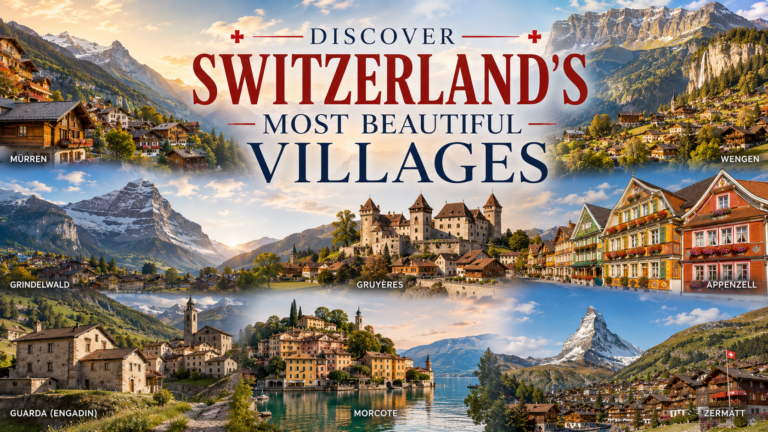
The village of Appenzell feels remarkably different from many Swiss destinations. Colorful painted facades, traditional customs, local cheese-making traditions, and rolling green hills create a setting that seems untouched by modern tourism trends.
While nearby visitors often focus on famous Alpine viewpoints, the broader Appenzell region offers a combination of mountain scenery and living cultural heritage rarely found elsewhere in the country.
The surrounding hiking routes reveal panoramic landscapes, alpine pastures, and dramatic limestone formations that rival more famous mountain regions.
Val Bavona: One of Switzerland’s Wildest Valleys
In the Italian-speaking canton of Ticino lies a valley that feels almost frozen in time.
Val Bavona is among the most remarkable cultural landscapes in the Alps. Massive granite boulders, stone villages, traditional houses, waterfalls, and narrow agricultural terraces create an environment shaped by centuries of adaptation to challenging mountain conditions.
Unlike many Swiss valleys, modern development remains limited.
Small settlements appear tucked beneath enormous rock formations while historic stone architecture blends seamlessly into the surrounding landscape.
The valley offers visitors a rare opportunity to experience a version of Alpine life that has largely disappeared elsewhere in Europe.
Creux du Van: Switzerland’s Natural Amphitheater
Hidden within the Jura Mountains, far from the country’s famous Alpine peaks, lies one of Switzerland’s most extraordinary geological formations.
Creux du Van is a massive natural rock arena created by erosion over thousands of years.
Towering limestone cliffs curve around a vast semi-circular basin, creating a landscape that resembles a giant natural amphitheater.
Wild ibex, chamois, and birds of prey frequently inhabit the area.
Despite its spectacular appearance, Creux du Van remains considerably less visited than many famous Alpine destinations, making it one of the country’s most rewarding scenic discoveries.
The Timeless Village of Guarda
Switzerland contains many beautiful villages, but few preserve their historic character as completely as Guarda.
Located in the Lower Engadine region of Graubünden, the village is known for its beautifully decorated traditional houses featuring distinctive sgraffito artwork.
The settlement gained additional recognition as the setting for the famous Swiss children’s story “Schellen-Ursli,” yet it remains far quieter than better-known mountain resorts.
Surrounded by forests, valleys, and alpine landscapes, Guarda offers visitors a glimpse into centuries-old Romansh culture that continues to thrive in eastern Switzerland.
Lake Oeschinen’s Quiet Corners
Lake Oeschinen is no longer a secret.
Its turquoise waters and dramatic mountain setting have become increasingly popular among visitors.
Yet most travelers experience only the main viewpoints near the arrival area.
The true hidden gem lies beyond the crowds.
Walking further around the lake reveals secluded shorelines, quiet forest sections, and perspectives where towering cliffs and waterfalls dominate the landscape.
Away from the busiest sections, visitors can experience one of Switzerland’s most beautiful Alpine lakes in relative tranquility.
The Forgotten Grandeur of Bellinzona’s Castles
Many travelers pass through Ticino on their way to Lake Como or Lugano without realizing they are passing one of Switzerland’s most important historical sites.
Bellinzona’s three medieval castles form a UNESCO World Heritage Site and represent one of the best-preserved defensive systems in the Alps.
Strategically positioned to control major north-south trade routes, the fortifications once protected access between northern and southern Europe.
Today, the castles provide spectacular views across the surrounding valleys while offering insight into centuries of Swiss and European history.
Despite their significance, they attract far fewer international visitors than Switzerland’s famous mountain attractions.
Tamina Gorge: Where Thermal Waters Emerge
Near Bad Ragaz lies a natural wonder that helped transform the region into one of Switzerland’s historic wellness destinations.
Tamina Gorge is a dramatic rock canyon carved by powerful waters deep within the mountains.
A pathway leads visitors through narrow cliff walls to the thermal spring that has been known for centuries.
The experience feels almost cinematic.
Sheer rock faces rise overhead while rushing water echoes through the gorge below.
It is one of Switzerland’s most impressive natural formations, yet remains surprisingly absent from many travel itineraries.
Binntal: A Valley Protected by Time
The Alps contain many beautiful valleys.
Few remain as peaceful as Binntal.
Located in the canton of Valais near the Italian border, the valley is known for exceptional biodiversity, traditional villages, and geological significance.
Protected landscapes help preserve its unique character.
Wildflower meadows, historic mountain settlements, and extensive hiking trails offer a quieter alternative to Switzerland’s busiest Alpine regions.
For travelers seeking nature rather than infrastructure, Binntal represents one of the country’s most authentic mountain experiences.
The Aare Gorge: Water and Stone
The power of glacial water is dramatically displayed within the Aare Gorge near Meiringen.
Over thousands of years, the Aare River carved a narrow passage through limestone rock, creating towering canyon walls that rise dramatically above the water below.
Wooden walkways allow visitors to explore sections of the gorge from within.
The constantly changing interplay of light, water, and stone creates an experience unlike anything found in Switzerland’s famous mountain panoramas.
It is a reminder that some of the country’s most remarkable landscapes exist not on mountain summits but deep within the terrain itself.
Wengen Without the Crowds
Many visitors know Wengen as part of the Jungfrau region.
Few venture beyond the village itself.
Exploring the surrounding hiking routes reveals a quieter side of one of Switzerland’s most celebrated mountain areas.
Traditional wooden chalets, alpine meadows, distant glacier views, and peaceful mountain paths offer experiences that contrast sharply with the crowds often found at major nearby attractions.
The hidden gem is not necessarily the village—it is the slower rhythm of life found just beyond the most visited viewpoints.
Where Switzerland Keeps Its Secrets
The most memorable hidden gems in Switzerland share a common characteristic.
They reveal dimensions of the country that cannot be experienced through famous landmarks alone.
Some preserve ancient traditions. Others showcase extraordinary geology, forgotten history, or remote Alpine ecosystems. Many remain hidden simply because they require travelers to slow down, explore secondary roads, or spend an extra day beyond the standard itinerary.
In a country celebrated for world-famous scenery, the greatest surprises often emerge where fewer people are looking.
That quieter Switzerland still exists—in stone villages beneath granite cliffs, along forgotten valleys, beside secluded lakeshores, and within landscapes where the sense of discovery remains very much alive.