
Switzerland’s Most Famous Landmarks: The Places That Shaped a Nation’s Global Identity
Some countries are defined by cities. Others are defined by monuments. Switzerland is defined by landmarks that have become symbols far beyond its borders.
A mountain recognized around the world without explanation. A medieval bridge that survived centuries of change. A lakeside castle that inspired artists and writers. A railway journey through glaciers and high alpine landscapes. Together, these places tell the story of Switzerland more effectively than any guidebook.
Rather than existing as isolated attractions, Switzerland’s most famous landmarks reveal the country’s geography, history, engineering achievements, cultural traditions, and deep connection to the Alpine environment.
The Matterhorn: The Mountain That Became Switzerland’s Symbol
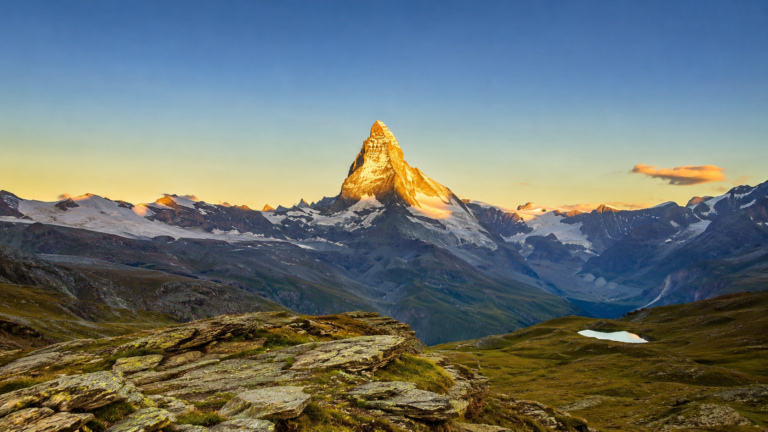
Rising dramatically above Zermatt near the Italian border, the Matterhorn is arguably the most recognizable mountain on Earth.
Its distinctive pyramid-shaped summit has appeared on countless postcards, travel campaigns, paintings, and commercial products. Yet its fame extends beyond appearance. The mountain occupies a central place in the history of Alpine exploration, particularly after the first successful ascent in 1865, one of mountaineering’s most significant events.
Visible from numerous viewpoints around Zermatt, the Matterhorn embodies the image many people associate with Switzerland before they ever visit the country.
Few natural landmarks anywhere possess such immediate global recognition.
Jungfraujoch: Europe’s Legendary High-Altitude Destination
Known as the “Top of Europe,” Jungfraujoch combines extraordinary natural scenery with one of Switzerland’s greatest engineering achievements.
The railway station, located within the Bernese Alps, sits among glaciers and high mountain peaks, offering access to a landscape that feels almost polar in character.
Visitors travel through tunnels carved into the mountains before emerging into a world of ice, snow, and panoramic Alpine views.
More than a century after its opening, Jungfraujoch remains one of the country’s most celebrated destinations, representing Switzerland’s ability to unite tourism, transportation, and mountain engineering.
Chillon Castle: Switzerland’s Most Famous Castle
On the shores of Lake Geneva near Montreux stands Chillon Castle, one of Europe’s most picturesque medieval fortresses.
Built on a rocky island connected to the shoreline, the castle controlled important trade routes for centuries. Its strategic location helped shape regional history, while its beauty attracted generations of artists, including Lord Byron, who immortalized the site in literature.
Today, the castle’s towers, courtyards, halls, and lakeside setting make it one of Switzerland’s most visited historic landmarks.
Its image has become synonymous with Swiss cultural heritage.
Chapel Bridge: Lucerne’s Enduring Medieval Icon
Spanning the Reuss River in Lucerne, Chapel Bridge is among the most recognizable historic structures in Switzerland.
Originally constructed during the 14th century, the covered wooden bridge served both defensive and transportation purposes. Its triangular painted panels provide insight into Swiss religious and civic history.
Although a devastating fire damaged much of the bridge in 1993, extensive restoration preserved one of the country’s most beloved landmarks.
Together with Lucerne’s Water Tower, Chapel Bridge remains a defining symbol of historic Switzerland.
Rhine Falls: Europe’s Largest Waterfall
Near the town of Neuhausen am Rheinfall, the Rhine River plunges dramatically over a broad rocky ledge, creating one of Europe’s most impressive natural spectacles.
Rhine Falls combines immense water volume, dramatic scenery, and accessibility. Visitors can experience the falls from riverside pathways, observation platforms, boats, and nearby viewpoints that place them remarkably close to the rushing water.
Unlike many famous waterfalls hidden in remote wilderness, Rhine Falls lies within easy reach of major Swiss cities, contributing significantly to its popularity and international recognition.
The Aletsch Glacier: The Giant of the Alps
The Great Aletsch Glacier is the largest glacier in the Alps and one of Switzerland’s most significant natural treasures.
Part of the UNESCO-listed Swiss Alps Jungfrau-Aletsch region, the glacier stretches through a vast high-mountain landscape shaped by ice over thousands of years.
Observation points such as Eggishorn, Bettmerhorn, and Moosfluh provide remarkable views of this immense river of ice.
The glacier serves not only as a tourism landmark but also as a powerful reminder of the natural forces that continue to shape the Swiss Alps.
Bern’s Old Town: A Living Medieval Capital
Unlike many historic districts preserved primarily for tourism, Bern’s Old Town remains the active heart of Switzerland’s capital city.
Recognized as a UNESCO World Heritage Site, the district features sandstone arcades, medieval streets, historic fountains, and architectural continuity rarely found in European capitals.
The iconic Zytglogge clock tower stands among its most recognizable landmarks, drawing visitors who gather daily to watch its historic mechanical figures perform.
Bern demonstrates how Swiss heritage can remain fully integrated into modern urban life.
The Lion Monument: A National Symbol of Loyalty
Hidden within a sandstone cliff in Lucerne, the Lion Monument ranks among Switzerland’s most emotionally powerful landmarks.
Designed to commemorate Swiss Guards who died during the French Revolution, the sculpture depicts a mortally wounded lion protecting a shield.
American writer Mark Twain famously described it as one of the world’s most moving pieces of stone sculpture.
Its significance lies not in size or grandeur but in the emotional connection it creates between history, sacrifice, and national memory.
St. Gallen Abbey Library: A Treasure of European Knowledge
The Abbey Library of St. Gallen is among the oldest and most important monastic libraries in the world.
Located within the UNESCO-listed Abbey District of St. Gallen, the library preserves priceless manuscripts and historical documents that illuminate centuries of European intellectual and cultural development.
Its magnificent Baroque interior has become almost as famous as the collection itself.
For travelers interested in culture rather than landscapes, few Swiss landmarks offer greater historical depth.
The Swiss National Park: A Different Kind of Landmark
Not all famous landmarks are buildings or mountains.
Established in 1914, the Swiss National Park in the canton of Graubünden represents Switzerland’s commitment to conservation and environmental stewardship.
Protected landscapes, wildlife habitats, and untouched mountain ecosystems make the park one of the country’s most important natural landmarks.
Its significance extends beyond tourism, reflecting Switzerland’s long-standing relationship with nature and scientific conservation.
Where Switzerland Reveals Itself
The most famous landmarks in Switzerland are remarkably diverse. Some were created by nature over millions of years. Others emerged through centuries of human history, artistic achievement, engineering innovation, or cultural preservation.
Together, they form a portrait of Switzerland that extends far beyond scenic beauty alone. The Matterhorn reflects the country’s Alpine identity. Jungfraujoch showcases engineering ambition. Chillon Castle preserves medieval history. Chapel Bridge and Bern’s Old Town connect modern Switzerland with its past. Rhine Falls and the Aletsch Glacier highlight the power of nature.
For travelers seeking to understand Switzerland rather than simply visit it, these landmarks offer the clearest introduction to a nation where mountains, heritage, and innovation continue to coexist in extraordinary ways.