Switzerland Calls for Civilian Protection After Deadly Strike on Ukrainian Buses
Switzerland has condemned a deadly Russian airstrike involving two civilian buses near Kramatorsk in eastern Ukraine, where at least 30 people were killed and 18 others injured, according to information released by Ukrainian authorities and reported by international news organizations. The October 8 attack has renewed concerns about the safety of civilians in communities exposed to sustained military operations and prompted fresh calls for compliance with international humanitarian law.
The Swiss Federal Department of Foreign Affairs (FDFA) expressed sympathy for the victims and their families in a statement published on the social media platform X. Switzerland also called for de-escalation and reiterated that all parties to the conflict must respect international humanitarian law, particularly the obligation to protect civilian populations.
The statement places Switzerland among the countries and international institutions responding to the latest reported civilian casualties as Russia’s full-scale war against Ukraine continues into its fifth calendar year.
Civilian buses hit in eastern Ukraine
The attack occurred near Kramatorsk, a major city in the Donetsk region that remains under Ukrainian control. The area is close to the front lines and has experienced repeated attacks during the war.
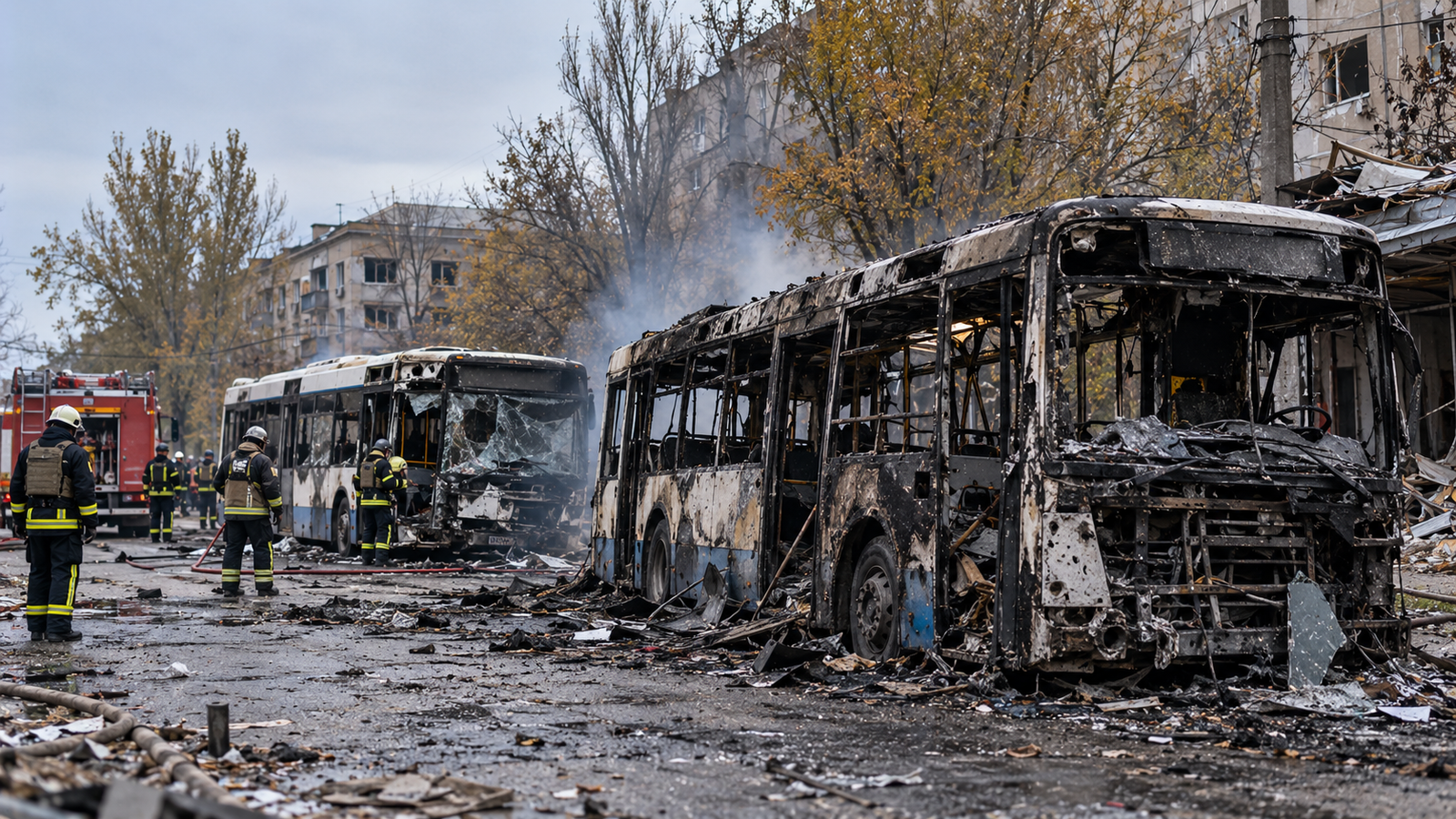
According to reporting by CBS News, a Russian guided bomb struck a street near two passenger buses on Thursday, October 8. The incident killed at least 30 people and wounded at least 18, according to regional officials. The damaged vehicles and casualties highlighted the risks facing people using ordinary transport in an area affected by ongoing hostilities.
The precise circumstances surrounding every victim’s presence at the scene have not been independently established in the information available. Nevertheless, the reported death toll makes the incident one of the major civilian-loss events reported in Ukraine during the latest wave of attacks.
Kramatorsk is strategically important because it forms part of the urban area supporting Ukraine’s defensive position in northern Donetsk. Its proximity to active fighting exposes residents to dangers from aerial weapons, artillery and other military operations, even when they are carrying out routine activities.
The attack also illustrates a broader problem for communities near the front: public transport remains necessary for everyday movement, but crowded vehicles and roadside stops can become dangerous when attacks reach civilian areas.
Bern calls for de-escalation and compliance with international law
Switzerland’s response focused on the human consequences of the attack and the legal obligations governing armed conflict.
In its public statement, the FDFA expressed solidarity with those affected and emphasized that civilian protection must remain a priority for every party to the conflict. The call for de-escalation reflects Switzerland’s diplomatic position that the violence must not undermine the fundamental rules intended to limit harm during warfare.
International humanitarian law distinguishes civilians and civilian objects from lawful military targets. Parties to an armed conflict must distinguish between civilians and combatants and between civilian objects and military objectives. They must also take precautions to reduce civilian harm.
The circumstances of an individual strike, including its intended target and the information available to those conducting it, are relevant when assessing whether the rules of war have been violated. A high civilian death toll is a grave concern, but establishing individual criminal responsibility requires an investigation into the specific facts and applicable law.
The United Nations’ human rights leadership has stressed that civilians must never be deliberately targeted and that alleged violations should be investigated. That principle is particularly relevant when attacks cause extensive casualties among people travelling, working or living in populated areas.
Switzerland’s statement did not announce a new sanction or military measure in response to the bus attack. Its publicly reported response centered on condemnation, sympathy for victims and the need to uphold international humanitarian law.
United Nations warns of rising civilian casualties
The attack near Kramatorsk occurred during a wider period of intensified strikes across Ukraine. On October 9, the United Nations Human Rights Monitoring Mission in Ukraine published a statement from UN High Commissioner for Human Rights Volker Türk expressing alarm over civilian deaths and injuries recorded during several days of attacks.
According to the UN statement, at least 85 civilians had reportedly been killed and 346 injured in Russian strikes since October 5. Those figures covered multiple incidents across the country rather than the bus attack alone. The UN also highlighted damage to electricity infrastructure and the resulting pressure on communities already facing power disruptions.
The wider casualty figures illustrate how the consequences of the war extend beyond the immediate front lines. Airstrikes can kill or injure civilians, damage homes and public infrastructure, and disrupt access to essential services. Power outages add another layer of difficulty for households, hospitals and other facilities that depend on reliable electricity.
The United Nations has also raised concerns about reported civilian casualties in occupied territory and in Russia, emphasizing that all parties must meet their obligations under international humanitarian law. Allegations involving any party require appropriate investigation and assessment based on the available evidence.
Another deadly attack highlights the wider risks
The bus strike followed another major attack reported in Ukraine on October 7. According to international reporting and statements by European officials, a strike on a residential building in Pryluky, in the Chernihiv region, killed at least 22 people, including five children.
The incidents occurred in different parts of Ukraine, but together they demonstrate the continuing danger facing civilians as the conflict expands across urban areas and critical infrastructure. The European Union condemned attacks on civilians and civilian objects in a statement delivered at the Organization for Security and Co-operation in Europe’s Permanent Council on October 8.
These incidents also complicate efforts to maintain essential services and protect people in communities far from the most active ground engagements. Emergency responders must deal with casualties and damaged buildings while authorities work to preserve electricity supplies, transportation and other basic services.
For residents of eastern Ukraine, the threat is especially immediate because of the region’s proximity to military operations. The continuing danger can also make evacuation and other essential travel more difficult, although the specific effects of the October 8 attack on local transport services have not been fully established in the available reporting.
Switzerland’s response within the wider diplomatic context
Switzerland’s condemnation reflects its continued engagement with the consequences of Russia’s full-scale invasion, which began in February 2022. The country’s response to the bus attack emphasized humanitarian obligations rather than announcing a separate policy initiative.
Switzerland has also pursued measures related to Ukraine’s longer-term recovery. On October 9, a bilateral reconstruction agreement between Switzerland and Ukraine entered into force, establishing a legal basis for greater involvement by Swiss companies in rebuilding Ukrainian infrastructure and supporting economic recovery. The agreement is separate from Switzerland’s response to the Kramatorsk attack, but it illustrates another aspect of the relationship between the two countries.
The reconstruction agreement cannot resolve the immediate security risks facing civilians. Its significance lies in the longer-term effort to mobilize expertise, goods, services and private-sector participation for recovery in a country whose infrastructure and economy have been heavily affected by the war.
For Switzerland and other European countries, the challenge remains twofold: responding to immediate humanitarian consequences while supporting conditions for a durable peace and eventual reconstruction.
Civilian protection remains a central concern
The deaths near Kramatorsk have renewed attention to the vulnerability of civilians during a war in which missiles, guided bombs and drones continue to threaten populated areas. Switzerland’s call for de-escalation and respect for humanitarian law reinforces the need to protect civilians regardless of where they live or which party controls the surrounding territory.
The next important developments will include any further verified information about the victims, investigations into the circumstances of the strike and additional responses from Ukrainian authorities and international institutions. The available reports establish the scale of the loss of life, but they do not by themselves resolve every question about the attack’s circumstances or legal responsibility.
For the families of those killed and injured, the immediate consequences are personal and irreversible. For the international community, the incident is another reminder that protecting civilians must remain a central obligation throughout the conflict, not simply a concern raised after a deadly strike.