Swiss Centre Party Launches Bid for Stronger Government Influence Ahead of 2027 Vote
Switzerland’s Centre Party has formally opened its campaign for the 2027 federal elections, signaling an ambition to expand its influence in national politics and strengthen its position within the country’s governing institutions. The move marks one of the earliest major campaign launches ahead of what is expected to be a closely watched electoral contest in a changing political landscape.
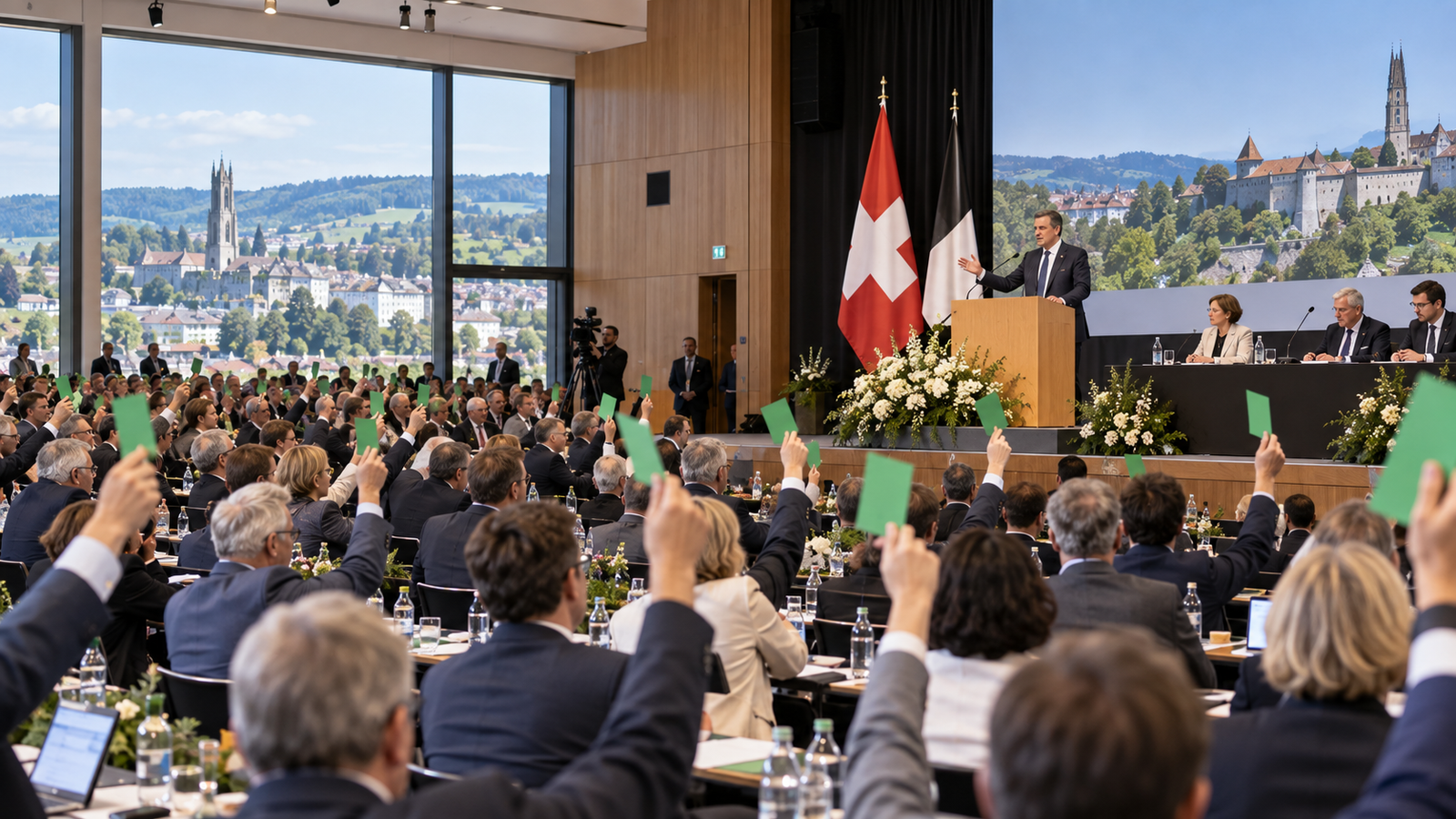
Party delegates gathered in the canton of Fribourg on Saturday to outline priorities for the coming election cycle and to present a vision that places the party at the center of Switzerland’s political decision-making. Leaders argued that the country’s increasingly polarized political environment creates an opportunity for a centrist force capable of building compromises between left- and right-wing blocs.
At the heart of the party’s strategy is a goal that extends beyond parliamentary gains. The Centre Party is seeking to secure a second seat on Switzerland’s seven-member Federal Council, the collective executive body that governs the country. Such an outcome would significantly increase the party’s influence over federal policymaking and strengthen its voice within Switzerland’s consensus-driven political system.
The Federal Council occupies a unique position in Swiss governance. Unlike many parliamentary democracies where executive power is concentrated in a prime minister or president, Switzerland’s government is shared among seven federal councillors representing major political forces. The arrangement is based on long-standing power-sharing traditions designed to reflect the country’s diverse political and linguistic makeup.
For decades, representation in the Federal Council has been influenced by an informal political balance often referred to as the “magic formula,” which allocates cabinet seats among the country’s largest parties. Although the formula has evolved over time, competition for cabinet representation remains one of the most significant long-term objectives for Switzerland’s political parties.
The Centre Party believes recent political developments justify a larger role in government. The party has steadily consolidated its position since its creation through the merger of the former Christian Democratic People’s Party and the Conservative Democratic Party. It currently occupies a middle ground in Swiss politics, advocating pragmatic solutions and positioning itself as a bridge between ideological camps.
Election results over recent years have demonstrated the party’s resilience. While larger parties continue to dominate national vote totals, the Centre has maintained a strong presence in both chambers of parliament and remains an important participant in coalition-building and legislative negotiations. Its influence is often amplified by Switzerland’s consensus-oriented political culture, where broad support is frequently required to advance major reforms.
The launch of the campaign comes at a time when several political issues are shaping national debate. Questions surrounding immigration, economic competitiveness, energy policy, social security, and Switzerland’s relationship with international institutions are expected to feature prominently in the lead-up to the 2027 elections. Political parties across the spectrum are already positioning themselves on these issues as they seek to define the national agenda.
For the Centre Party, the challenge will be translating its reputation for moderation into measurable electoral gains. While Swiss voters often support pragmatic policymaking, political competition has become increasingly intense. The Swiss People’s Party remains the country’s largest political force, while the Social Democrats, FDP.The Liberals, Greens, and Green Liberal Party continue to compete for influence across different voter groups.
Political analysts frequently note that centrist parties face a delicate balancing act. Their strength often lies in attracting voters from multiple ideological backgrounds, but this can make it difficult to distinguish themselves during election campaigns dominated by highly visible debates. The Centre Party’s leadership appears aware of this challenge and has emphasized the need to sharpen the party’s profile while maintaining its reputation as a constructive political actor.
The timing of the campaign launch is also notable because Switzerland remains in the middle of a politically active period that includes several national referendums and policy debates. These votes often serve as indicators of public sentiment and can influence party strategies heading into federal elections. Observers will be watching closely to see whether the Centre Party can use upcoming national discussions to strengthen its message and expand support.
Federal elections are scheduled for October 2027, leaving more than a year for parties to refine their platforms and build momentum. While campaign rhetoric is likely to intensify as the vote approaches, the Centre Party’s early launch suggests it wants to frame itself as a leading force in shaping Switzerland’s future political direction rather than simply reacting to developments created by larger rivals.
Whether the party ultimately succeeds in winning a stronger parliamentary mandate or securing additional representation in the Federal Council remains uncertain. What is clear, however, is that the Centre Party has begun positioning itself for a larger role in Swiss politics. As the road to the 2027 election unfolds, its ability to convince voters that consensus-based leadership remains relevant in an increasingly competitive political environment may determine whether that ambition becomes reality.