The Evolution of Swiss Democracy
Switzerland is often admired for its mountains, lakes, and picturesque villages, but one of its most remarkable achievements cannot be photographed from a scenic viewpoint. It is a political system that gives ordinary citizens an unusually direct role in shaping the country’s future.
The evolution of Swiss democracy is a story that stretches across centuries. It did not emerge through a single revolution, dramatic declaration, or sudden political transformation. Instead, it developed gradually through local traditions, regional cooperation, compromise, and an enduring belief that citizens should have a voice in public affairs.
Today, Switzerland is recognized around the world for its system of direct democracy. Yet the foundations of that system were laid long before the modern Swiss state existed.
Voices in the Alpine Valleys
The roots of Swiss democracy can be traced to the rural communities of medieval central Switzerland.
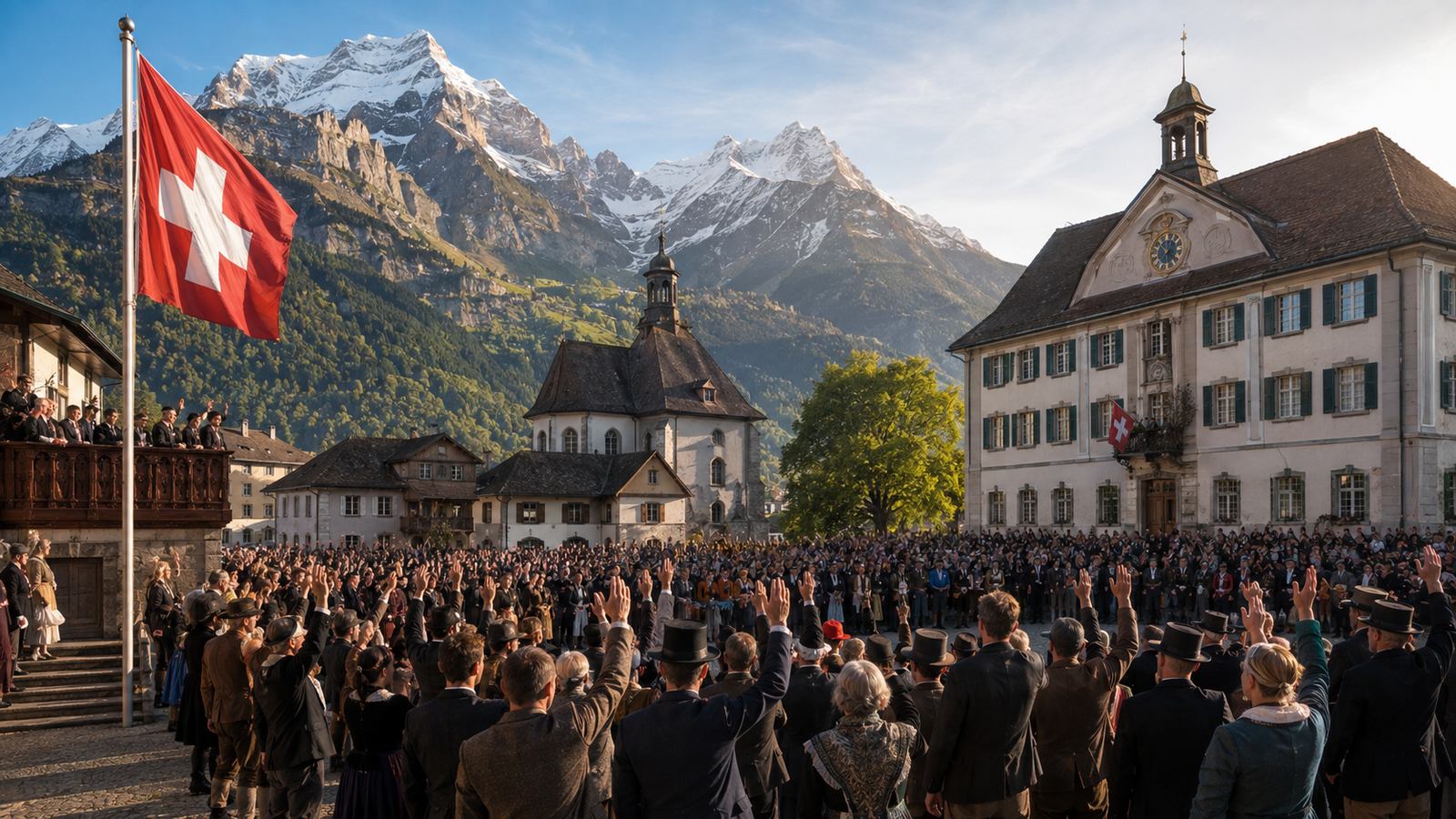
In several Alpine regions, local residents gathered in open-air assemblies to discuss community matters, settle disputes, and make collective decisions. These gatherings became known as the Landsgemeinde, a tradition that survives in a limited form in a few cantons even today.
Unlike many parts of medieval Europe, where political power was concentrated among kings, nobles, or religious authorities, certain Swiss communities developed customs that allowed local participation in governance.
These assemblies were not democratic by modern standards. Participation was generally restricted to male citizens, and many groups remained excluded. Nevertheless, the principle that political decisions should involve the community became deeply embedded in Swiss political culture.
The mountainous geography of Switzerland also played a role. Isolated valleys often required practical cooperation among residents, encouraging traditions of local self-government and collective responsibility.
Alliances That Strengthened Local Autonomy
The formation of the early Swiss Confederation during the late thirteenth century helped reinforce these traditions.
The Federal Charter of 1291, associated with the communities of Uri, Schwyz, and Unterwalden, established agreements for mutual support and protection. While the document was not a democratic constitution in the modern sense, it reflected a commitment to local autonomy and shared decision-making.
As additional territories joined the Confederation over subsequent centuries, Switzerland evolved into a network of alliances rather than a centralized kingdom.
Political authority often remained close to local communities. Cantons developed their own institutions, laws, and governing traditions, creating a political landscape that differed significantly from many neighboring states.
This emphasis on decentralization would later become one of the defining characteristics of Swiss democracy.
Reform, Debate, and New Political Ideas
The sixteenth century brought profound changes through the Protestant Reformation.
Religious leaders such as Huldrych Zwingli encouraged public debate about faith, authority, and governance. While the Reformation primarily concerned religion, it also contributed to broader discussions about civic responsibility and the role of citizens in society.
Different cantons adopted different religious positions, leading to periods of tension and conflict. Yet the Confederation survived by developing mechanisms for coexistence among communities with differing beliefs.
This ability to manage diversity through negotiation and compromise became an important feature of Swiss political culture.
Over time, these habits of discussion and consensus-building helped prepare the ground for more formal democratic institutions.
Winds of Change from Revolutionary Europe
The late eighteenth century introduced new political ideas that challenged traditional structures across Europe.
In 1798, French revolutionary forces invaded Switzerland and established the Helvetic Republic. The new government attempted to replace the decentralized Confederation with a centralized state modeled on revolutionary France.
Many Swiss communities resisted these changes. Although the Helvetic Republic was short-lived, it introduced important concepts such as equal citizenship and national political institutions.
The period revealed a tension that would continue to shape Swiss politics: how to balance national unity with strong local autonomy.
When Napoleon’s influence declined, Switzerland moved toward a political system that combined both principles rather than fully embracing either extreme.
The Constitution That Transformed the Nation
One of the most important milestones in the evolution of Swiss democracy came in 1848.
Following a brief civil conflict known as the Sonderbund War, Switzerland adopted a new federal constitution. The document transformed the Confederation into a modern federal state while preserving substantial powers for individual cantons.
The constitution established a national parliament, a federal government, and a framework for democratic governance that remains influential today.
Unlike many European countries of the era, Switzerland sought to balance national institutions with local self-government. This approach allowed regional identities to coexist within a unified political system.
The 1848 constitution is widely regarded as the foundation of modern Switzerland.
Citizens Gain a Stronger Voice
Swiss democracy continued to evolve throughout the nineteenth century.
In 1874, constitutional reforms expanded the rights of citizens by introducing the optional referendum. This mechanism allowed voters to challenge laws passed by parliament and demand a nationwide vote.
A further step followed in 1891 with the introduction of the popular initiative. Citizens gained the ability to propose constitutional amendments if they collected enough signatures.
These innovations fundamentally changed the relationship between citizens and government.
Rather than simply electing representatives every few years, Swiss voters acquired tools that allowed them to participate directly in major political decisions.
This system gradually became one of the defining features of Swiss democracy.
Democracy Beyond Elections
Today, Switzerland’s political system is often described as a combination of representative and direct democracy.
Citizens elect representatives to parliament, but they also retain significant powers through referendums and popular initiatives. Major constitutional changes require public approval, and voters regularly participate in national, cantonal, and local ballots.
This frequent engagement encourages public discussion and political participation.
Supporters argue that the system strengthens accountability and encourages consensus. Critics occasionally point to slower decision-making processes, but the model has proven remarkably stable over time.
The Swiss experience demonstrates that democracy can take different forms beyond the representative systems commonly found elsewhere.
Expanding Political Rights
The story of Swiss democracy also includes struggles for greater inclusion.
For much of Swiss history, political participation was limited to men. Women gained the right to vote at the federal level only in 1971, considerably later than in many other Western democracies.
Some cantons introduced women’s suffrage earlier, while others resisted change for decades. The final canton to grant women voting rights at the local level did so in 1991 following a ruling by the Swiss Federal Supreme Court.
These developments illustrate that Swiss democracy, like democracy elsewhere, has evolved through ongoing debates about representation and equality.
The expansion of political rights remains an essential chapter in the country’s democratic journey.
Democracy in Everyday Swiss Life
One reason Swiss democracy attracts international attention is how deeply it is woven into everyday life.
Political participation extends beyond election campaigns. Citizens regularly receive voting materials, engage in public debates, and cast ballots on a wide range of issues.
Local governance remains particularly important. Municipalities and cantons continue to exercise significant authority over education, infrastructure, taxation, and public services.
This decentralized structure reflects historical traditions that date back centuries and helps explain why local identity remains so strong throughout Switzerland.
A Legacy That Continues to Evolve
The evolution of Swiss democracy is not a story with a final chapter. It is an ongoing process shaped by changing social expectations, technological developments, and new political challenges.
Yet many of the principles that emerged in Alpine valleys centuries ago remain visible today: local participation, shared responsibility, compromise, and respect for diverse viewpoints.
These traditions helped transform a collection of mountain communities into one of the world’s most stable democratic states.
For visitors exploring Switzerland’s historic town squares, cantonal capitals, and scenic rural landscapes, the country’s democratic heritage may not always be immediately visible. Nevertheless, it has shaped the institutions, communities, and civic culture that define modern Switzerland.
The Swiss political system is ultimately more than a collection of laws and procedures. It is the result of centuries of gradual evolution, reflecting a national belief that citizens should play an active role in governing their own society.