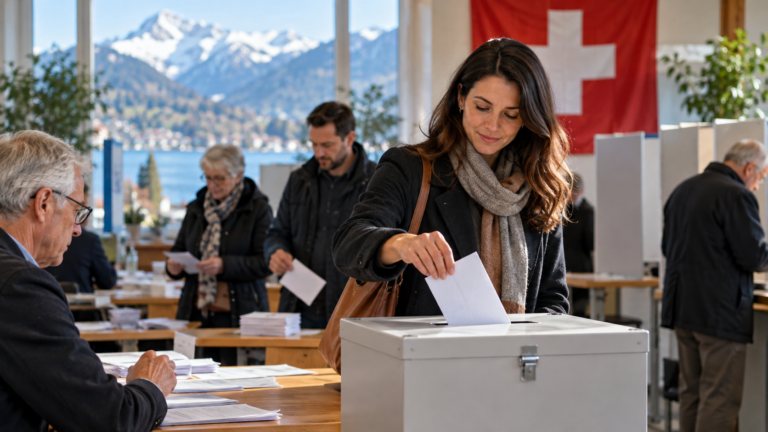

Switzerland Moves to Expand Federal Voting Rights for Adults With Disabilities
Switzerland has begun a formal review of its federal voting rules, opening the way for adults with intellectual disabilities who are currently excluded under certain legal arrangements to gain full participation in national political life. The Federal Council announced the consultation on October 14, 2026, proposing changes to the Constitution and related legislation that would remove this exclusion from federal political rights.
The proposal addresses a longstanding question in Swiss democracy: whether a person’s need for extensive legal assistance should determine their ability to participate in elections, national referendums and other forms of direct democracy. The government says the proposed reform would strengthen individual autonomy and remove unequal treatment of citizens with intellectual disabilities.
Federal government opens consultation on electoral reform
The consultation launched in Bern marks a formal step toward changing how Switzerland defines eligibility for federal political rights. The proposed legislation would amend Article 136 of the Federal Constitution, alongside the Federal Act on Political Rights and the legislation governing Swiss citizens living abroad.
Under the existing framework, certain Swiss citizens can lose their federal political rights if they are deemed permanently incapable of making decisions and are placed under comprehensive guardianship or represented through a relevant advance-care arrangement. The proposed reform seeks to remove that exclusion rather than make eligibility dependent on the individual’s disability or requirement for assistance.
If adopted, the changes would allow all adult Swiss citizens to participate in federal political affairs without this additional restriction. The proposed rights include voting in National Council elections, participating in federal popular votes, and signing federal popular initiatives and referendum requests.
The announcement does not mean that the rules have already changed. The government has opened a consultation to gather feedback on draft legislation before the reform proceeds through the remaining political and legislative stages.
Why the current rules are being reconsidered
Switzerland’s Constitution establishes political rights for adult Swiss citizens, but its existing wording contains an exception linked to certain legal findings concerning mental incapacity. Implementing legislation connects that exception to specific protective arrangements under adult-protection law.
The proposed revision reflects changing approaches to disability, autonomy and equal participation. A person may require substantial support with everyday activities or legal affairs without that need necessarily determining their ability to express a political preference.
The Federal Council and Parliament want to eliminate the distinction that currently affects some people with intellectual disabilities. The government has also connected the proposal to wider efforts to modernize Switzerland’s adult-protection framework, including work toward abolishing comprehensive guardianship.
This debate involves more than access to a ballot paper. Federal political participation includes the ability to influence legislation and public policy through Switzerland’s system of representative elections and direct democracy.
International disability rights add to the pressure for change
Switzerland’s international commitments provide important context for the proposed reform. The country ratified the United Nations Convention on the Rights of Persons with Disabilities on April 15, 2014, and the convention entered into force for Switzerland on May 15 that year. It establishes a framework for protecting the rights of people with disabilities and promoting their participation in public life.
Article 29 of the convention addresses participation in political and public life. In its review of Switzerland, the UN Committee on the Rights of Persons with Disabilities raised concerns about the exclusion of people considered permanently incapable of discernment from voting at federal and cantonal levels. It recommended removing legal provisions that deny voting rights on this basis and improving accessibility and support for political participation.
The government’s latest initiative therefore comes against a broader background of scrutiny over whether domestic electoral rules fully support equal political participation. The proposed amendment would address the federal-level exclusion described in the current legal framework.
However, changes to federal voting eligibility would not, by themselves, resolve every barrier that people with disabilities may encounter when trying to participate in politics.
Cantonal experience offers a point of comparison
Switzerland’s federal system gives cantons responsibility for important aspects of political rights in cantonal and municipal affairs. As a result, the legal position of people under comprehensive guardianship has not been identical throughout the country.
Geneva provides one example. In November 2020, voters approved a constitutional change removing the possibility of suspending the political rights of people permanently incapable of discernment in cantonal and communal matters. The decision allowed affected residents to participate in local and cantonal political processes, although federal restrictions remained separate.
That distinction illustrates why the current federal proposal matters. Reforms at the cantonal level do not automatically alter the Constitution’s federal eligibility rules. A separate national legal change is required to address the federal exclusion.
The experience of individual cantons also highlights the difference between formally granting rights and making them practical. Accessible voting information, understandable explanations of ballot questions and appropriate assistance can all influence whether people can exercise their rights independently and effectively.
What the proposal could change for voters
The proposed reform would remove a legal barrier affecting eligible adult Swiss citizens who currently lose federal political rights under the specified arrangements. Its scope includes elections, national referendums and the signing of popular initiatives and referendum requests.
For people directly affected, the change would recognize their entitlement to participate in decisions that shape public services, social policy and the country’s political direction. It would also remove the assumption that a requirement for extensive support should, by itself, prevent political participation.
Implementation would still matter. Accessible information, suitable voting procedures and support that respects an individual’s own choices would remain important to ensuring that the right can be exercised in practice. Existing federal legislation already provides for arrangements intended to help people with disabilities cast votes, while cantons have responsibilities for facilitating voting when a person cannot perform the necessary steps independently.
The reform concerns federal political rights for Swiss citizens. It should not be interpreted as a blanket change to every legal question involving disability, guardianship or eligibility for political participation at every level of government.
Consultation is the next milestone
The consultation opened on October 14, 2026, and is scheduled to close on January 28, 2027, according to the Swiss government’s official announcement.
The process provides an opportunity for interested parties to comment on the proposed constitutional and legislative amendments before the government determines the next steps. The final outcome, timetable and precise form of any eventual legal changes remain undecided.
Switzerland’s initiative places the balance between legal protection, individual autonomy and democratic participation at the center of a national policy debate. The decisive question is no longer simply whether citizens with disabilities should be able to access voting procedures, but whether disability-related support arrangements should continue to determine who can exercise federal political rights.
If the proposal becomes law, it would remove an existing exclusion and broaden formal access to Switzerland’s national democratic institutions. Until then, the consultation represents a proposed reform rather than an enacted change.