The Complete History of Switzerland: From Alpine Tribes to a Modern Global Nation
Introduction
Switzerland is widely known for its dramatic Alpine landscapes, political neutrality, precision engineering, and high quality of life. Yet behind the country’s modern reputation lies a remarkable history that stretches back thousands of years. The story of Switzerland is one of diverse cultures, mountain communities, political cooperation, and a continuous effort to maintain independence amid powerful neighbors.
Located at the crossroads of Western and Central Europe, Switzerland has been shaped by Celtic tribes, Roman expansion, medieval alliances, religious conflicts, industrial growth, and global diplomacy. Understanding the history of Switzerland helps explain how a small landlocked nation became one of the world’s most stable, prosperous, and respected countries.
Historical Background
Human settlement in the Swiss region dates back to prehistoric times. Archaeological discoveries reveal that people lived around Swiss lakes and valleys thousands of years ago. Some of Europe’s most important prehistoric lake-dwelling settlements have been found in Switzerland and are now recognized as UNESCO World Heritage sites.
Before Roman rule, much of the territory was inhabited by Celtic tribes, particularly the Helvetii. Around 58 BC, the Roman general Julius Caesar defeated the Helvetii during the Gallic Wars, bringing much of the region under Roman influence. Roman towns, roads, bridges, and trade networks transformed the area, connecting it to the wider Roman Empire.
Following the decline of Rome in the fifth century, Germanic tribes, including the Alemanni and Burgundians, settled in different parts of the region. Over time, the territory became part of the Frankish Empire and later the Holy Roman Empire. These centuries laid the foundations for the linguistic and cultural diversity that still characterizes Switzerland today.
The Birth of the Swiss Confederation
The origins of modern Switzerland are traditionally linked to the year 1291. During this period, local communities in the Alpine regions sought greater autonomy from the Habsburg rulers, one of Europe’s most powerful dynasties.
Representatives from the rural cantons of Uri, Schwyz, and Unterwalden formed an alliance known as the Federal Charter of 1291. The agreement aimed to preserve local freedoms and mutual defense. Although historians continue to debate the exact significance of the charter at the time, it later became an important symbol of Swiss nationhood.
The alliance gradually expanded as additional territories joined the confederation. Military victories against Habsburg forces strengthened the reputation of the Swiss cantons and encouraged further cooperation. By the fifteenth century, the Swiss Confederation had emerged as a significant regional power.
One of the most famous legends associated with this era is that of William Tell, a folk hero said to have resisted foreign oppression. While historians have found no definitive evidence that Tell was a real historical figure, his story became a powerful symbol of Swiss independence and freedom.
Expansion and Challenges in the Late Middle Ages
Between the fourteenth and sixteenth centuries, the Swiss Confederation continued to grow. New cantons joined the alliance, expanding its territory and influence. Swiss soldiers earned a reputation as highly skilled fighters and were frequently recruited as mercenaries across Europe.
A major turning point came in 1499 with the Swabian War. The conflict weakened the influence of the Holy Roman Empire over the Swiss territories and strengthened the Confederation’s autonomy. In 1648, the Peace of Westphalia formally recognized Swiss independence from the Holy Roman Empire.
Despite these successes, internal divisions often challenged unity. Differences between rural and urban cantons, as well as political and economic interests, sometimes created tensions within the Confederation.
The Reformation and Religious Divisions
The sixteenth century brought profound religious change. Switzerland became one of the key centers of the Protestant Reformation.
In Zurich, reformer Huldrych Zwingli challenged established Catholic practices and introduced Protestant reforms. Later, Geneva became an influential center of Protestant thought under John Calvin, whose ideas shaped religious movements throughout Europe.
Not all regions embraced the Reformation. Several cantons remained Catholic, leading to religious conflicts and political divisions. Although these tensions occasionally erupted into violence, Switzerland gradually developed mechanisms that allowed communities with different beliefs to coexist within the Confederation.
The experience of managing religious diversity helped shape the country’s later traditions of compromise, local autonomy, and political cooperation.
Revolution, Napoleon, and a New Political Order
The late eighteenth century brought dramatic change. In 1798, French revolutionary forces invaded Switzerland and established the Helvetic Republic, replacing the loose confederation with a centralized government.
The new system proved controversial and faced resistance from many Swiss communities accustomed to local self-rule. Political instability followed until Napoleon Bonaparte introduced the Act of Mediation in 1803, restoring a degree of cantonal autonomy.
After Napoleon’s defeat, European powers met at the Congress of Vienna in 1815. During these negotiations, Switzerland’s permanent neutrality was formally recognized. This decision would become one of the defining features of Swiss foreign policy and national identity.
The Creation of Modern Switzerland
The nineteenth century was a transformative period. Political disagreements between conservative and liberal cantons eventually led to the brief Sonderbund War in 1847. Although the conflict lasted only a few weeks, it paved the way for major constitutional reform.
In 1848, Switzerland adopted a new federal constitution. This document created the modern Swiss federal state, balancing national authority with strong cantonal powers. It established democratic institutions, a federal parliament, and a framework that remains the basis of Swiss government today.
The constitution marked a turning point in Swiss history, transforming a loose alliance of states into a unified nation while preserving regional identities.
Industrialization and Economic Growth
During the nineteenth and early twentieth centuries, Switzerland underwent rapid industrial development. Textile manufacturing, machinery production, engineering, and chemical industries expanded significantly.
Swiss entrepreneurs and innovators gained international recognition for precision craftsmanship and technological expertise. The country’s watchmaking industry became particularly famous, helping establish Switzerland’s global reputation for quality and reliability.
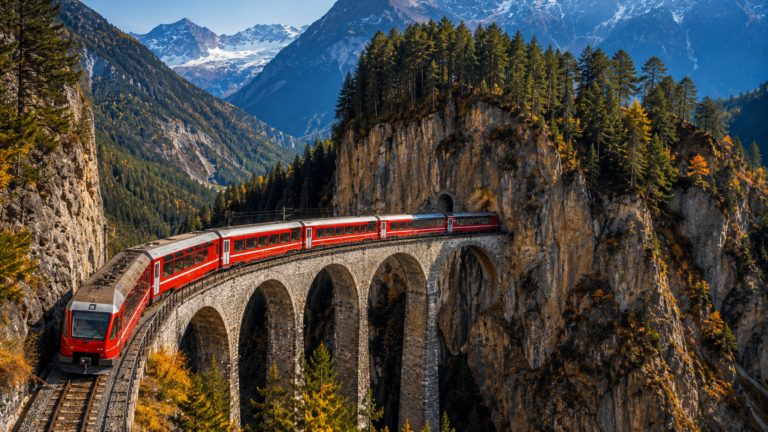
The expansion of railways improved transportation across challenging Alpine terrain. Major engineering projects connected remote regions and strengthened national integration.
At the same time, tourism emerged as an important economic sector. Visitors from across Europe traveled to the Swiss Alps to experience mountain scenery, health resorts, and outdoor recreation.
Switzerland in the World Wars
Switzerland maintained neutrality during both World War I and World War II. Although the country avoided direct involvement in the conflicts, it faced significant economic, political, and humanitarian challenges.
During World War II, Switzerland was surrounded by Axis-controlled territory and mobilized its military forces for defense. The country served as a diplomatic intermediary and provided refuge for many people fleeing persecution, though its wartime policies continue to be studied and debated by historians.
The experience reinforced Switzerland’s commitment to neutrality while highlighting the complexities of maintaining that position during global crises.
Cultural and Historical Significance
Switzerland’s history is significant because it demonstrates how diverse communities can cooperate despite differences in language, religion, and regional identity. Today, the country recognizes four national languages—German, French, Italian, and Romansh—reflecting centuries of cultural development.
Swiss traditions of federalism, direct democracy, and local autonomy have attracted international attention and influenced political thinkers worldwide. The country’s commitment to consensus-building remains a central feature of its governance.
Interesting Facts About Swiss History
- The Swiss National Day is celebrated on August 1 and commemorates the Federal Charter of 1291.
- Switzerland has never had a single monarch ruling the entire country.
- The country is home to numerous UNESCO World Heritage Sites, including prehistoric lake dwellings.
- Geneva became one of Europe’s most influential centers of Protestant reform.
- Swiss neutrality was internationally recognized in 1815 and remains a cornerstone of foreign policy.
- The International Committee of the Red Cross was founded in Geneva in 1863.
- Switzerland joined the United Nations relatively recently, becoming a member in 2002 after a national referendum.
Present-Day Importance
Modern Switzerland combines historical traditions with global influence. It is a leading center for finance, science, innovation, diplomacy, and international cooperation. Cities such as Geneva host major international organizations, while Swiss universities and research institutions contribute to advancements in numerous fields.
The country’s political stability, strong economy, and commitment to democratic participation continue to attract worldwide interest. Many of the principles that define Switzerland today—neutrality, federalism, and cooperation—are deeply rooted in its historical development.
Conclusion
The history of Switzerland is a story of resilience, adaptation, and unity. From Celtic settlements and Roman provinces to medieval alliances and a modern federal republic, the Swiss people have shaped a nation built on cooperation and independence. Over centuries, Switzerland successfully balanced regional diversity with national cohesion, creating a unique political and cultural identity.
Today, the country’s history remains visible in its languages, traditions, institutions, and landscapes. Understanding Switzerland’s past provides valuable insight into how a small Alpine nation became one of the world’s most respected and influential countries.