
The Legend of William Tell: Switzerland’s Hero
Few stories are as deeply woven into Switzerland’s national identity as the Legend of William Tell. For centuries, the tale of a skilled marksman who defied tyranny has inspired generations of Swiss citizens and fascinated visitors from around the world.
Whether viewed as folklore, patriotic myth, or a symbolic account of the struggle for freedom, the story remains one of the most recognizable legends in European history. Its setting among the lakes and mountains of central Switzerland adds to its enduring appeal, transforming the legend into something that feels inseparable from the landscape itself.
Today, travelers can follow the traces of William Tell across the cantons surrounding Lake Lucerne, where history, tradition, and storytelling continue to shape local culture.
A Hero Emerges in Medieval Switzerland
According to popular tradition, William Tell lived during the early fourteenth century, a period when the Swiss regions of Uri, Schwyz, and Unterwalden were resisting the growing influence of the Habsburg rulers.
The most famous episode of the legend takes place in the town of Altdorf. The Austrian governor, known as Hermann Gessler, ordered local residents to bow before his hat displayed on a pole in the town square as a symbol of imperial authority.
Tell refused.
As punishment, Gessler commanded him to shoot an apple placed on the head of his young son. Tell, renowned for his skill with a crossbow, successfully split the apple with a single shot. However, he had secretly prepared a second bolt.
When questioned about it, Tell reportedly admitted that the second arrow was intended for Gessler should the first shot have harmed his child.
This act of defiance transformed Tell into a symbol of resistance against oppression. The story continues with his dramatic escape from captivity and the eventual killing of Gessler, events that helped spark a wider uprising among the Swiss communities.
Between History and Legend
Despite the popularity of the story, historians have never found definitive evidence proving that William Tell existed as a historical individual.
The earliest written versions of the legend appeared more than a century after the events they supposedly describe. Several elements of the tale also resemble older folk stories found elsewhere in Europe, particularly narratives involving expert archers forced to shoot objects from a child’s head.
As a result, most modern historians regard William Tell as a legendary or symbolic figure rather than a documented historical person.
This distinction is important. While the Swiss Confederation itself emerged through genuine historical developments during the late thirteenth and early fourteenth centuries, the story of William Tell belongs primarily to the realm of folklore and national tradition.
Yet the absence of definitive proof has done little to diminish the legend’s influence. In many ways, its symbolic meaning has proven more powerful than historical certainty.
The Landscape Behind the Legend
Central Switzerland provides an extraordinary backdrop for the William Tell story.
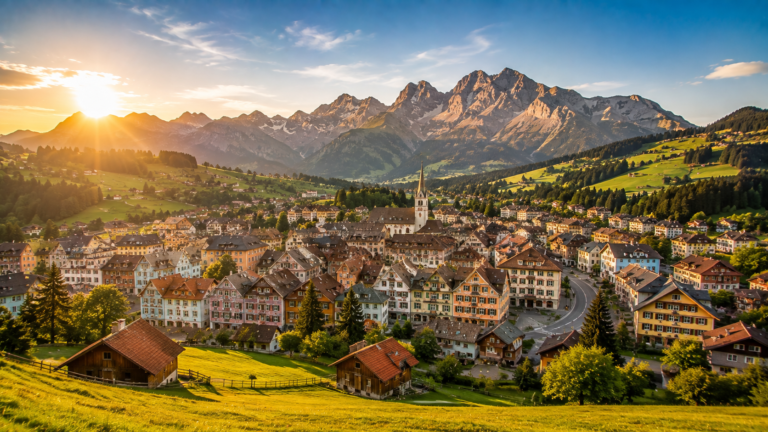
The region surrounding Lake Lucerne is characterized by dramatic mountain peaks, steep cliffs, emerald valleys, and historic lakeside villages. These landscapes have become closely associated with the origins of the Swiss Confederation and the stories that helped define it.
Visitors frequently explore locations linked to the legend, including Altdorf in the canton of Uri. The town’s central square features monuments dedicated to William Tell and remains one of the most significant destinations connected to the story.
Another notable site is the Tellskapelle, or William Tell Chapel, located along the shores of Lake Lucerne. According to tradition, this marks the place where Tell escaped from the boat transporting him across the lake during a violent storm.
Whether historically accurate or not, these locations help bring the legend to life and offer visitors a deeper connection to Swiss cultural heritage.
How a Folk Tale Became a National Symbol
The Legend of William Tell gained increasing prominence during the centuries that followed Switzerland’s formation.
By the eighteenth and nineteenth centuries, the story had become closely associated with ideas of liberty, independence, and self-government. At a time when many European nations were experiencing political upheaval, Tell represented the courage of ordinary people standing against unjust authority.
One of the most influential interpretations came from German playwright and poet Friedrich Schiller. His 1804 drama William Tell introduced the story to a much wider international audience and helped establish the legendary archer as a global symbol of freedom.
The play became enormously popular throughout Europe and contributed significantly to the modern image of William Tell that many people recognize today.
Traditions That Keep the Legend Alive
The William Tell story remains an active part of Swiss cultural life.
In Altdorf, open-air performances and theatrical productions periodically retell the legendary events. Museums, monuments, and local celebrations continue to preserve the narrative for new generations.
Many schools also teach the story as an important component of Swiss cultural heritage, while carefully distinguishing between historical evidence and traditional folklore.
Visitors traveling through central Switzerland often encounter references to Tell in artwork, statues, public spaces, souvenirs, and local storytelling traditions. The legend has become part of the region’s cultural landscape in much the same way as its mountains and lakes.
Following William Tell Through Modern Switzerland
For travelers interested in Swiss history and culture, exploring sites associated with William Tell offers a unique way to experience the country’s origins.
The journey typically includes Altdorf, Lake Lucerne, and nearby historic locations connected to the early Swiss Confederation. Along the way, visitors discover not only a legendary hero but also the landscapes that shaped Switzerland’s development.
Many travelers are surprised by how strongly the story remains embedded in everyday Swiss identity. Even in an era of advanced technology and global connections, the legend continues to resonate because it speaks to universal themes: courage, family, justice, and the desire for freedom.
A Legend Larger Than History
The enduring power of William Tell does not depend on whether historians ultimately prove that he existed. His significance lies in what he represents.
For generations, the legendary archer has embodied the values many Swiss people associate with their nation—independence, resilience, local self-government, and determination in the face of powerful forces.
The mountains, lakes, and villages of central Switzerland provide a fitting stage for this remarkable story. As visitors stand beside the waters of Lake Lucerne or walk through the streets of Altdorf, they encounter more than a legend. They encounter a narrative that has helped shape the identity of a country for centuries.
That enduring connection between landscape, tradition, and national memory is what makes the Legend of William Tell one of Switzerland’s most captivating cultural treasures.