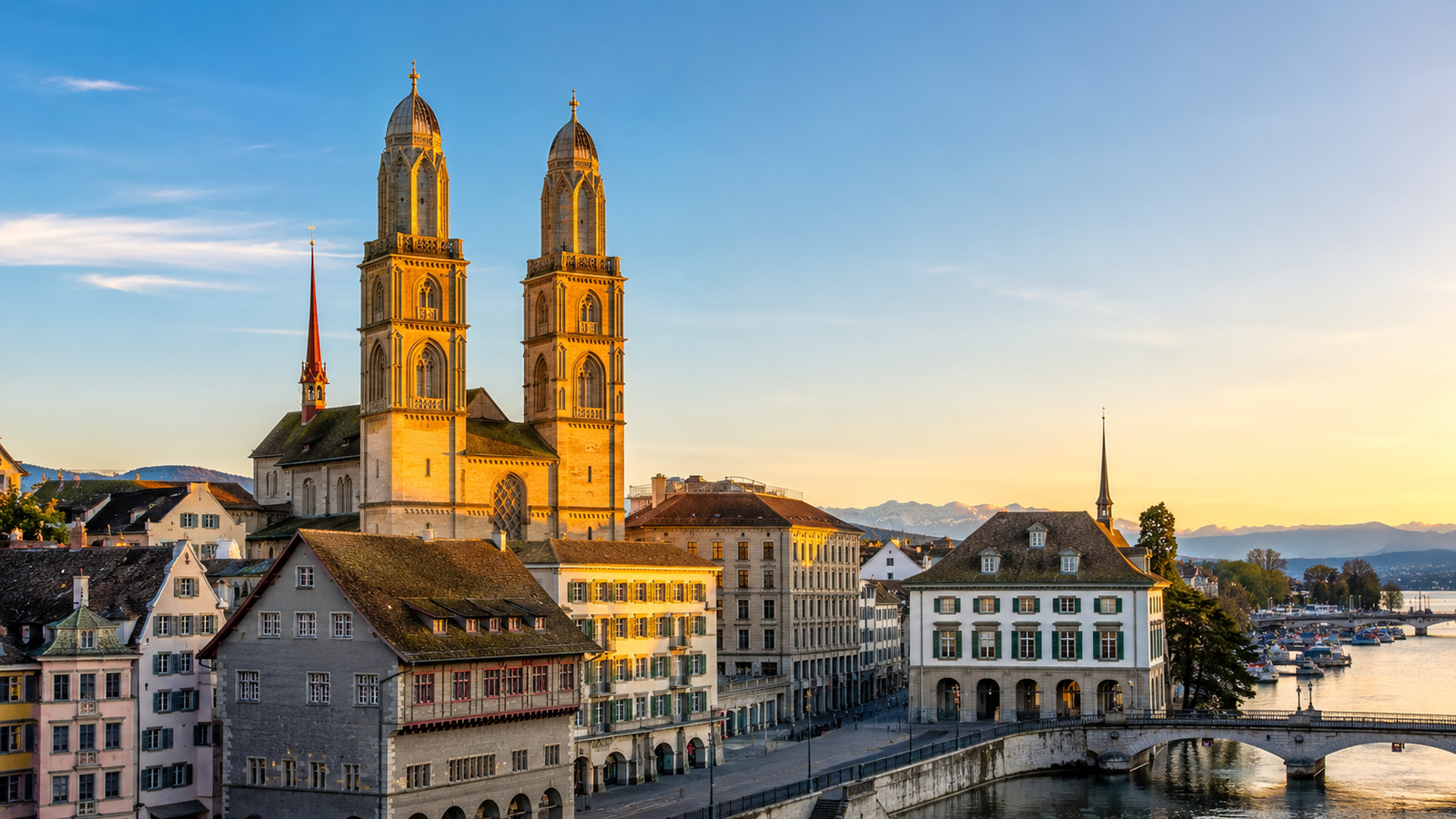
Grossmünster, Zurich, Switzerland
Grossmünster: The Zurich Church That Helped Shape the Protestant Reformation
Standing prominently above the Limmat River with its unmistakable twin towers, Grossmünster is more than a landmark on Zurich’s skyline. It is one of the most historically influential churches in Switzerland, a place where religion, politics, architecture, and cultural identity converged to shape the future of an entire nation.
For many visitors arriving in Zurich’s Old Town, the church is an immediate visual reference point. Yet behind its imposing Romanesque stone walls lies a story that reaches far beyond architecture. Grossmünster occupies a central place in the history of the Swiss Reformation and remains one of the city’s most significant cultural and spiritual monuments.
Today, travelers come not only to admire its architecture but also to understand the events that transformed Zurich into a center of religious reform and intellectual change.
A Church Rooted in Legend
The origins of Grossmünster blend documented history with enduring legend. According to tradition, Charlemagne discovered the graves of Zurich’s patron saints, Felix and Regula, after his horse knelt at the site where they were buried. Inspired by this event, he is said to have ordered the construction of a church on the location.
While historians regard the story as legendary rather than proven fact, it remains an important part of Zurich’s cultural heritage. Archaeological evidence confirms that Christian worship existed on the site long before the current church was built.
The present Grossmünster began taking shape around the early 12th century. Construction continued for generations, reflecting the scale and ambition of one of medieval Zurich’s most important ecclesiastical projects.
Its elevated position overlooking the river ensured that the church would dominate the city’s religious and civic landscape.
A Masterpiece of Romanesque Architecture
Grossmünster is widely regarded as one of Switzerland’s most important examples of Romanesque architecture.
Unlike the highly decorative Gothic cathedrals found elsewhere in Europe, Romanesque churches emphasize solidity, symmetry, and monumental forms. Grossmünster reflects these characteristics through its thick stone walls, rounded arches, massive columns, and balanced proportions.
The church’s twin towers are among Zurich’s most recognizable architectural features. Although modifications and restorations have occurred over the centuries, the towers continue to define the city’s historic skyline.
Inside, visitors encounter a surprisingly restrained interior. The simplicity is largely the result of Reformation-era changes that removed many medieval decorations. Rather than ornate embellishments, the church emphasizes architectural structure, light, and space.
This simplicity offers a direct connection to the principles that later shaped Zurich’s religious transformation.
The Heart of the Swiss Reformation
Grossmünster’s greatest historical significance stems from its association with Huldrych Zwingli, the leader of the Swiss Reformation.
In 1519, Zwingli became the people’s priest at Grossmünster. His arrival marked the beginning of profound religious change in Zurich.
At the time, much of Western Europe was questioning established religious practices. Inspired by a return to biblical teachings, Zwingli began preaching directly from scripture rather than following traditional liturgical readings.
His sermons attracted growing attention and support. Over the following years, reforms introduced in Zurich challenged longstanding church practices and reshaped religious life throughout the city.
From Grossmünster, Zwingli advocated theological principles that differed from those emerging simultaneously under Martin Luther in Germany. As a result, Zurich became a major center of the Reformed tradition, influencing Protestant movements across Switzerland and beyond.
The church therefore occupies a unique place in European religious history. Unlike many historic churches that merely witnessed important events, Grossmünster served as one of the principal stages upon which the Swiss Reformation unfolded.
Exploring the Church Interior
Visitors entering Grossmünster often notice the contrast between its powerful exterior and its understated interior atmosphere.
The nave’s high arches and stone columns create a sense of grandeur without excessive ornamentation. Natural light filters through modern stained-glass windows, adding color and visual interest while respecting the church’s historical character.
One of the most notable artistic features is the stained-glass work by Swiss artist Augusto Giacometti. Installed during the twentieth century, these windows introduce vibrant colors into the otherwise restrained interior.
Additional modern stained-glass windows by German artist Sigmar Polke further enrich the church. Their contemporary design demonstrates how Grossmünster continues to evolve while honoring its historic foundations.
The crypt beneath the church offers another layer of historical exploration. It contains archaeological remains and information that help visitors understand the site’s development over centuries.
Together, these spaces reveal how Grossmünster functions both as a place of worship and as a living historical monument.
Climbing the Towers
For many travelers, one of the highlights of a visit is climbing the church tower.
The ascent involves a significant number of steps, but the reward is one of Zurich’s most impressive viewpoints. From the top, visitors enjoy panoramic views of the Old Town, the Limmat River, Lake Zurich, and the surrounding hills.
The perspective reveals how closely the city’s historical development is tied to its geography. Medieval streets, church spires, riverside buildings, and modern districts all become visible from above.
On clear days, the distant Alps can also be seen on the horizon, adding another dimension to the experience.
The tower climb provides an opportunity to appreciate both Zurich’s architectural heritage and its natural setting.
Grossmünster and Zurich’s Old Town
Grossmünster occupies a strategic location within Zurich’s historic center.
Across the river stands Fraumünster, another of Zurich’s most famous churches, known internationally for its stained-glass windows created by Marc Chagall. Nearby, St. Peter’s Church features one of Europe’s largest church clock faces.
Together, these landmarks form the historic and cultural heart of the city.
The area surrounding Grossmünster is ideal for exploration on foot. Narrow medieval streets, public squares, historic buildings, cafés, museums, and riverside promenades create an environment where centuries of history remain visible in everyday urban life.
Visitors often combine a church visit with walks through Niederdorf, Zurich’s picturesque Old Town district, or along the Limmat waterfront.
A Symbol Beyond Religion
Although Grossmünster remains an active Protestant church, its significance extends far beyond faith.
For historians, it represents a turning point in European religious history. For architects, it stands as an important Romanesque monument. For residents, it is one of Zurich’s defining landmarks. For travelers, it offers a gateway to understanding the city’s evolution from a medieval settlement into one of Switzerland’s most influential urban centers.
The church’s ability to connect these different narratives explains its enduring appeal.
Its towers have watched over Zurich through political transformations, economic growth, religious change, and cultural development. Few buildings in Switzerland can claim such a close connection to the formation of a city’s identity.
Visiting Today
Grossmünster remains one of Zurich’s most visited attractions, drawing both worshippers and travelers throughout the year.
Its central location makes it easily accessible from Zurich’s main railway station and from most parts of the city center. Whether approached from the riverside, viewed from a bridge crossing the Limmat, or encountered while wandering through the Old Town, the church quickly becomes a focal point of any visit.
For those interested in Swiss history, architecture, religion, or urban heritage, Grossmünster offers an experience that goes well beyond sightseeing. It provides a direct encounter with the ideas, people, and events that helped shape modern Switzerland while remaining one of the most recognizable landmarks on Zurich’s skyline.