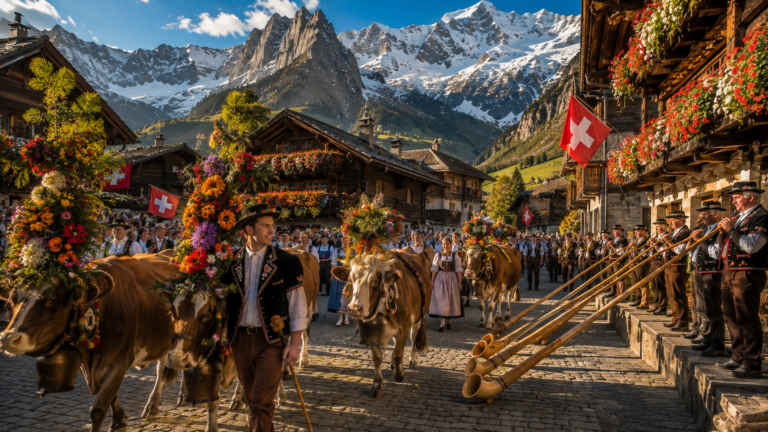

The Story of Swiss Independence 1291
Where Switzerland’s Story Truly Begins
Long before Switzerland became known for alpine scenery, precision watches, and political neutrality, it was a collection of rugged mountain communities determined to protect their freedoms.
The story of Swiss independence begins in the heart of the Alps during the late thirteenth century, a period when powerful noble families and expanding empires competed for influence across Central Europe. Among the valleys surrounding Lake Lucerne, local communities faced growing uncertainty about their future. What emerged from this challenging era would eventually become one of the world’s oldest continuously existing political federations.
Today, many Swiss people view the events of 1291 as the symbolic birth of their nation. While historians carefully distinguish between documented facts and later patriotic traditions, there is little doubt that the alliance formed that year laid the foundation for modern Switzerland.
A Mountain Region Caught Between Great Powers
In the late Middle Ages, the territory that would become Switzerland was part of the Holy Roman Empire. Although imperial authority existed, many mountain communities enjoyed considerable local autonomy.
The forest cantons of Uri, Schwyz, and Unterwalden occupied strategically important routes through the Alps. Trade traffic moving between northern and southern Europe passed through these valleys, particularly after the opening of the Gotthard Pass route. Control of these transportation corridors brought economic opportunities but also attracted the attention of ambitious rulers.
The powerful House of Habsburg sought to expand its influence across the region. As Habsburg authority increased, many local communities feared losing long-established rights and freedoms. Village leaders recognized that cooperation might be their best defense against outside interference.
The stage was set for an agreement that would have consequences far beyond what anyone at the time could have imagined.
The Federal Charter of 1291
The most important surviving document from Switzerland’s founding era is the Federal Charter of 1291.
Created in early August 1291, the charter was an alliance agreement between Uri, Schwyz, and Unterwalden. Rather than declaring independence in the modern sense, the document established mutual support among the three communities.
The charter pledged cooperation in maintaining peace, resolving disputes, and defending against external threats. It emphasized collective security while preserving local self-government. The agreement reflected practical concerns rather than grand political ideals, yet its principles would resonate through centuries of Swiss history.
Modern historians generally regard the Federal Charter as one of the earliest and most significant milestones in the development of the Swiss Confederation.
Although the document did not immediately create a nation, it established a framework for cooperation that proved remarkably durable.
The Legend of the Rütli Oath
No story of Swiss independence is complete without mentioning one of the country’s most famous national legends.
According to tradition, representatives from the three founding cantons met secretly at the Rütli Meadow overlooking Lake Lucerne. There they swore an oath to resist tyranny and defend their liberties.
This dramatic scene occupies a central place in Swiss cultural memory. The story gained enormous popularity through literature, art, and later national celebrations.
However, historians note that there is no contemporary evidence proving that such a meeting occurred exactly as described. The tale emerged in written sources centuries after the supposed event.
As a result, the Rütli Oath is best understood as an important national legend rather than a verified historical fact. While the alliance itself is documented, the famous oath belongs largely to the realm of patriotic tradition.
The distinction does not diminish its cultural significance. For many Swiss people, the story symbolizes unity, cooperation, and self-determination.
A Struggle for Survival
The alliance formed in 1291 did not instantly secure freedom or stability.
Over the following decades, tensions with the Habsburgs continued. The young confederation faced military and political challenges that tested the strength of its cooperation.
One of the most significant moments came in 1315 at the Battle of Morgarten. Swiss forces from the mountain cantons achieved a surprising victory against a larger Habsburg army. Fighting in difficult terrain that favored local defenders, the confederates demonstrated that unity could overcome superior numbers.
The victory strengthened the alliance and encouraged additional communities to join.
As the confederation expanded, its members continued developing systems of cooperation while preserving considerable local independence. This balance between unity and autonomy became a defining characteristic of Swiss political culture.
From Three Cantons to a Growing Confederation
What began as a regional pact gradually evolved into something much larger.
Throughout the fourteenth and fifteenth centuries, cities and territories including Lucerne, Zurich, Bern, Glarus, and Zug joined the confederation. Each new member brought different economic strengths, cultural traditions, and political interests.
Despite these differences, the cantons shared a commitment to collective defense and mutual support.
The expanding confederation became increasingly influential within Central Europe. Its military successes earned respect, while its decentralized political structure allowed diverse communities to cooperate without surrendering their identities.
Unlike many emerging European states that centralized power under monarchs, the Swiss Confederation developed through negotiation, alliances, and local participation.
This distinctive path would shape Switzerland for centuries.
The Heroes Who Became National Symbols
Swiss independence stories often feature legendary figures who symbolize resistance and courage.
The most famous is William Tell, the legendary archer said to have defied a tyrannical Habsburg official. According to tradition, Tell was forced to shoot an apple from his son’s head before later helping inspire rebellion.
Like the Rütli Oath, historians generally regard the William Tell story as folklore rather than documented history. No contemporary evidence confirms his existence.
Yet the legend has become one of Switzerland’s most enduring national symbols. For generations, it has represented the values of freedom, individual courage, and resistance to oppression.
The popularity of these stories reveals how nations often combine historical facts with cultural narratives to create a shared sense of identity.
The Legacy That Endures Today
The events of 1291 remain deeply woven into Switzerland’s national consciousness.
Every year on August 1, Swiss National Day commemorates the Federal Charter and the traditional founding of the Confederation. Across the country, celebrations include speeches, bonfires, lantern processions, fireworks, and community gatherings.
Visitors can explore places associated with Switzerland’s origins, including the region around Lake Lucerne and the historic Rütli Meadow. These landscapes continue to connect modern Switzerland with its founding traditions.
The principles established by the early alliance—local autonomy, cooperation, mutual defense, and collective decision-making—still influence Swiss political institutions today.
Modern Switzerland is vastly different from the medieval communities that signed the Federal Charter. It is a multilingual, highly developed nation with a global reputation for diplomacy, innovation, and stability.
Yet many of the values that define the country can be traced back to those mountain valleys and lakeshores more than seven centuries ago.
Why 1291 Still Matters
The story of Swiss independence is not simply a tale of battles and alliances. It is the story of communities choosing cooperation over division and self-government over outside control.
While historians continue to debate certain details and separate legend from documented fact, the significance of 1291 remains clear. The Federal Charter marked the beginning of a political experiment that gradually evolved into modern Switzerland.
In an age when kingdoms and empires dominated Europe, a handful of Alpine communities forged an alliance built on mutual trust and shared interests. Their decision created foundations that would survive wars, political upheavals, and centuries of change.
More than seven hundred years later, the spirit of that alliance continues to shape Switzerland, making the story of 1291 one of the most remarkable nation-building stories in European history.