Famous Swiss Explorers and Scientists
A Small Nation with a Global Impact
Switzerland is often celebrated for its dramatic Alpine landscapes, precision watches, and political neutrality. Yet one of the country’s most remarkable contributions to the world lies in a different realm entirely: discovery.
For centuries, Swiss explorers and scientists have pushed beyond known boundaries, whether crossing oceans, studying distant cultures, unlocking the mysteries of the natural world, or transforming modern science. Despite its relatively small size, Switzerland has produced individuals whose work has reshaped medicine, physics, geography, engineering, and humanitarian thought.
Their stories reveal a nation that has long valued education, curiosity, innovation, and international cooperation. From the laboratories of Zurich and Geneva to remote regions of Africa, Asia, and Antarctica, Swiss thinkers and adventurers have left a lasting mark on human history.
Curiosity Beyond the Mountains
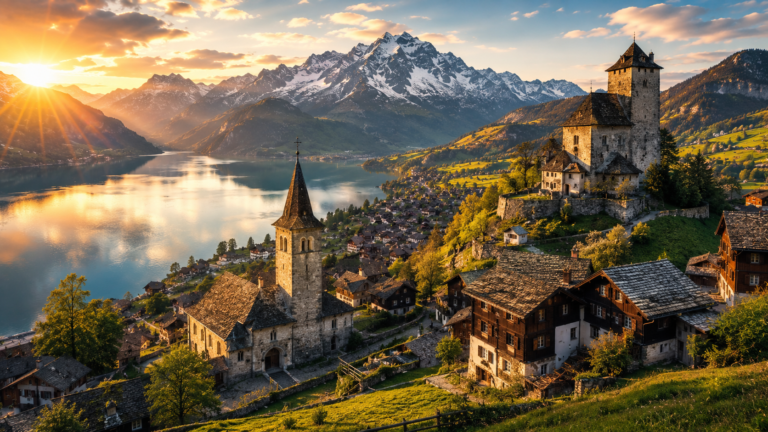
Switzerland’s geography may seem isolating at first glance. Surrounded by mountains and lacking direct access to the sea, the country might appear an unlikely birthplace for explorers.
Yet the opposite proved true.
The Alps encouraged generations of Swiss citizens to develop skills in navigation, observation, engineering, and endurance. Universities and scientific institutions flourished, particularly during the nineteenth and twentieth centuries. Combined with political stability and a strong educational tradition, these conditions created fertile ground for innovation.
Many Swiss researchers became global citizens, working far beyond their homeland while maintaining strong ties to Swiss academic institutions.
Their achievements helped establish Switzerland’s reputation as a center of knowledge and scientific excellence.
Horace-Bénédict de Saussure and the Scientific Alps
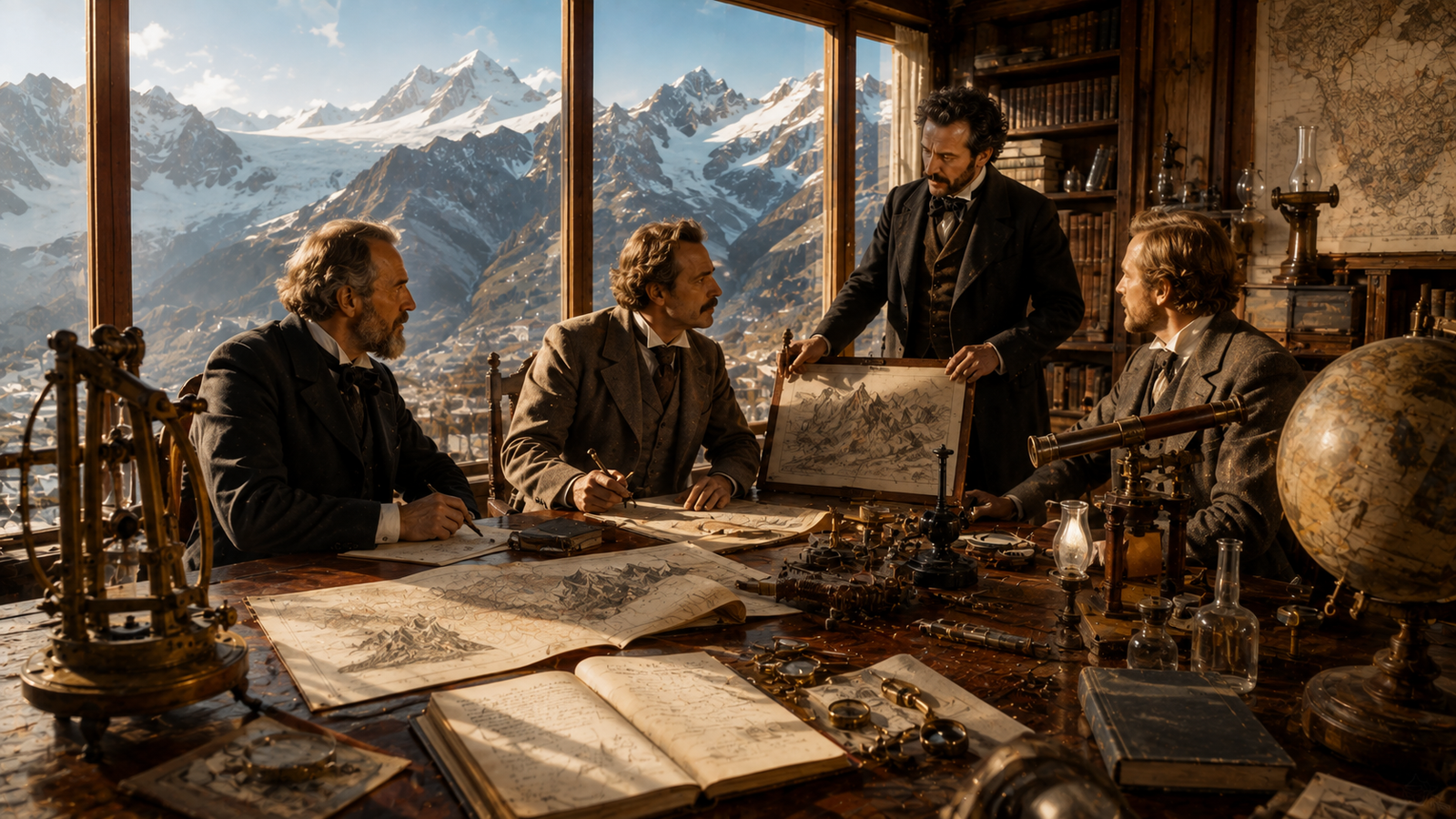
One of Switzerland’s earliest scientific pioneers was Horace-Bénédict de Saussure.
Born in Geneva in 1740, de Saussure became fascinated by the Alps at a time when mountains were still viewed with fear by many Europeans. Rather than seeing them as obstacles, he recognized them as natural laboratories.
His scientific expeditions throughout the Alpine region helped advance geology, meteorology, and natural history. He famously encouraged attempts to reach the summit of Mont Blanc and later conducted extensive scientific observations there himself.
His measurements of altitude, atmospheric conditions, and geological formations laid important foundations for modern Alpine science.
Today, many historians regard him as one of the fathers of mountaineering science.
Louis Agassiz and the Ice Age Revolution
Few Swiss scientists transformed our understanding of Earth as dramatically as Louis Agassiz.
Born in the canton of Fribourg in 1807, Agassiz became fascinated by glaciers and geological processes. Through careful observation of Alpine landscapes, he proposed a groundbreaking idea: vast ice sheets had once covered much of Europe and North America.
At the time, the concept seemed radical.
However, his evidence helped establish what became known as Ice Age theory. His research fundamentally changed geology by demonstrating the powerful influence of glaciers on shaping landscapes.
Modern climate science and glaciology continue to build upon principles that emerged from these early investigations.
The Swiss Alps provided the laboratory that inspired one of the most important geological discoveries in history.
Auguste Piccard and the Edge of Space
Among Switzerland’s most extraordinary explorers was Auguste Piccard.
A physicist, inventor, and adventurer, Piccard refused to limit exploration to Earth’s surface. During the 1930s, he became famous for pioneering high-altitude balloon flights designed to study cosmic radiation.
In 1931, he reached an altitude of more than 15 kilometers, making him one of the first humans to enter the stratosphere.
His achievements represented a major step toward modern space exploration.
Piccard’s curiosity did not stop in the sky. Later, he developed deep-sea exploration vehicles that allowed researchers to investigate the ocean’s depths.
Remarkably, he became both a pioneer of near-space exploration and deep-ocean exploration during the same lifetime.
Jacques Piccard and the Deepest Place on Earth
The spirit of exploration continued through Auguste’s son, Jacques Piccard.
In 1960, Jacques Piccard and U.S. Navy Lieutenant Don Walsh descended nearly 11 kilometers into the Challenger Deep in the Mariana Trench, the deepest known location in Earth’s oceans.
Their vessel, the bathyscaphe Trieste, reached a depth previously thought impossible for human exploration.
The mission demonstrated that people could safely travel to extreme ocean depths and opened new possibilities for marine science.
Few explorers in history have ventured farther from ordinary human experience than Jacques Piccard.
His achievement remains one of the greatest milestones in exploration.
Albert Einstein’s Swiss Years
Although born in Germany, Albert Einstein achieved many of his most important breakthroughs while living in Switzerland.
After studying in Zurich and later working at the Swiss Patent Office in Bern, Einstein developed ideas that would revolutionize physics.
In 1905, often called his “miracle year,” he published groundbreaking papers on special relativity, the photoelectric effect, Brownian motion, and mass-energy equivalence.
These discoveries transformed modern science.
Switzerland provided the intellectual environment in which one of history’s greatest scientific minds developed theories that continue to influence physics today.
Visitors to Bern can still explore locations associated with Einstein’s life and work.
Heinrich Rohrer and the Invisible World
Swiss innovation continued well into the twentieth century.
Heinrich Rohrer helped revolutionize nanotechnology through the invention of the scanning tunneling microscope.
Developed with colleague Gerd Binnig, the instrument allowed scientists to visualize individual atoms for the first time.
The achievement earned them the Nobel Prize in Physics in 1986.
Today, technologies ranging from advanced electronics to nanomedicine owe much to this breakthrough.
Rohrer’s work demonstrated that exploration is not always about distant places. Sometimes the greatest discoveries occur in worlds too small for the naked eye to see.
Exploring Humanity and Culture
Swiss exploration was not limited to science and geography.
Many Swiss scholars traveled extensively to study languages, cultures, religions, and societies around the world.
Swiss researchers contributed significantly to archaeology, anthropology, ethnography, and historical scholarship throughout the nineteenth and twentieth centuries.
Their work helped preserve knowledge of civilizations, traditions, and cultures that might otherwise have been lost.
This tradition reflects Switzerland’s longstanding commitment to international understanding and cultural exchange.
A Legacy That Still Inspires
The stories of Switzerland’s explorers and scientists share a common theme.
Whether studying glaciers, ascending into the stratosphere, descending to the deepest parts of the ocean, or uncovering the laws of physics, each pursued questions that extended beyond the known world.
Their achievements transformed entire fields of knowledge.
Today, Switzerland remains one of the world’s leading centers for research, innovation, and education. Institutions such as the ETH Zurich and CERN continue the tradition of scientific discovery that earlier generations helped establish.
The nation’s influence reaches far beyond its borders, not through military power or territorial expansion, but through ideas.
Discovery as Part of Switzerland’s Identity
The legacy of famous Swiss explorers and scientists can still be felt across the globe.
Their discoveries changed how humanity understands mountains, oceans, climate, technology, and the universe itself. They demonstrated that curiosity can overcome geography and that a small country can make an enormous contribution to human knowledge.
For travelers exploring Switzerland today, the story is visible everywhere—from museums and universities to observatories and research centers nestled among the Alps.
The mountains may define Switzerland’s landscape, but exploration and discovery have helped define its place in history.