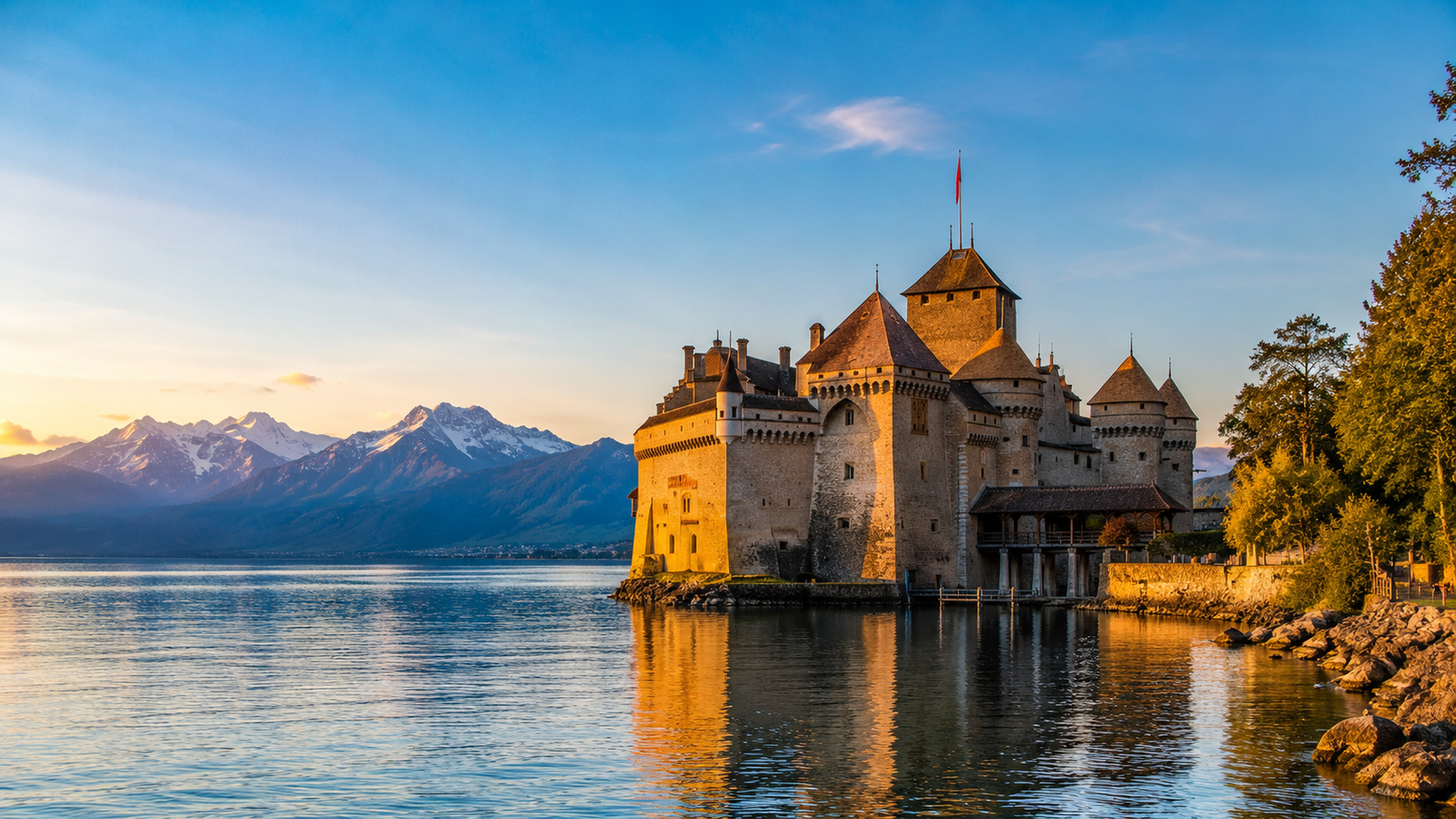
Chillon Castle, Veytaux, Switzerland
Chillon Castle: Exploring Switzerland’s Legendary Fortress on Lake Geneva
Few landmarks in Switzerland combine dramatic scenery, medieval history, literary fame, and architectural significance as successfully as Chillon Castle. Rising from a rocky island along the shores of Lake Geneva, this remarkable fortress occupies one of the most picturesque locations in the country. Surrounded by water, framed by Alpine peaks, and connected to the shoreline by a bridge, the castle appears almost unchanged from another era.
Located near Montreux in the Canton of Vaud, Chillon Castle has guarded an important transportation route between northern and southern Europe for centuries. Today it stands as Switzerland’s most visited historical monument, attracting travelers interested in history, architecture, culture, and some of the finest lakeside scenery in the country.
A Strategic Position on Lake Geneva
The setting of Chillon Castle explains much of its historical importance. The fortress occupies a rocky island between the lake and steep mountains, controlling a narrow corridor that historically connected trade and pilgrimage routes across the Alps.
Archaeological investigations have revealed evidence of human occupation on the site dating back to the Bronze Age. The strategic location made it an ideal place to monitor movement through the region, and over time a fortified complex developed on the island.
The first documented reference to Chillon Castle dates to 1150, when it belonged to the Counts of Savoy. During the Middle Ages, the Savoy dynasty expanded its influence across much of what is now western Switzerland. Chillon became one of its most important strongholds, overseeing traffic along the historic Via Francigena route that linked northern Europe with Rome.
Travelers, merchants, and pilgrims moving through the region would have passed beneath the castle’s watchful presence, making it both a military asset and a source of economic power.
The Castle of the Savoy Counts
The castle experienced major development during the 13th century under Peter II of Savoy. Rather than functioning solely as a defensive fortress, Chillon evolved into an elegant lakeside residence.
The Savoy rulers expanded and modernized the complex, creating impressive halls, residential quarters, storage areas, and fortified defenses. The castle’s architecture reflects both practical military requirements and the prestige expected of a noble residence.
One of Chillon’s most distinctive features is its network of underground vaulted chambers. Supported by stone pillars and Gothic arches, these spaces resemble cathedral architecture more than conventional military construction. Originally used for storage and supplies, parts of the underground area later served as prison cells.
Many of the castle’s surviving structures date from this medieval period, providing visitors with an unusually complete picture of aristocratic life during the High Middle Ages.
Bernese Rule and Political Change
A major turning point came in 1536 when Bernese forces captured the castle during their conquest of the Pays de Vaud. Following a brief siege, Chillon became an administrative center for Bernese authorities.
For more than two centuries, the fortress continued to serve multiple functions. It acted as a government center, arsenal, prison, and military installation. Defensive features were adapted to accommodate changing warfare technologies, including firearms.
Although the castle remained important, its role gradually shifted. Administrative officials eventually preferred more comfortable residences elsewhere, and parts of the complex were used primarily for storage.
Even so, the Bernese period left a lasting mark on the castle’s appearance and history, adding another chapter to the evolution of the monument.
From Fortress to National Heritage Site
The modern story of Chillon Castle began in 1798 during the Vaudois Revolution. Control of the castle passed peacefully from Bernese authorities to local patriots, and it became property of the newly established Canton of Vaud.
For a time, the castle continued to function as a prison and state facility. Yet during the 18th and 19th centuries, changing attitudes toward history and heritage transformed public perceptions of medieval monuments.
Writers, artists, and intellectuals became fascinated by Chillon’s romantic setting. The castle emerged as one of Europe’s most celebrated historical landmarks, inspiring generations of visitors and helping preserve the structure for future generations.
Extensive restoration efforts began in the late 19th century under the leadership of archaeologist and architect Albert Naef. These conservation projects helped protect the castle while improving scholarly understanding of its development.
Lord Byron and International Fame
No discussion of Chillon Castle is complete without mentioning its connection to literature.
In 1816, British poet Lord Byron visited the castle and learned the story of François Bonivard, a Genevan patriot who had been imprisoned there for opposing Savoy authority. Inspired by the tale, Byron wrote The Prisoner of Chillon, one of his most famous works.
The poem introduced the castle to an international audience and transformed Bonivard into a symbol of political freedom and resistance. Visitors still seek out the prison chamber traditionally associated with his captivity.
Chillon also attracted numerous other influential figures. Jean-Jacques Rousseau referenced the site in his novel Julie, or the New Heloise, while artists such as J.M.W. Turner, Gustave Courbet, Victor Hugo, Leo Tolstoy, and Salvador Dalí found inspiration in the castle and its spectacular surroundings.
This extraordinary cultural legacy distinguishes Chillon from many other European castles. It is not simply a historical monument but also a place deeply embedded in artistic and literary history.
Highlights Inside the Castle
Visitors exploring Chillon encounter a complex of interconnected buildings, courtyards, halls, towers, and underground chambers.
Among the most memorable areas are the medieval underground vaults. Their Gothic architecture creates a striking atmosphere, and the spaces reveal how the castle functioned as both fortress and prison.
The courtyards offer insight into daily life within the castle walls. Different sections were reserved for military operations, administrative functions, and noble residences. Together they illustrate the social hierarchy of medieval society.
The great halls overlooking Lake Geneva are equally impressive. These rooms once hosted banquets, official ceremonies, and judicial proceedings. Large windows frame views of the lake and mountains, reminding visitors why the Savoy rulers valued the location so highly.
The castle keep remains another highlight. Rising above the surrounding structures, it provides panoramic views across the fortress, the shoreline, and the Alps beyond.
Throughout the complex, visitors encounter murals, architectural details, archaeological artifacts, and exhibitions that bring centuries of history to life.
The Setting That Makes Chillon Unique
Many castles possess fascinating histories, but few can match Chillon’s scenery.
The fortress appears to float on Lake Geneva, with water surrounding its stone walls. Across the lake, the mountains of the Alps create a dramatic backdrop that changes with the seasons. In summer, sailboats glide across the water. During winter, snow-covered peaks reflect in the lake’s calm surface.
The lakeside promenade linking Montreux and Villeneuve offers one of the most beautiful approaches to any historical monument in Switzerland. Walking along the shoreline toward the castle allows visitors to appreciate how perfectly the structure integrates with the surrounding landscape.
This harmony between architecture and nature explains why artists and photographers continue to be drawn to the site.
Planning a Visit
Chillon Castle is located between Montreux and Villeneuve on the northeastern shore of Lake Geneva. The castle is easily accessible by train, bus, bicycle, car, or on foot via the lakeside path.
Many travelers combine a castle visit with time in Montreux, one of Switzerland’s best-known resort towns. The surrounding region also offers vineyards, lake cruises, mountain excursions, and cultural attractions that make it easy to build a full-day itinerary.
A self-guided visit typically allows enough time to explore the castle’s rooms, courtyards, towers, exhibitions, and panoramic viewpoints at a comfortable pace.
Whether viewed from a passing boat, approached along the shoreline, or explored room by room, Chillon Castle remains one of Switzerland’s most compelling historic destinations—a place where medieval history, Alpine scenery, and literary legend meet on the edge of Lake Geneva.