
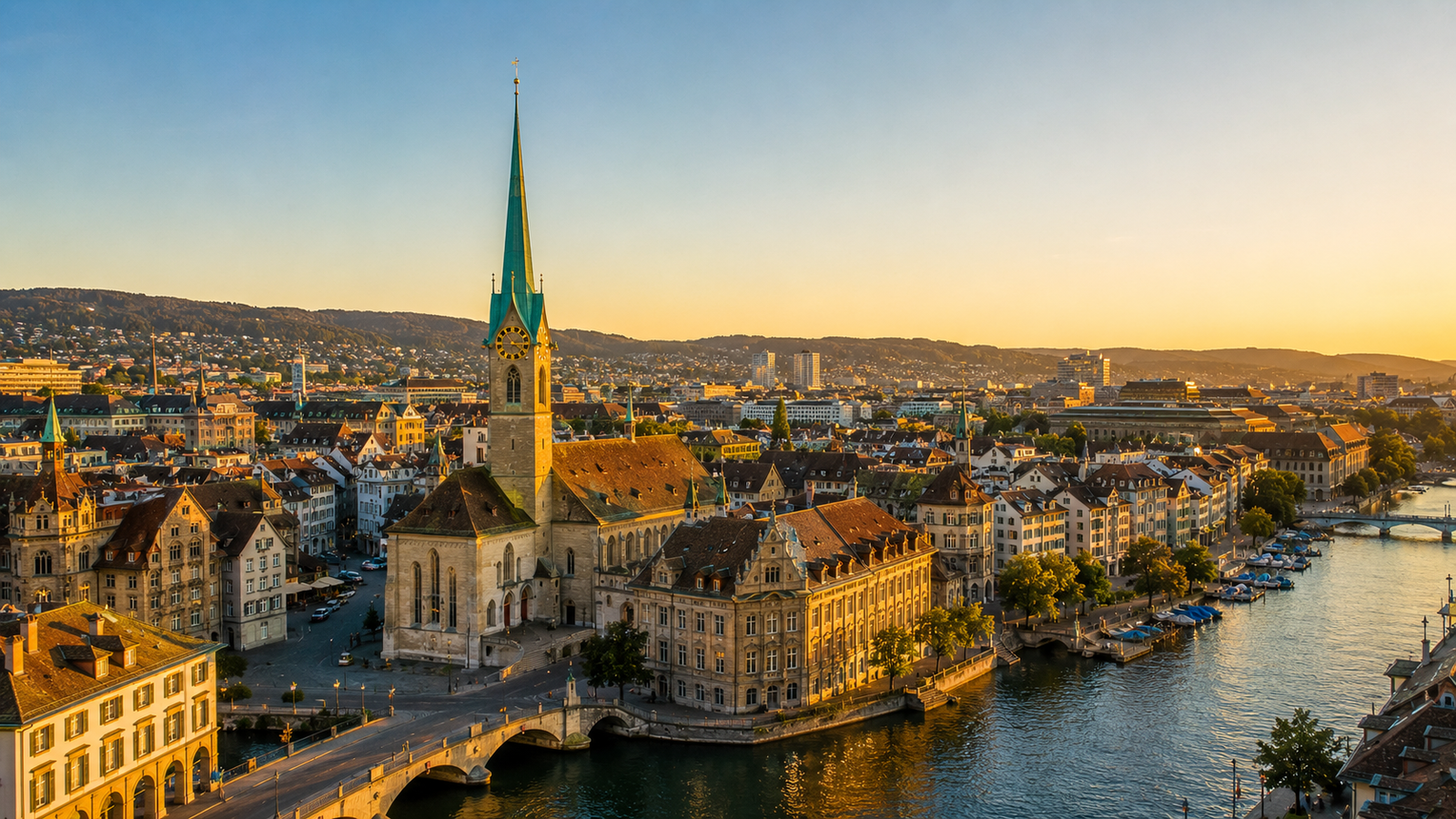
Fraumünster, Zurich, Switzerland
Fraumünster Zurich: Where Medieval History Meets Chagall’s Masterpieces
In a city celebrated for financial institutions, lakeside scenery, and a remarkably preserved Old Town, one building consistently draws visitors to pause, look upward, and absorb centuries of history. Fraumünster stands along the banks of the Limmat River in central Zurich, its elegant tower rising above the surrounding medieval streets. While the church is often photographed as one of Zurich’s iconic landmarks, its significance extends far beyond architecture.
Fraumünster is a place where the story of Zurich’s political development, religious transformation, and artistic legacy intersects. From its origins as a royal abbey in the ninth century to its role in the Reformation and its internationally renowned stained-glass windows, the church offers a remarkable journey through more than a thousand years of Swiss history.
A Royal Foundation at the Heart of Zurich
The origins of Fraumünster date back to 853, when King Louis the German founded a Benedictine convent for his daughter Hildegard. The institution quickly became one of the most influential religious establishments in the region.
Unlike many medieval convents, the abbey held substantial political and economic authority. The abbesses enjoyed privileges granted by the Holy Roman Empire, and for centuries the convent exercised considerable influence over Zurich. Historical records show that the abbey possessed rights associated with governance, trade, and coinage, making it a major force in the city’s development.
The church that visitors see today evolved over many centuries. The earliest structure was replaced and expanded as Zurich grew. Romanesque and Gothic architectural elements gradually merged into a building that reflects multiple stages of medieval construction, creating the distinctive character that survives today.
An Architectural Story Written Across Centuries
Fraumünster is not a monument frozen in a single era. Instead, it serves as an architectural timeline.
The Romanesque choir remains one of the church’s most important historic features. Later Gothic additions introduced soaring proportions and elegant vaulting that transformed the interior space. Restoration projects over subsequent centuries preserved the structure while adapting it to changing religious and civic needs.
The church’s tower has become a recognizable feature of Zurich’s skyline. Its slender profile and green spire create a visual landmark visible from many points throughout the historic center.
Inside, the contrast between ancient stonework and modern artistic interventions creates a unique atmosphere. Visitors encounter a building that respects its medieval foundations while embracing contemporary expressions of faith and creativity.
The Reformation and a Turning Point for Zurich
Few places in Zurich are as closely connected to the city’s religious transformation as Fraumünster.
During the early sixteenth century, Zurich became a center of the Protestant Reformation under the leadership of Huldrych Zwingli. In 1524, Katharina von Zimmern, the last abbess of Fraumünster, transferred the convent and its assets to the Zurich city authorities. Her decision helped facilitate a peaceful transition during a period of significant religious and political change.
The convent was dissolved, and the church became part of the Reformed tradition that continues today. This transition marked the end of nearly seven centuries of monastic history while opening a new chapter in Zurich’s religious life.
For visitors interested in European history, Fraumünster provides a tangible connection to one of the most influential periods in Switzerland’s past.
The Chagall Windows That Captivate the World
While Fraumünster’s history is impressive, many travelers arrive for a different reason: the breathtaking stained-glass windows created by Marc Chagall.
Installed in 1970, the five monumental windows transformed the church into one of Switzerland’s most celebrated artistic destinations. Created when Chagall was in his eighties, the works display the vibrant colors and spiritual symbolism that defined his career.
Each window explores biblical themes through a distinctive color palette and narrative imagery. Deep blues, luminous greens, radiant reds, and golden yellows flood the choir with shifting light throughout the day.
The windows depict figures and stories from both the Old and New Testaments, blending religious symbolism with Chagall’s unmistakable artistic style. Rather than functioning merely as decorative elements, they create an immersive visual experience that changes with the sunlight.
In 1978, Chagall added a striking rose window in the southern transept. The circular composition presents themes from the Book of Genesis, with Noah’s Ark occupying the center as a symbol of salvation and renewal.
For many visitors, standing quietly beneath these windows becomes the defining memory of a visit to Zurich.
Giacometti’s Contribution
Chagall’s masterpieces are not the only artistic treasures inside Fraumünster.
The church also features an important stained-glass window created by Swiss artist Augusto Giacometti. Installed in the north transept, the work demonstrates a different artistic approach while complementing the vibrant visual environment of the church.
The combination of medieval architecture and twentieth-century stained-glass art gives Fraumünster a distinctive identity among European churches. It is both a historic monument and a living gallery of sacred art.
Exploring the Crypt and Hidden Layers of History
Many visitors focus on the main sanctuary and overlook one of Fraumünster’s most fascinating features: the crypt.
Located beneath the choir, the crypt contains some of the oldest surviving elements of the original abbey complex. Archaeological remains reveal traces of Zurich’s early medieval development and provide insight into the foundations of the convent established more than a millennium ago.
Multimedia exhibits help explain the evolution of the church, the history of the abbey, and the broader story of Zurich. For travelers interested in archaeology and urban history, the crypt offers an additional dimension that enriches the overall experience.
The Setting in Zurich’s Old Town
Part of Fraumünster’s appeal lies in its location.
The church stands beside the historic Münsterhof square in the heart of Zurich’s Old Town. Narrow streets, historic buildings, riverside promenades, and centuries-old public spaces surround the site.
A short walk across Münsterbrücke leads to Grossmünster, creating an opportunity to explore two of Zurich’s most significant churches in a single visit. Nearby cafés, museums, and cultural institutions make the area ideal for a leisurely day of sightseeing.
The church is also easily accessible from Zurich Main Station, allowing visitors to incorporate it into almost any city itinerary.
Seasonal Atmosphere Throughout the Year
Fraumünster offers a different experience in every season.
Spring brings fresh light that enhances the brilliance of the stained glass. Summer fills the surrounding squares with outdoor activity and cultural events. Autumn creates a quieter atmosphere ideal for reflective visits, while winter often lends the church a particularly serene character as holiday decorations appear throughout the Old Town.
Regardless of the season, the interior remains a place of calm amid the energy of Switzerland’s largest city.
For travelers exploring Zurich for the first time, Fraumünster serves as more than a sightseeing stop. It is a place where royal foundations, medieval power, religious reform, archaeological discoveries, and world-famous art converge within a single historic building. Few attractions in Switzerland present such a compelling combination of history, culture, architecture, and artistic achievement, making Fraumünster one of Zurich’s essential experiences.