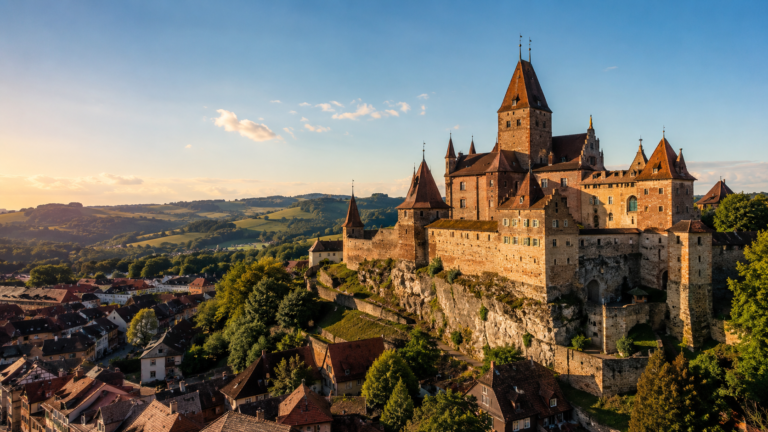

Gruyères Castle, Gruyères, Switzerland
Gruyères Castle: Exploring Eight Centuries of History Above Switzerland’s Most Famous Medieval Village
Long before Gruyère cheese became internationally recognized, a powerful noble family ruled from a hilltop fortress overlooking rolling pastures and Alpine peaks. Today, Gruyères Castle remains one of Switzerland’s most remarkable historic landmarks, rising above the medieval village of Gruyères like a scene preserved from another era.
Perched on a rocky hill in the canton of Fribourg, the castle combines centuries of political history, artistic heritage, and breathtaking scenery. Visitors who climb through the cobbled streets of Gruyères eventually arrive at a monument that has witnessed the transformation of Switzerland from a collection of feudal territories into a modern nation.
More than simply a medieval fortress, Gruyères Castle serves as a historical museum, an architectural treasure, and a gateway to understanding the cultural identity of one of Switzerland’s most celebrated regions.
A Fortress Built for Power and Protection
The origins of Gruyères Castle date to the Middle Ages, when the Counts of Gruyères established their residence on a naturally defensive hilltop position. Construction began during the 13th century, creating a fortified residence that could oversee trade routes and surrounding agricultural lands.
For centuries, the Counts governed the region from this strategic location. The castle functioned not only as a military stronghold but also as an administrative center where political decisions shaped local life.
The influence of the Gruyères dynasty extended across much of the surrounding territory. However, financial difficulties eventually weakened the family’s position, and in the 16th century the county passed into the hands of the authorities of Fribourg and Bern.
This transition marked the beginning of a new chapter in the castle’s history. Rather than being abandoned, the fortress continued serving as an administrative residence and regional center, allowing it to remain an active part of local life for generations.
First Impressions: Arrival Above the Village
One of the most memorable aspects of visiting Gruyères Castle is the approach itself.
The medieval village below remains largely preserved, with stone-paved streets, traditional buildings, and panoramic mountain views creating an atmosphere that feels remarkably authentic. As visitors walk uphill toward the castle, the fortress gradually dominates the skyline.
Crossing the entrance evokes a sense of entering another century. Thick stone walls, towers, courtyards, and historic gateways reveal the defensive purpose of the structure while also hinting at the noble lifestyle once enjoyed within its walls.
The castle’s elevated position provides commanding views across the Fribourg countryside. Green meadows, forested hills, and distant Alpine peaks form a landscape that has changed surprisingly little since medieval times.
Architecture That Reflects Centuries of Change
Unlike castles that remain frozen in a single historical period, Gruyères Castle tells a story of continuous evolution.
While its medieval foundations remain clearly visible, successive generations adapted and expanded the structure according to changing needs and artistic tastes. Defensive features coexist with elegant residential spaces, illustrating the transition from fortress to noble residence.
The castle’s layout centers around a picturesque courtyard surrounded by historic buildings. Towers, ramparts, and stone facades preserve the character of the medieval era, while interior rooms reveal influences from later centuries.
Large windows, decorative halls, and refined living quarters demonstrate how comfort gradually became as important as defense. These architectural layers make the castle particularly valuable for understanding how European noble residences evolved over time.
Visitors effectively walk through multiple centuries of architectural history within a single site.
Inside the Castle Museum
Today, Gruyères Castle operates as a museum that showcases both regional history and artistic heritage.
The interior contains furnished rooms, historical artifacts, decorative objects, paintings, and exhibits that illustrate life within the castle across different periods. Rather than presenting a single historical narrative, the museum explores the many identities the castle has held throughout its existence.
Among the highlights are the grand halls, historic chambers, and collections connected to the former Counts of Gruyères. Visitors gain insight into medieval governance, noble lifestyles, and the social structures that shaped the region.
The castle also reflects an important period during the 19th century when artists and intellectuals became fascinated with romantic interpretations of the Middle Ages. During this era, decorative enhancements and artistic additions contributed to the castle’s distinctive character.
This blend of authentic medieval history and later artistic vision gives Gruyères Castle a personality that differs from many other historic fortresses in Switzerland.
Gardens with a View
While the interiors attract significant attention, many visitors find themselves equally captivated by the castle gardens.
Positioned along the fortress walls, these landscaped areas offer some of the finest viewpoints in the region. Carefully maintained flower beds and pathways frame sweeping vistas across the surrounding countryside.
From the terraces, visitors can admire the rolling landscapes of western Switzerland and, on clear days, enjoy views extending toward the Alpine skyline.
The contrast between cultivated gardens and dramatic natural scenery creates an atmosphere that encourages visitors to linger. It is easy to understand why generations of residents, officials, and artists found inspiration in this location.
The Castle and the Identity of Gruyères
Few Swiss destinations are as closely connected to a single historic monument as Gruyères.
The castle remains inseparable from the identity of the village below. Together they create one of Switzerland’s most recognizable cultural landscapes.
Visitors often arrive initially because of the region’s world-famous cheese traditions, but many discover that the historical significance of Gruyères is equally compelling. The castle provides context for understanding how local communities developed, how trade flourished, and how regional culture evolved over centuries.
Its presence continues to shape tourism, education, and cultural preservation efforts throughout the region.
The relationship between village, countryside, and fortress remains remarkably intact, offering a rare glimpse into the historical geography of medieval Switzerland.
Seasonal Experiences at the Castle
Every season presents a different perspective on Gruyères Castle.
During spring, gardens and surrounding meadows begin to bloom, adding vibrant color to the medieval setting.
Summer brings long days and clear views of the surrounding mountains, making it one of the most popular periods for exploring both the castle and village.
Autumn introduces warm tones across the countryside, creating a particularly photogenic backdrop for the historic architecture.
Winter transforms the hilltop fortress into an almost storybook scene, especially when snow blankets the rooftops and surrounding landscape.
Unlike attractions that depend heavily on a particular season, Gruyères Castle remains visually striking throughout the year.
Exploring Beyond the Fortress
A visit to Gruyères Castle naturally extends into the wider cultural landscape surrounding it.
The village itself ranks among Switzerland’s most picturesque historic settlements, inviting exploration beyond the castle walls. Nearby museums, local restaurants, cheese-related attractions, and scenic walking routes allow visitors to experience multiple dimensions of regional culture.
The broader Fribourg region combines French-speaking traditions, agricultural heritage, and mountain scenery in a way that feels distinct from many other parts of Switzerland.
For travelers seeking a destination that combines history, architecture, culture, and landscape within a compact setting, Gruyères Castle offers an experience that reaches far beyond its stone walls. Standing atop its terraces and looking across centuries-old scenery, visitors encounter not simply a preserved monument but a living symbol of Switzerland’s enduring connection to its medieval past.