Partial Lunar Eclipse to Grace Swiss Skies Before Sunrise This Week
A striking celestial event is set to unfold over Switzerland later this week as a partial lunar eclipse becomes visible in the early hours of Friday morning, offering skywatchers a rare opportunity to witness much of the Moon pass through Earth’s shadow.
The eclipse comes just weeks after a widely observed solar eclipse across parts of Europe, continuing an unusually active period for astronomy enthusiasts. Weather permitting, observers across Switzerland will be able to watch the event develop before dawn, with the most dramatic moments occurring shortly before the Moon disappears below the western horizon.
According to astronomical forecasts, the eclipse will begin during the pre-dawn hours and reach its peak shortly after 6 a.m. local time. In Bern, the event is expected to begin around 4:33 a.m., with maximum eclipse occurring at approximately 6:12 a.m. The Moon will set less than an hour later, limiting visibility of the eclipse’s final stages for Swiss observers.
During a lunar eclipse, Earth moves directly between the Sun and the Moon, causing Earth’s shadow to fall across the lunar surface. Unlike a solar eclipse, which is visible only from a narrow path on Earth, a lunar eclipse can be seen from anywhere on the night side of the planet where the Moon is above the horizon.
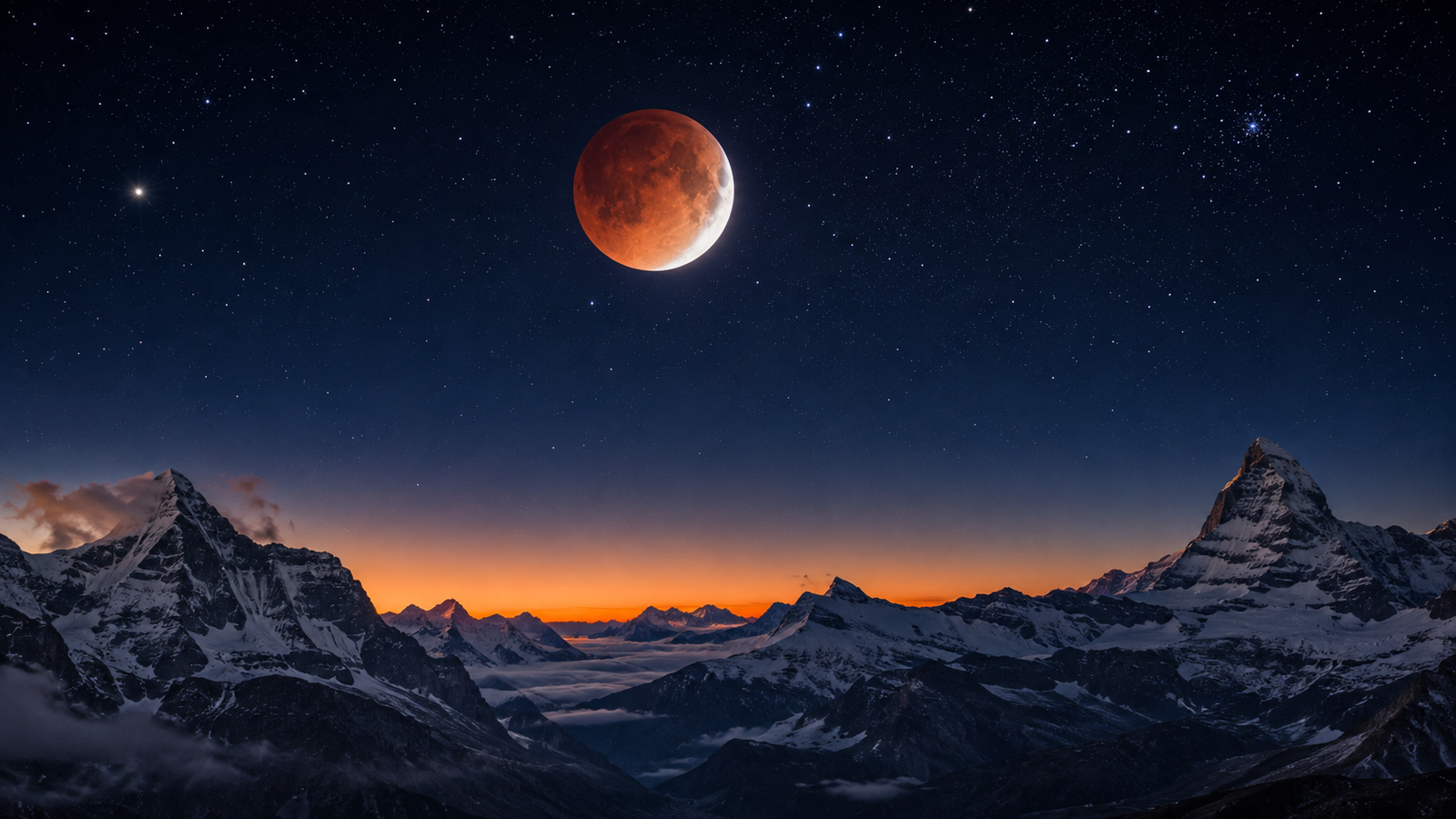
This week’s event is classified as a partial lunar eclipse, but astronomers note that it will be unusually deep. More than 90% of the Moon is expected to enter Earth’s dark central shadow, known as the umbra. Because such a large portion of the lunar surface will be obscured, the Moon may appear dramatically darker than normal and could take on reddish, copper, or rust-colored tones.
The reddish appearance often associated with lunar eclipses occurs because sunlight passing through Earth’s atmosphere is filtered and bent toward the Moon. Shorter blue wavelengths are scattered, while red and orange light continues through the atmosphere and illuminates the eclipsed lunar surface. The same atmospheric effect is responsible for the vivid colors often seen during sunrise and sunset.
For viewers in Switzerland, location will play an important role in determining how much of the eclipse is visible. Astronomers recommend finding a site with a clear, unobstructed view toward the west-southwest horizon. Buildings, hills, mountains, and trees could block the Moon during the most visually impressive phase because it will be sitting very low in the sky as dawn approaches.
The timing presents both challenges and opportunities for photographers. Because the Moon will be near the horizon, photographers may be able to capture dramatic compositions featuring landscapes, mountains, lakes, or city skylines beneath the eclipsed Moon. Experts recommend using a tripod and planning shooting locations in advance to maximize the chances of obtaining clear images.
Astronomers have highlighted the significance of this eclipse because it is among the deepest partial lunar eclipses of the decade. Although it falls just short of becoming a total lunar eclipse, the visual effect may closely resemble one because nearly the entire lunar disk will be immersed in Earth’s shadow. Some observers may informally describe the event as a “Blood Moon” due to the anticipated reddish coloration, though technically it remains a partial eclipse.
The event also follows another major astronomical spectacle visible from Switzerland earlier this month. On August 12, Swiss residents observed a rare partial solar eclipse in which the Moon covered a large portion of the Sun. The proximity of the solar and lunar eclipses is not unusual from an astronomical perspective, as eclipses often occur in seasonal clusters when the Sun, Earth, and Moon align favorably.
Unlike solar eclipses, lunar eclipses require no special protective equipment. Astronomers emphasize that they are completely safe to view with the naked eye. Binoculars or telescopes can enhance the experience by revealing additional details and color variations across the lunar surface, but they are not necessary for enjoying the spectacle.
The eclipse will be visible across large portions of Europe, Africa, North America, and South America, though viewing conditions and timing will vary by region. In Switzerland, the combination of an eclipsed Moon and the first light of dawn could create particularly striking scenery for those willing to rise early.
Whether viewed from an Alpine viewpoint, a city rooftop, or a countryside field, Friday morning’s eclipse offers a reminder of the predictable yet awe-inspiring movements of the solar system. For Swiss skywatchers, it may be one of the most memorable astronomical displays visible from the country this year.