
Bachalpsee, Grindelwald, Switzerland
Bachalpsee: The Alpine Mirror Lake Above Grindelwald
Some of Switzerland’s most famous landscapes require long mountain expeditions or remote alpine journeys. Bachalpsee is different. Despite sitting high above Grindelwald in the Bernese Oberland, this celebrated mountain lake can be reached through a relatively accessible hike, making one of the Alps’ most iconic views available to a wide range of visitors.
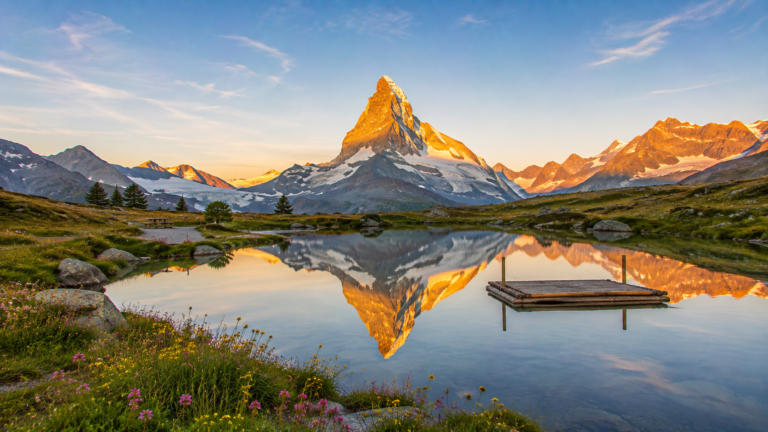
Photographs of Bachalpsee often appear almost unreal. On calm days, the lake reflects the surrounding mountains with remarkable clarity, creating mirror-like images of rugged peaks, blue skies, and alpine meadows. Yet the appeal of Bachalpsee extends far beyond photography. The lake represents a classic Swiss mountain experience where hiking, scenery, geology, and alpine tranquility come together in a landscape shaped by glaciers and time.
Located in the heart of the Jungfrau Region, Bachalpsee has become one of the most recognizable alpine lakes in Switzerland and one of the most rewarding destinations for visitors seeking accessible mountain scenery.
A Lake Above the Tree Line
Bachalpsee sits at an elevation of approximately 2,265 meters above sea level on the slopes above Grindelwald. Positioned in an open alpine basin, the lake is surrounded by grassy mountain terrain rather than dense forests, giving visitors unobstructed views across the Bernese Alps.
The lake is actually composed of two connected bodies of water. During periods of higher water levels, the separation between them becomes less noticeable, while lower water conditions reveal the distinct nature of the twin lakes.
Its elevated location contributes significantly to its visual appeal. Without nearby trees blocking the horizon, the surrounding mountains dominate the landscape, creating a panoramic setting that feels expansive and remarkably open.
The lake is fed primarily by snowmelt and alpine runoff, and its appearance changes subtly throughout the year as seasonal conditions influence water levels and surrounding vegetation.
Why Bachalpsee Became a Photography Icon
Among Switzerland’s countless alpine lakes, Bachalpsee occupies a special place in landscape photography.
The lake’s reputation comes largely from its reflections. When weather conditions are calm, the water can mirror major peaks of the Bernese Alps, including views toward the Schreckhorn massif and surrounding mountain ranges.
Unlike many reflective lakes located deep within narrow valleys, Bachalpsee’s open setting allows for broad compositions that capture sky, mountains, and water in a single frame. The result is a landscape that has appeared in travel publications, tourism campaigns, and photography collections for decades.
Sunrise and early morning are particularly valued by photographers because wind conditions are often calmer, increasing the likelihood of near-perfect reflections. The changing light throughout the day also transforms the character of the lake, shifting from cool alpine tones to warm golden hues during evening hours.
Yet even visitors without cameras quickly understand why the lake has earned international recognition. The reflections create a visual symmetry that is striking in person and memorable long after the visit ends.
The Journey Is Part of the Experience
Unlike remote mountain lakes requiring extensive hiking, Bachalpsee is often reached from the First mountain area above Grindelwald.
Visitors typically travel by gondola from Grindelwald to First, where a well-established hiking trail leads toward the lake. The route is considered one of the most popular walks in the Jungfrau Region because it combines accessibility with exceptional scenery.
The path crosses open alpine terrain with continuous views of surrounding peaks, glaciers, and valleys. Along the way, hikers encounter grazing cattle, wildflowers during summer, and expansive mountain panoramas that make the walk rewarding even before reaching the lake itself.
The route generally appeals to a broad range of visitors, including families, casual hikers, and experienced mountain enthusiasts seeking a scenic excursion rather than a strenuous alpine climb.
By the time Bachalpsee appears ahead, the approach has already become an integral part of the experience.
A Front-Row View of the Bernese Alps
One of Bachalpsee’s greatest strengths is its location within one of Switzerland’s most celebrated mountain landscapes.
The Bernese Alps contain some of the country’s most famous peaks, glaciers, and alpine environments. From the lake, visitors gain an exceptional perspective on this dramatic terrain.
The surrounding skyline includes rugged ridges, glacier-shaped valleys, and prominent mountain summits that define the Jungfrau Region. Because the lake sits within an elevated alpine basin, these features appear especially prominent against the open sky.
The visual relationship between water and mountains is central to the destination’s appeal. The lake does not merely exist within the landscape—it actively reflects and amplifies it.
For many visitors, Bachalpsee offers one of the clearest examples of how Switzerland’s mountain scenery has become internationally associated with the country itself.
Seasonal Transformations
Although Bachalpsee is most frequently visited during summer and early autumn, the lake undergoes dramatic seasonal changes.
In late spring, melting snow gradually reveals the surrounding terrain. Alpine flowers begin appearing across mountain meadows, introducing vibrant colors to the landscape.
Summer brings the most accessible hiking conditions and the greatest diversity of visitors. Green pastures, clear water, and long daylight hours create ideal circumstances for exploration and photography.
Autumn often delivers some of the year’s clearest visibility. Cooler temperatures, reduced haze, and changing alpine vegetation contribute to particularly striking scenery.
During winter, snow covers much of the area surrounding the lake. Access conditions change significantly, and the landscape takes on an entirely different character shaped by ice, snow, and winter light.
Each season presents a distinct interpretation of the same alpine setting.
Beyond the Lake
Many visitors arrive at Bachalpsee expecting a short stop before returning to Grindelwald. Instead, the lake frequently becomes the starting point for further exploration.
The surrounding First area contains an extensive network of hiking routes connecting alpine ridges, mountain viewpoints, and additional scenic destinations. Longer trails continue deeper into the mountain environment, offering opportunities to experience the Bernese Alps beyond the most popular viewpoints.
Adventure attractions in the First region also attract visitors seeking more active experiences, creating an appealing combination of outdoor recreation and natural scenery.
Because of its location within the Jungfrau Region, Bachalpsee can easily be combined with visits to other iconic Swiss destinations, making it a valuable component of broader travel itineraries.
The Quiet Moments That Define the Experience
Despite its popularity, Bachalpsee retains an atmosphere that encourages visitors to slow down.
Many travelers find that the most memorable moments occur not during the hike itself but after arriving at the shoreline. Sitting beside the water, watching clouds move across reflected mountain peaks, or observing subtle changes in light often becomes the highlight of the visit.
The lake’s appeal lies partly in its simplicity. There are no historic monuments, elaborate attractions, or complex narratives to interpret. Instead, Bachalpsee showcases the natural relationship between water, mountains, sky, and weather.
In a country famous for dramatic alpine scenery, the lake demonstrates that some of Switzerland’s most enduring landscapes are not defined by scale alone, but by balance. The reflections, the silence, the open views, and the surrounding peaks combine to create an experience that feels both distinctly Swiss and timeless. For many visitors to the Bernese Oberland, Bachalpsee becomes not just another scenic stop, but one of the most memorable mountain landscapes they encounter in the Alps.