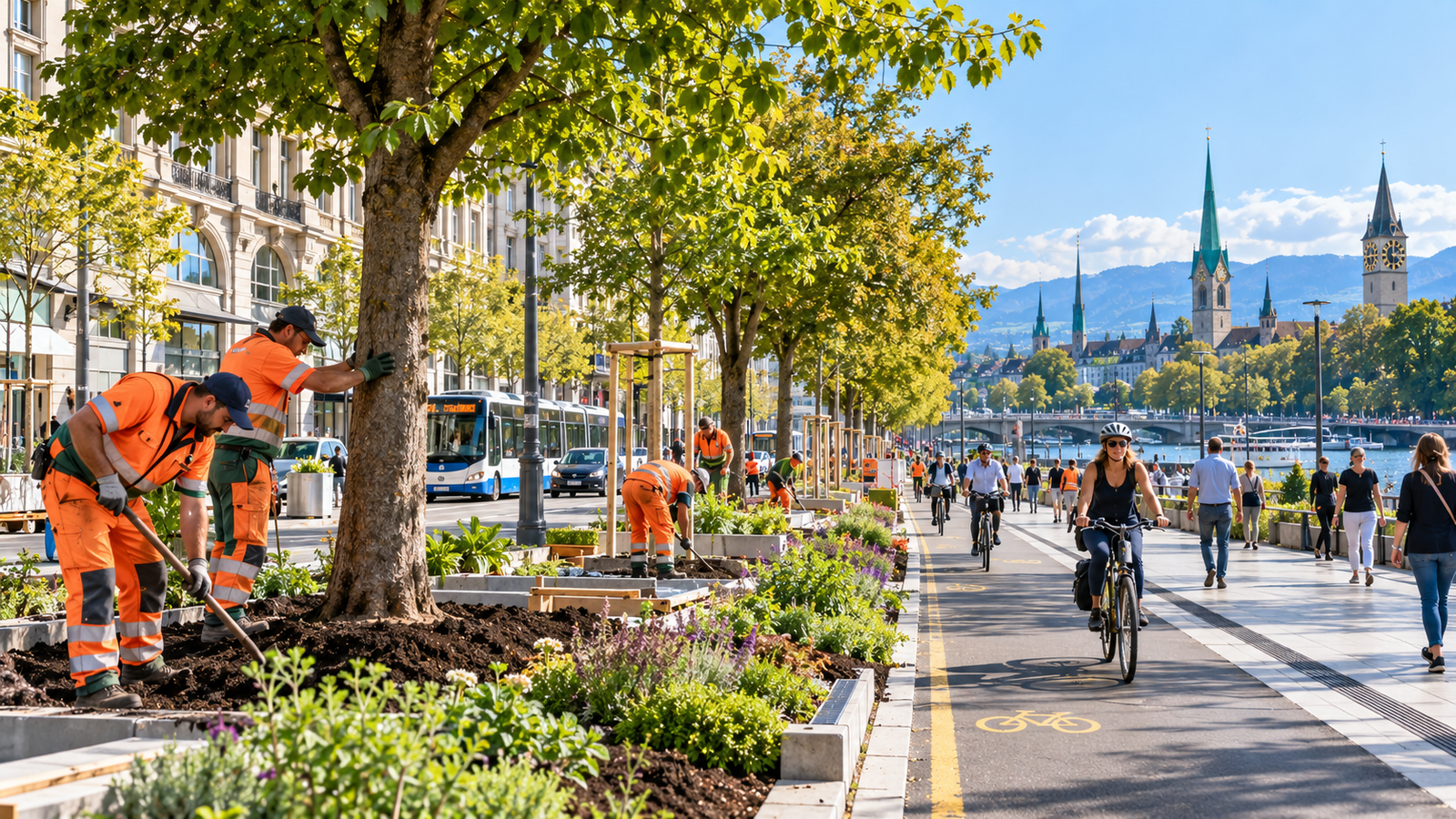
Zurich Accelerates Urban Greening Plan as Tree-Planting Goals Gain Momentum
ZURICH — City officials in Zurich say a large-scale effort to make Switzerland’s biggest city greener and more resilient to rising temperatures is moving ahead faster than expected, with significant progress already recorded during the first year of implementation. The initiative combines expanded tree planting, new green spaces, and transportation changes designed to reduce the dominance of asphalt and improve quality of life in urban neighborhoods.
The program stems from climate and mobility measures approved by Zurich voters in 2024. Under the long-term plan, city authorities are working toward transforming extensive areas of public space by 2035, replacing portions of paved surfaces with vegetation while reallocating road space to walking, cycling, and public transportation.
According to the city’s first annual implementation report, approximately one-third of the greening target has already been achieved. Progress toward transportation-related goals has been more modest but remains on track, with officials reporting that a portion of the planned expansion of environmentally friendly transport infrastructure has already been completed.
The early results have been helped by several major projects that have added vegetation and public green areas to the urban landscape. City officials highlighted completed and ongoing developments that contribute to reducing heat accumulation while creating more pleasant public spaces for residents.
The initiative arrives as Swiss cities face growing pressure to adapt to warmer conditions. Recent climate reporting has documented record heat and drought conditions across Switzerland, raising concerns about public health, infrastructure resilience, and the increasing intensity of urban heat islands. These heat islands occur when concrete, asphalt, and densely built environments absorb and retain heat, causing cities to remain significantly warmer than surrounding areas.
Urban planners increasingly view trees as one of the most effective tools for reducing local temperatures. Tree canopies provide shade, lower surface temperatures, improve air quality, and help cool neighborhoods through evaporation. Research and planning documents referenced by Zurich authorities emphasize that expanding urban tree cover is becoming a critical part of long-term climate adaptation strategies.
Beyond the current initiative, Zurich recently adopted a broader street-tree strategy intended to reshape the city’s public spaces over the coming decades. The plan seeks to significantly increase tree canopy coverage along public streets and establish clearer guidelines for planting and preserving urban trees. Officials say the strategy is designed not only to combat heat but also to strengthen biodiversity and improve the overall urban environment.
City authorities have identified several districts where additional greenery is especially needed. Areas with limited tree cover and higher exposure to summer heat are expected to receive particular attention as future projects move forward. The objective is to distribute the benefits of urban greening more evenly across the city rather than concentrating them in neighborhoods that already have substantial vegetation.
Transportation changes are also central to the initiative. The city plans to gradually dedicate more space to pedestrians, cyclists, and public transit while reducing the amount of land devoted exclusively to motor vehicle traffic. Officials argue that combining mobility improvements with environmental upgrades can help create streets that are both more sustainable and more comfortable during periods of extreme heat.
Several future projects remain in planning or approval stages. Proposed redevelopments would introduce dozens of additional trees, expand landscaped areas, and redesign road layouts. Some initiatives still require regulatory approvals or face long implementation timelines, meaning the full transformation will unfold over many years.
The broader discussion extends beyond Zurich. Across Europe, municipalities are examining how urban design can help communities adapt to increasingly frequent heatwaves. Swiss researchers and climate specialists have repeatedly warned that rising temperatures will require cities to rethink traditional approaches to land use, public space design, and environmental management.
Public concern about extreme summer heat has become increasingly visible. Discussions among residents, including online community forums, have reflected growing awareness of the effects of prolonged heat and drought on urban environments, vegetation, and daily life. While such comments do not constitute scientific evidence, they illustrate how climate-related challenges are becoming more noticeable to the public.
For Zurich, the success of the initiative will ultimately be measured not only by the number of trees planted or square meters transformed, but by whether the city can create a more resilient urban environment capable of withstanding future climate pressures. Early figures suggest progress is underway, but city leaders acknowledge that many of the largest projects remain ahead and that sustained investment will be necessary to meet long-term targets.
As Swiss cities continue adapting to a warming climate, Zurich’s experience is likely to be closely watched as an example of how local governments can combine environmental planning, transportation policy, and public space redesign in pursuit of a cooler and more sustainable urban future.