Swiss President Urges Global Cooperation as UN Confronts Growing International Crises
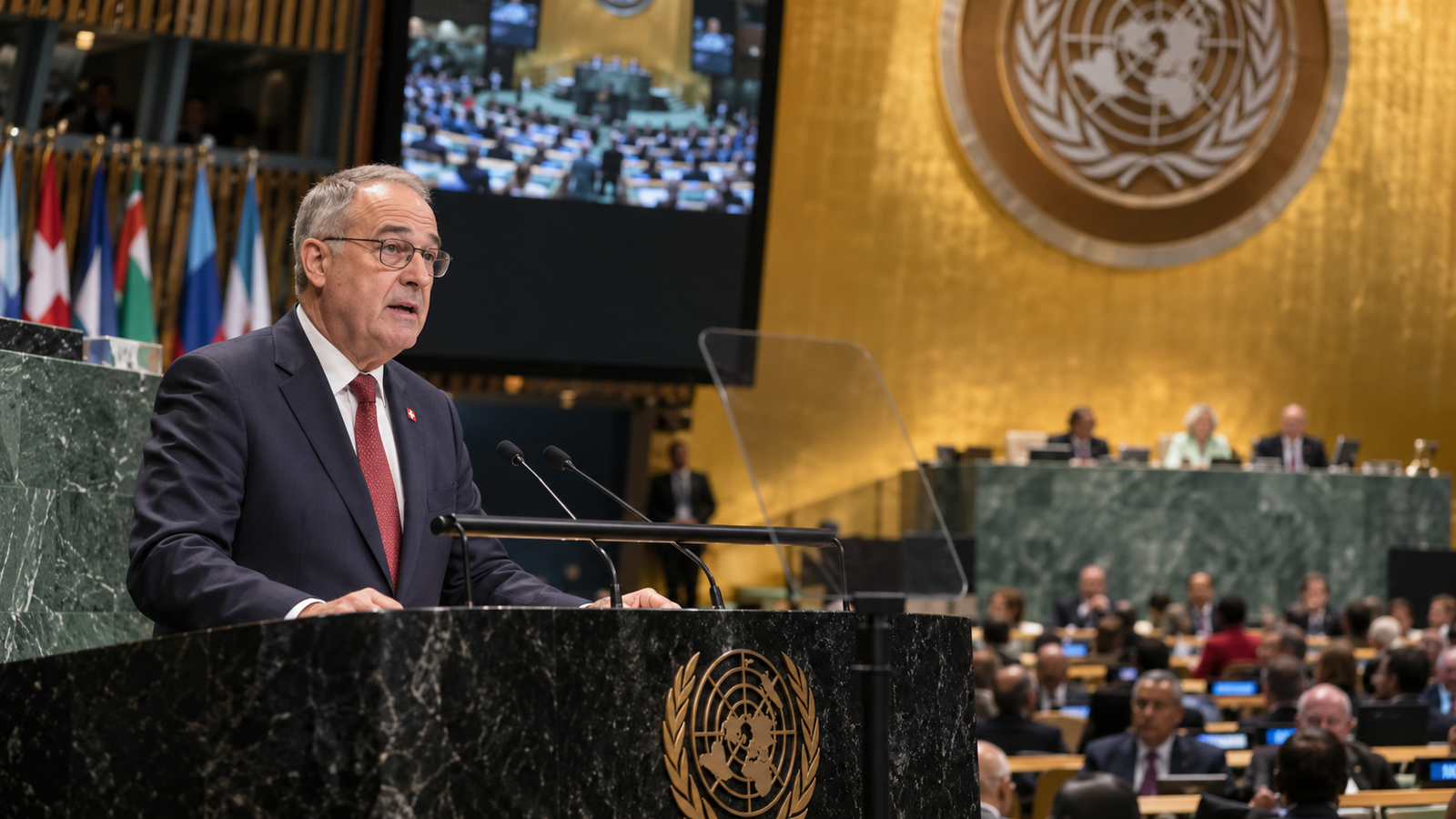
UNITED NATIONS, New York — Swiss President Guy Parmelin used his address to the United Nations General Assembly to deliver a message centered on international cooperation, warning that global challenges cannot be solved through isolation or rivalry alone. Speaking before world leaders gathered in New York, Parmelin called on countries to demonstrate that dialogue and collaboration remain viable tools in an increasingly divided world.
His remarks came during a week dominated by discussions about armed conflicts, geopolitical tensions, economic uncertainty, climate-related risks, and the rapid development of artificial intelligence. The annual gathering of world leaders has unfolded against a backdrop of growing concern about the effectiveness of international institutions and the ability of nations to work together on issues that cross borders.
Parmelin emphasized Switzerland’s longstanding commitment to diplomacy, consensus-building, and multilateral engagement. The Swiss leader argued that international cooperation remains essential for addressing complex global challenges that no single nation can resolve independently. According to Swiss reports from the General Assembly, he encouraged countries to prove that cooperation remains possible even during periods of heightened political disagreement.
The speech arrived at a particularly challenging moment for global diplomacy. Multiple conflicts continue to dominate international discussions, including the war in Ukraine and instability across the Middle East. At the same time, governments are grappling with economic pressures, security concerns, migration issues, and debates over emerging technologies. These overlapping challenges have increased pressure on international organizations to deliver meaningful solutions.
United Nations Secretary-General António Guterres delivered a similar message during the opening of the General Assembly, stressing the need for a world built on interdependence rather than fragmentation. Guterres warned that widening divisions among nations could undermine efforts to address urgent global problems and urged leaders to strengthen international cooperation.
For Switzerland, the appeal for dialogue aligns closely with its foreign policy traditions. The country has long positioned itself as a neutral actor that supports mediation, humanitarian assistance, and diplomatic engagement. Geneva hosts numerous international organizations and diplomatic forums, giving Switzerland a prominent role in facilitating discussions on global governance, human rights, public health, and peacebuilding.
Although Switzerland is not among the world’s largest powers, it frequently promotes solutions based on negotiation and international law. Swiss officials have often argued that stable institutions and constructive dialogue are essential for managing disputes before they escalate into broader crises.
The timing of Parmelin’s remarks is notable because questions about the future role of multilateral institutions have become increasingly common. Several world leaders attending the General Assembly have expressed concerns about whether existing international structures are equipped to address modern challenges. Discussions this year have included proposals for institutional reform, efforts to improve global coordination, and debates over how international organizations should respond to rapidly changing geopolitical realities.
The General Assembly has also become a platform for competing visions of international relations. While some leaders have emphasized national sovereignty and self-reliance, others have argued that global problems require collective action. Parmelin’s intervention placed Switzerland firmly in the latter camp, highlighting the value of cooperation even when countries disagree on specific issues.
Artificial intelligence emerged as another major topic during this year’s gathering. Policymakers are increasingly debating how governments should regulate advanced technologies while preserving innovation and economic growth. Concerns about cybersecurity, misinformation, and the societal impact of AI have added another layer of complexity to international discussions.
Climate change, humanitarian emergencies, and economic instability were also prominent themes throughout the week. Officials warned that environmental pressures, resource shortages, and extreme weather events continue to affect communities around the world. Many delegates argued that stronger international coordination will be necessary to mitigate future risks and support vulnerable populations.
As the United Nations approaches a period of leadership transition and institutional reflection, the debate over the future of multilateral cooperation is expected to intensify. Secretary-General Guterres is nearing the end of his term, while member states continue discussions about how the organization should adapt to evolving global challenges.
Against that backdrop, Switzerland’s message focused less on specific policy proposals and more on the broader principle of international engagement. Parmelin’s appeal suggested that despite growing divisions, diplomacy remains a critical tool for managing disputes and addressing shared challenges.
Whether world powers can translate calls for cooperation into concrete action remains uncertain. However, the Swiss president’s speech reflected a belief that dialogue, compromise, and international partnership remain essential foundations of global stability. As leaders continue their meetings in New York, the effectiveness of those principles will be tested by the many crises confronting the international community.