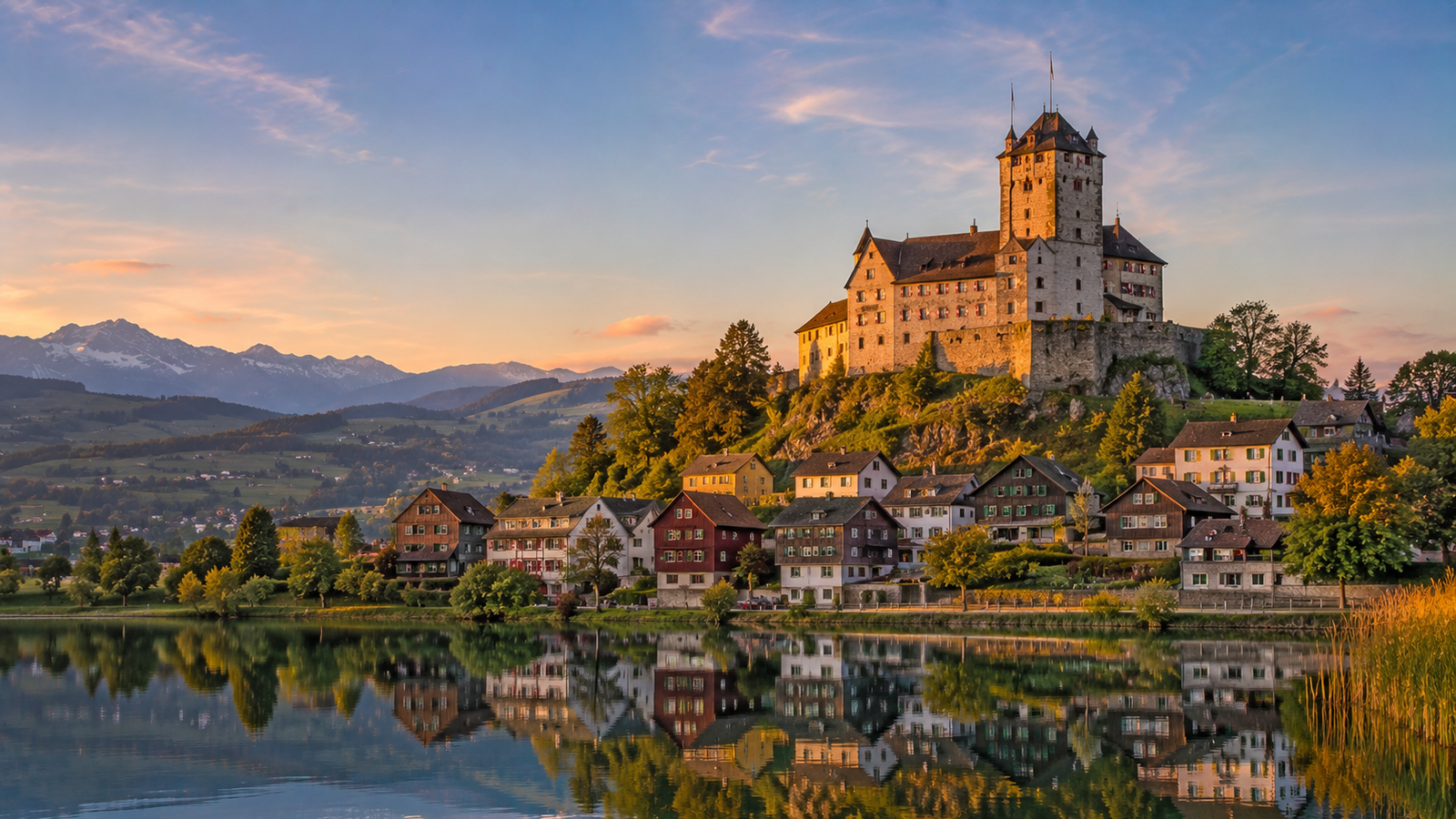
Werdenberg Castle, Werdenberg, Switzerland
Werdenberg Castle: Exploring One of Switzerland’s Best-Preserved Medieval Strongholds
Approaching Werdenberg Castle for the first time feels like stepping into a medieval painting. Above a small lake and a cluster of centuries-old wooden houses, the castle rises from a hillside overlooking the Rhine Valley, much as it has for more than seven hundred years.
Unlike many historic fortresses that stand isolated from their original surroundings, Werdenberg Castle remains closely connected to the settlement that grew beneath its walls. Together, the castle and the tiny medieval town of Werdenberg form one of Switzerland’s most authentic historical landscapes. Visitors do not simply tour a monument here—they enter a remarkably preserved environment where architecture, history, and scenery continue to coexist much as they have for generations.
In a country celebrated for alpine panoramas and lakeside destinations, Werdenberg Castle offers a different kind of journey: a chance to experience the atmosphere of medieval Switzerland in one of its most intact settings.
A Castle Born in the Age of Noble Dynasties
The origins of Werdenberg Castle date to the 13th century, when the Counts of Werdenberg established a fortified residence above an important route through the Rhine Valley.
Its elevated position provided strategic advantages. From the castle, rulers could oversee trade movements, protect regional interests, and demonstrate political authority across the surrounding landscape. During the Middle Ages, control of such locations often determined economic influence and territorial power.
Over time, ownership changed as political conditions evolved across eastern Switzerland. Various noble families and regional authorities shaped the castle’s development, leaving behind architectural layers that reflect centuries of adaptation rather than a single period of construction.
Today, those historical transformations remain visible throughout the complex, offering visitors a tangible connection to the region’s medieval past.
Looking Down on Switzerland’s Smallest Historic Town
One of the most distinctive features of Werdenberg Castle is its relationship with the settlement below.
The town of Werdenberg is often recognized as one of Switzerland’s smallest historic towns and among the country’s best-preserved medieval communities. A narrow main street lined with timber houses stretches beneath the castle hill, creating a scene that appears largely untouched by modern urban development.
The connection between castle and town reflects a classic medieval pattern. The fortress provided protection and administration, while the settlement supported economic and social life.
Walking between the castle and the town allows visitors to understand how these communities functioned centuries ago. Unlike reconstructed historical attractions, Werdenberg retains an authenticity that comes from continuous occupation and careful preservation.
The result is a rare opportunity to experience an entire medieval ensemble rather than a single landmark.
Architecture That Reflects Centuries of Change
At first glance, Werdenberg Castle appears simple compared with some of Switzerland’s larger fortresses. Its appeal, however, lies in its authenticity rather than grandeur.
The castle complex includes defensive walls, residential spaces, courtyards, and structural elements that reveal how medieval noble families lived and governed. Over the centuries, portions of the fortress were modified to meet changing needs, creating an architectural record of evolving lifestyles and political circumstances.
Visitors exploring the castle encounter thick stone walls, historic rooms, and elevated viewpoints that highlight both defensive design and domestic comfort.
The structure demonstrates how medieval castles served multiple purposes. They were military installations, administrative centers, residences, and symbols of authority all at once.
Inside the Castle Museum
Today, Werdenberg Castle functions as an important cultural and historical museum.
Exhibitions focus on the history of the castle, the surrounding region, and the families who once controlled the area. Through artifacts, historical documents, household objects, and interpretive displays, visitors gain insight into everyday life during different periods of Swiss history.
Rather than concentrating solely on warfare or noble lineage, the museum explores broader themes including social development, governance, trade, and cultural change.
This approach helps transform the castle from a static monument into a living historical narrative. Visitors leave with a deeper understanding not only of the fortress itself but also of the wider Rhine Valley region.
Views Across the Rhine Valley
While history draws many travelers to Werdenberg Castle, the scenery is equally memorable.
The castle’s hillside location provides sweeping views across the Rhine Valley toward neighboring Liechtenstein and the surrounding mountain landscapes. From the elevated grounds, visitors can appreciate why the location was considered strategically valuable during the Middle Ages.
The panorama changes with the seasons. Spring introduces vibrant greenery, summer offers clear views across the valley, autumn colors the forests surrounding the castle hill, and winter occasionally dusts the historic buildings with snow.
Photographers often find that the combination of medieval architecture, reflective waters, and mountain scenery creates some of eastern Switzerland’s most photogenic landscapes.
The Lake Below the Castle
Adding to Werdenberg’s distinctive character is the small lake at the foot of the hill.
The water provides a natural foreground to the castle and contributes significantly to the area’s visual appeal. Reflections of the fortress and historic houses create postcard-worthy scenes that attract photographers throughout the year.
Walking paths around the lake allow visitors to appreciate the relationship between the castle, the settlement, and the surrounding natural environment.
The peaceful atmosphere contrasts sharply with the political and military struggles that once shaped the region, reminding visitors how historical landscapes can evolve from centers of power into places of reflection and recreation.
Experiencing Werdenberg Beyond the Castle Walls
Although the fortress is the primary attraction, the broader destination deserves exploration.
The narrow streets of Werdenberg invite slow discovery. Historic wooden houses, carefully preserved façades, and quiet corners create an atmosphere rarely found in larger tourist centers.
The region also serves as a gateway to hiking routes, cultural attractions, and scenic drives through eastern Switzerland. Visitors interested in history often combine Werdenberg with nearby destinations in the Canton of St. Gallen or neighboring Liechtenstein.
Because the town remains relatively small, it rewards travelers who take time to observe details rather than rushing between major landmarks.
A Living Connection to Medieval Switzerland
Many castles survive only as ruins or heavily reconstructed monuments. Werdenberg Castle stands apart because it remains part of a broader historical landscape that has retained its character across centuries.
The fortress, the medieval town, the lake, and the surrounding valley together create an experience that feels remarkably complete. Visitors can see not only where noble families lived but also where ordinary residents worked, traded, and built communities under the protection of the castle.
That sense of continuity is increasingly rare in Europe. It allows modern travelers to experience history not as an isolated exhibit but as a living environment shaped by generations of human activity.
For those seeking a destination that combines heritage, scenery, and authenticity, Werdenberg Castle offers one of Switzerland’s most rewarding journeys into the medieval past.