
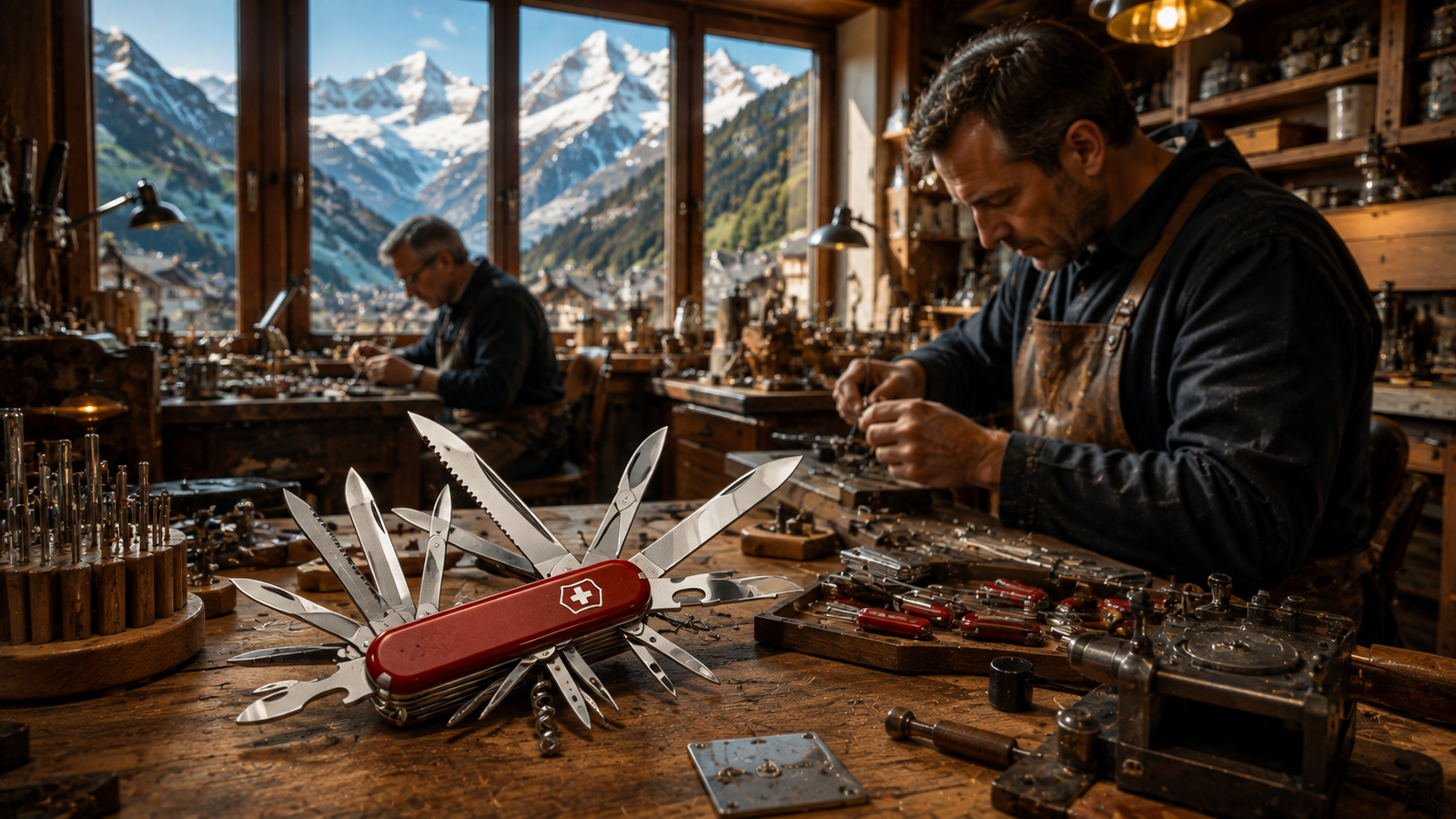
The Story of the Swiss Army Knife
A Small Tool with a Remarkable Story
Few objects are as closely associated with Switzerland as the Swiss Army Knife. Compact enough to fit in a pocket yet versatile enough to perform dozens of tasks, it has become one of the most recognizable products ever created. For generations, travelers, soldiers, explorers, engineers, and outdoor enthusiasts have carried one, often regarding it as a symbol of reliability and practical ingenuity.
What began as a simple military tool in the late nineteenth century eventually grew into a global icon. Its story reflects more than the evolution of a pocketknife. It reveals how Swiss craftsmanship, industrial innovation, and attention to quality helped transform a modest invention into an internationally respected brand.
When the Swiss Army Needed a Better Tool
The origins of the Swiss Army Knife can be traced to the 1880s, a period when Switzerland was modernizing its armed forces. The Swiss military sought a compact tool that could help soldiers perform several essential tasks. Troops needed a knife that could open canned food, maintain equipment, and assist with the assembly and disassembly of the service rifle issued at the time.
In 1891, the Swiss Army adopted a folding soldier’s knife designed specifically for military use. The first models included a blade, screwdriver, reamer, and can opener. Although simple by modern standards, the design represented a significant improvement over carrying several separate tools.
Initially, these military knives were manufactured in Germany because Swiss factories lacked sufficient production capacity. However, Swiss entrepreneurs soon recognized an opportunity to bring production home and create a distinctly Swiss product.
The Vision of Karl Elsener
The man most closely connected with the Swiss Army Knife’s success is Karl Elsener.
Born in central Switzerland, Elsener was a skilled cutler who believed Swiss manufacturers could produce high-quality knives that would rival foreign competitors. Determined to support local industry, he established a cutlery workshop in the village of Ibach in the canton of Schwyz.
In 1891, Elsener’s company began supplying knives to the Swiss military. Several years later, he developed a more advanced model that included springs on both sides of the handle, allowing additional tools to be incorporated into a compact design.
This innovation paved the way for the modern multi-tool concept. The new knife was more versatile while remaining portable and durable, characteristics that would define the product for generations.
How Victorinox Got Its Name
The company name Victorinox has a surprisingly personal origin. Following the death of his mother Victoria, Karl Elsener named his company in her honor. Later, when stainless steel became an important component of knife production, he combined “Victoria” with “inox,” derived from the French word inoxydable, meaning stainless.
The result was Victorinox, a name now recognized around the world.
The red handle and white cross shield that became synonymous with the brand also emerged during this period, helping distinguish Swiss-made knives from competitors.
A Symbol of Swiss Precision
Switzerland built its global reputation on precision engineering, quality manufacturing, and attention to detail. Industries ranging from watchmaking to medical technology benefited from these values, and the Swiss Army Knife became another expression of the same philosophy.
Unlike many products that rely heavily on marketing, the knife earned its reputation through performance. Its tools were carefully engineered, tested, and refined over decades. Blades needed to remain sharp, springs had to withstand repeated use, and mechanisms were designed to function reliably under demanding conditions.
This commitment to quality helped the knife gain a reputation far beyond Switzerland’s borders.
Crossing Oceans and Reaching the World
The Swiss Army Knife’s international popularity accelerated during the twentieth century. Soldiers, travelers, and tourists who visited Europe often returned home carrying one as a practical souvenir.
The knife became especially popular in North America, where outdoor recreation and camping culture expanded rapidly after World War II. Its combination of utility and portability appealed to hikers, climbers, hunters, and adventurers.
By the late twentieth century, the Swiss Army Knife was no longer viewed solely as military equipment. It had become a trusted companion for everyday life.
The phrase “Swiss Army Knife” itself entered popular language as a metaphor for any versatile tool capable of handling multiple tasks.
More Than Just a Knife
One reason for the product’s enduring appeal is its remarkable adaptability.
Over the decades, designers introduced new models tailored to different professions and lifestyles. Some included scissors, magnifying glasses, corkscrews, saws, pliers, tweezers, and file tools. Others featured specialized functions for technicians, fishermen, cyclists, and outdoor enthusiasts.
Certain models contained dozens of tools within a surprisingly compact package.
The knife’s evolution reflected changing consumer needs while maintaining the practical spirit of the original military design.
The Rivalry That Shaped an Industry
Although Victorinox is the name most commonly associated with the Swiss Army Knife, another important company played a major role in its history.
In the early twentieth century, Wenger, based in the canton of Fribourg, also supplied knives to the Swiss military. For many years, both companies shared military contracts and helped strengthen Switzerland’s reputation for premium cutlery.
This friendly rivalry encouraged innovation and quality improvements across the industry.
In 2005, Victorinox acquired Wenger, bringing together two historic names that had helped define the Swiss Army Knife’s legacy.
The Swiss Army Knife in Popular Culture
The knife’s influence extends far beyond workshops and military barracks.
It has appeared in countless films, television programs, documentaries, and adventure stories. Astronauts have carried Swiss Army Knives into space, while explorers have packed them on expeditions to some of the world’s most remote regions.
Its reputation for practicality made it a favorite among travelers who appreciated having multiple tools available without carrying bulky equipment.
As technology advanced, the knife retained its relevance by symbolizing self-reliance and preparedness.
Visiting the Birthplace of a Global Icon
Travelers interested in the history of the Swiss Army Knife can visit Ibach, the village where the story began.
Located near the scenic landscapes of central Switzerland, the area combines industrial heritage with Alpine beauty. Visitors can explore exhibitions dedicated to the development of Swiss cutlery, learn about traditional manufacturing techniques, and discover how a local workshop grew into a globally recognized company.
The experience offers insight into a lesser-known aspect of Swiss history—one rooted not in castles or mountain peaks, but in innovation and craftsmanship.
Why the Swiss Army Knife Still Matters
In an age dominated by digital technology, the enduring popularity of the Swiss Army Knife may seem surprising. Yet its appeal remains remarkably strong.
Part of its success lies in its simplicity. It solves everyday problems through thoughtful design rather than complexity. It embodies qualities that many people continue to admire: practicality, durability, precision, and reliability.
More than a century after the first military models were issued, the Swiss Army Knife remains one of Switzerland’s most successful inventions. It is a product that connects tradition with innovation, local craftsmanship with global recognition, and history with everyday usefulness.
For millions of people around the world, it remains far more than a pocket tool. It is a symbol of Swiss ingenuity—small in size, yet enormous in legacy.