The First Climbers of the Matterhorn
The Mountain That Refused to Be Conquered
For centuries, the Matterhorn dominated the skyline of the Alps like a giant stone pyramid. Rising above the valley of Zermatt in southern Switzerland, its sharp ridges and nearly vertical faces inspired awe, fear, and fascination in equal measure.
Today, the Matterhorn is one of the most photographed mountains in the world. Yet long before it became a symbol of Switzerland, it was considered unclimbable. Local residents viewed the peak with deep respect, while early travelers regarded it as one of the last great challenges of the Alps.
The story of the first climbers of the Matterhorn is far more than a mountaineering achievement. It is a tale of ambition, rivalry, courage, and tragedy that transformed alpine exploration forever.
A New Era of Alpine Adventure
The middle decades of the nineteenth century became known as the Golden Age of Alpinism. Wealthy travelers, scientists, and adventurers from Britain and across Europe flocked to the Alps in search of unexplored summits.
By the 1860s, many of the highest peaks had already been climbed. Only a few legendary mountains remained unconquered, and none attracted more attention than the Matterhorn.
Unlike broader Alpine summits, the Matterhorn presented a unique challenge. Its steep rock walls rose dramatically above surrounding glaciers, creating an intimidating profile visible from miles away.
Numerous attempts ended in failure. Harsh weather, unstable rock, and limited climbing technology made success extremely difficult.
Among those determined to reach the summit was a young English artist and mountaineer named Henry Whymper.
The Rivalry That Captivated the Alps
Henry Whymper first encountered the Matterhorn in 1860. Instantly captivated by its shape, he became obsessed with finding a route to the top.
Over several years, Whymper made repeated attempts from the Italian side of the mountain. He worked closely with experienced guides and explored various approaches, but the summit remained out of reach.
At the same time, Italian climber Jean-Antoine Carrel was pursuing the same goal. A highly skilled mountain guide from the Aosta Valley, Carrel possessed intimate knowledge of the mountain and was regarded as one of the finest climbers in the region.
A friendly but intense rivalry developed between Whymper and Carrel. Both men hoped to claim the first ascent, and each expedition was watched closely by the growing mountaineering community.
As the summer of 1865 approached, the race became increasingly urgent.
The Ascent That Made History
In July 1865, Whymper learned that Carrel was preparing another attempt from the Italian side. Determined not to lose the race, he quickly organized a team and chose a route from the Swiss side via the Hörnli Ridge.
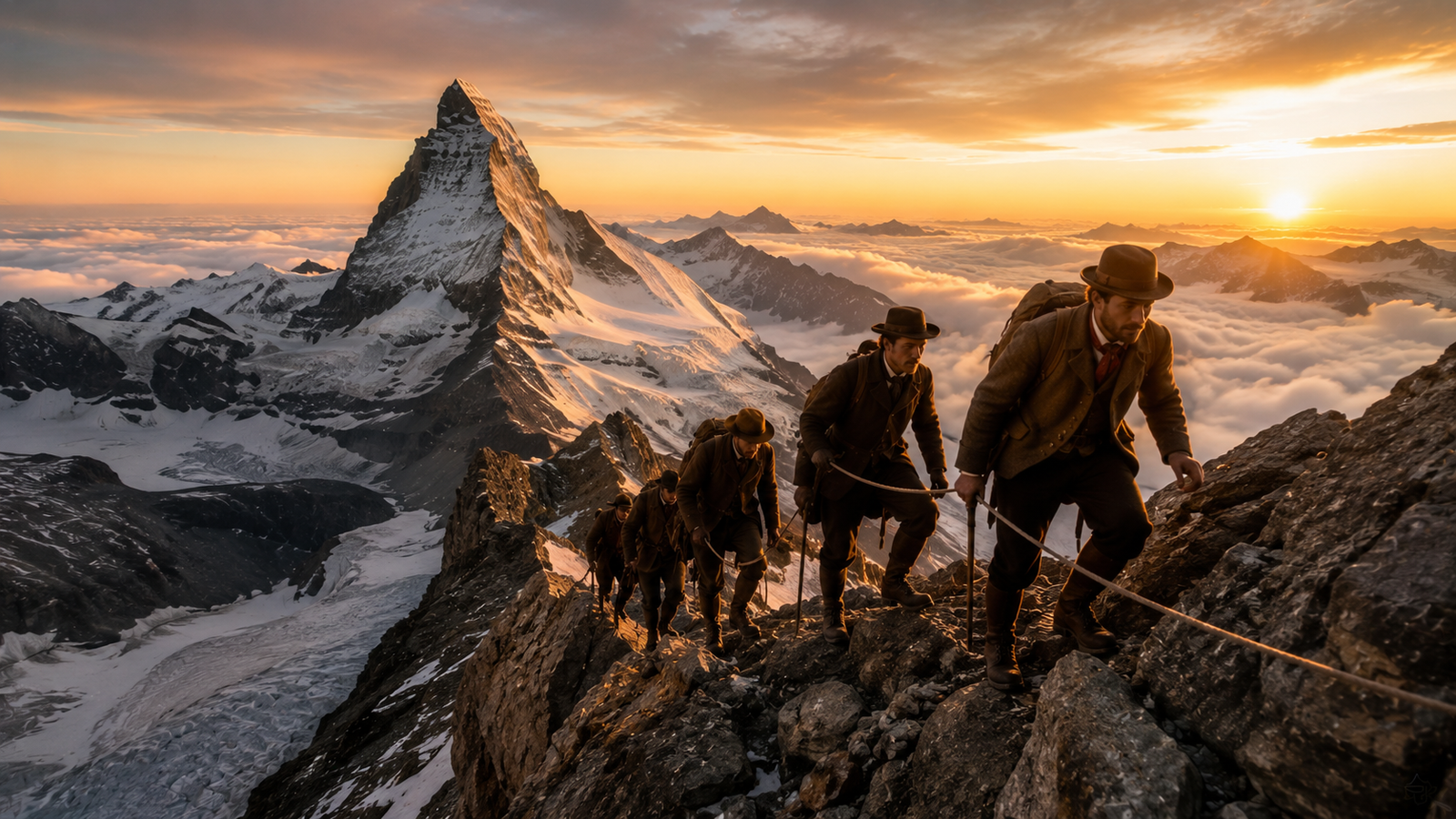
The climbing party included Henry Whymper, Lord Francis Douglas, Charles Hudson, Douglas Hadow, Michel Croz, Peter Taugwalder Sr., and Peter Taugwalder Jr.
On July 13, the team began its ascent.
Conditions were favorable, and progress exceeded expectations. The following day, July 14, 1865, the climbers reached the summit.
For the first time in human history, people stood atop the Matterhorn.
The achievement marked one of the greatest triumphs of nineteenth-century exploration. After years of failed attempts and fierce competition, the seemingly impossible had finally been accomplished.
From the summit, the climbers gazed across an ocean of Alpine peaks stretching across Switzerland, Italy, and France.
Their victory, however, would soon be overshadowed by disaster.
Tragedy on the Descent
The descent proved far more dangerous than the climb.
While moving down the mountain, Douglas Hadow reportedly slipped on a steep section of the ridge. His fall knocked Michel Croz from his position, and both men crashed into Charles Hudson and Lord Francis Douglas.
The four climbers fell together down the mountain.
The remaining members of the team were connected to the falling group by a rope. For a moment, it appeared everyone might be pulled to their deaths.
Then the rope snapped.
Whymper and the two Taugwalder guides remained on the mountain, while the four climbers plunged more than a thousand meters onto the glaciers below.
The accident shocked Europe.
What should have been remembered solely as one of the greatest achievements in mountaineering immediately became one of its most famous tragedies.
The Questions That Followed
The disaster sparked widespread public debate.
Investigators examined the accident, and newspapers across Europe reported extensively on the event. Questions arose regarding the quality of the rope, the experience of certain members of the team, and whether the ascent had been attempted too quickly.
No evidence ever proved deliberate wrongdoing.
Historical research generally supports the view that the tragedy resulted from a combination of difficult terrain, human error, and the inherent dangers of nineteenth-century mountaineering.
The accident also highlighted the limitations of climbing equipment available at the time. Modern ropes, harnesses, helmets, and safety systems did not yet exist.
For many people, the Matterhorn became a symbol of both human ambition and nature’s unforgiving power.
How the Matterhorn Changed Mountaineering
The first ascent of the Matterhorn marked a turning point in Alpine history.
The event brought international attention to mountain climbing and helped establish the Alps as a premier destination for adventure travel.
Guiding services expanded. Mountain huts were developed. Improved equipment gradually increased safety standards.
The climb also influenced public perceptions of risk and exploration. Victorian society admired heroic achievement, but the Matterhorn tragedy revealed the real dangers hidden behind tales of adventure.
In many ways, modern mountaineering culture emerged from the lessons learned on the Matterhorn.
Today, climbers from around the world continue to follow the Hörnli Ridge, tracing the route taken by Whymper and his companions more than 160 years ago.
The Mountain Above Zermatt
Visitors arriving in Zermatt quickly understand why the Matterhorn captured the imagination of generations.
Its distinctive shape dominates the landscape from nearly every viewpoint in the region. At sunrise, the peak glows with shades of gold and orange. In winter, snow and ice transform it into a spectacular natural monument.
The mountain has become one of Switzerland’s most recognized symbols, appearing in tourism campaigns, artwork, photography, and popular culture around the world.
Yet behind every postcard image lies a remarkable human story.
The first ascent was not simply about reaching a summit. It represented years of perseverance, intense rivalry, and extraordinary courage.
A Legacy Written in Stone
More than a century and a half after that historic day in July 1865, the Matterhorn remains one of the world’s most celebrated mountains.
Henry Whymper’s successful ascent secured his place in history, while the tragic loss of four members of the expedition ensured that the story would never be remembered as a simple tale of victory.
The mountain continues to attract climbers, hikers, photographers, and travelers who come to witness one of nature’s most extraordinary creations.
For many visitors, the Matterhorn is a breathtaking landmark. For others, it is a monument to the explorers who pushed beyond the limits of what seemed possible.
Its towering silhouette still stands above Zermatt, reminding the world that some of history’s greatest achievements are inseparable from the risks taken to achieve them.