Swiss National Park, Zernez, Switzerland
Swiss National Park: Inside Switzerland’s Untouched Alpine Wilderness
In a country celebrated for scenic mountains, picturesque villages, and world-famous rail journeys, one destination stands apart because of what it deliberately lacks. There are no hotels inside its boundaries, no roads built for sightseeing, no recreational facilities designed to reshape the landscape, and no attempts to make nature more accessible than it wishes to be.
The Swiss National Park exists for a different purpose.
Located in the southeastern canton of Graubünden near the Engadin Valley, the park represents one of Europe’s most significant conservation achievements. Established in 1914, it became Switzerland’s first and only national park and remains one of the continent’s most strictly protected natural areas.
More than a tourist attraction, it functions as a living scientific laboratory where natural processes unfold with minimal human interference. For visitors, this creates a rare opportunity to experience an Alpine environment that has been allowed to evolve largely on its own for more than a century.
A Revolutionary Conservation Project
When the Swiss National Park was established in 1914, the idea was remarkably ambitious.
Across Europe, landscapes were being altered by agriculture, forestry, infrastructure development, and expanding settlements. Switzerland chose a different path within a portion of the Lower Engadin region, setting aside a protected area where nature could recover and develop without direct exploitation.
The goal was not simply to preserve scenery but to observe how ecosystems function when human intervention is minimized.
This philosophy remains central to park management today.
Visitors are required to stay on designated trails, remove nothing from the landscape, and avoid disturbing wildlife. These regulations are not restrictions for their own sake; they are essential components of the park’s long-term conservation mission.
The result is one of the most carefully protected natural environments in the Alps.
A Landscape Defined by Natural Processes
The park covers a large section of Alpine terrain characterized by mountains, forests, meadows, rivers, and rocky valleys.
Unlike many mountain regions where forestry, grazing, and development have significantly shaped the landscape, much of the Swiss National Park has been allowed to evolve naturally for generations.
Dead trees remain where they fall. Forests regenerate without large-scale management. Rockslides, avalanches, and seasonal weather patterns influence ecological development as they have for centuries.
This commitment to natural processes creates an environment that differs noticeably from many other Alpine destinations.
Visitors often encounter landscapes that feel genuinely wild rather than carefully maintained.
The experience offers insight into what large portions of the Alps may have looked like before extensive human modification.
Wildlife Returns to the Mountains
One of the most visible outcomes of long-term protection has been the recovery and stability of wildlife populations.
The park is known for its opportunities to observe Alpine species in their natural habitats. Red deer are among the most commonly seen large mammals, particularly during certain seasons when they move across open slopes and valleys.
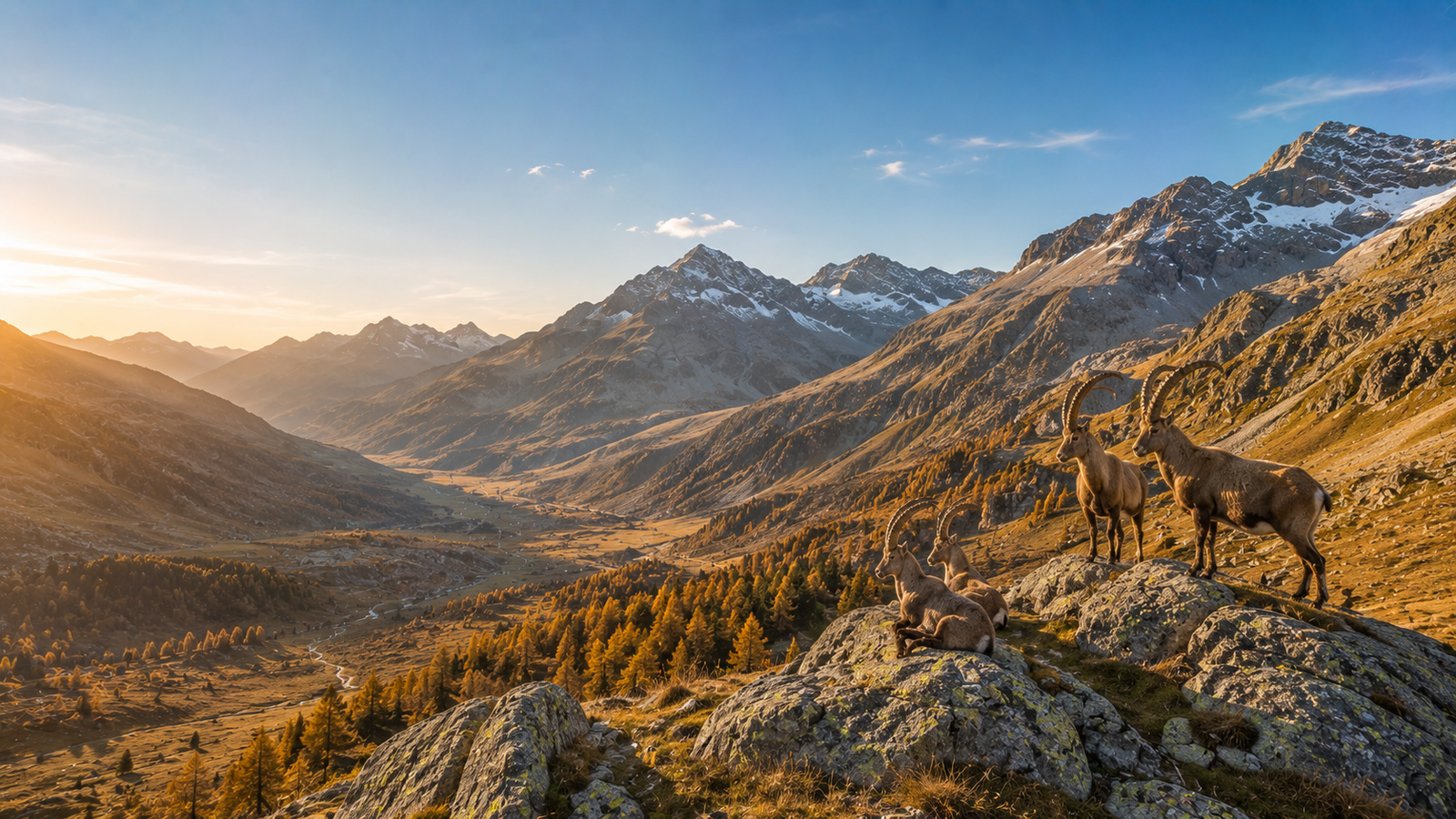
Alpine ibex, recognizable by their impressive curved horns, can often be spotted on rocky terrain. Chamois inhabit higher elevations, while marmots occupy meadows and grassy mountain environments.
Birdlife is equally important. Golden eagles patrol mountain skies, while numerous other Alpine species contribute to the park’s ecological diversity.
Wildlife sightings can never be guaranteed, but patient visitors often discover that observation becomes one of the most rewarding aspects of exploring the park.
Hiking Through a Protected Alpine World
The Swiss National Park is best experienced on foot.
An extensive network of marked hiking trails allows visitors to explore different habitats while minimizing environmental impact. Routes vary from relatively accessible walks to demanding mountain hikes that require good fitness and preparation.
Unlike destinations focused primarily on recreation, the trails here function as carefully managed observation corridors. They provide access to landscapes while ensuring sensitive ecosystems remain protected.
Many hikers quickly notice the absence of commercial distractions.
The emphasis remains firmly on nature, scenery, and ecological awareness.
Trails pass through forests of Swiss stone pine and larch, cross mountain streams, traverse alpine meadows, and lead to viewpoints overlooking vast valleys and rugged peaks.
Each route offers a slightly different perspective on the park’s remarkable diversity.
The Engadin Connection
The park occupies a significant portion of the Lower Engadin region, one of Switzerland’s most distinctive cultural and natural landscapes.
Nearby communities such as Zernez serve as gateways to the protected area. These villages provide visitor services while maintaining strong connections to local traditions and Romansh heritage.
The relationship between the park and surrounding communities is particularly important.
While the protected core remains largely untouched, neighboring settlements support conservation, scientific research, and sustainable tourism.
This balance allows visitors to experience both pristine natural environments and the cultural richness of southeastern Switzerland.
The surrounding Engadin scenery further enhances the appeal of the region, combining dramatic mountain landscapes with traditional Alpine architecture and centuries-old customs.
A Living Laboratory for Science
Beyond tourism, the Swiss National Park plays a major role in scientific research.
Since its establishment, researchers have studied ecological processes within the park, creating one of the longest continuous environmental observation programs in Europe.
Scientists examine topics ranging from forest regeneration and wildlife behavior to climate change and biodiversity. Because large portions of the landscape remain minimally influenced by human activity, the park provides valuable data that would be difficult to obtain elsewhere.
This research contributes not only to Swiss conservation efforts but also to broader international understanding of mountain ecosystems.
In many ways, the park’s scientific importance rivals its value as a visitor destination.
Seasonal Transformations
Every season reveals a different side of the Swiss National Park.
During spring, melting snow feeds streams and rivers while alpine vegetation begins to emerge. Summer brings accessible hiking conditions and increased wildlife activity across mountain slopes.
Autumn transforms the landscape with striking colors, particularly as larch forests turn shades of gold. It is also a season when red deer become especially active, attracting wildlife enthusiasts and photographers.
Winter presents an entirely different environment. Much of the park enters a period of natural dormancy, with access becoming more limited due to snow and seasonal conditions.
The changing seasons highlight one of the park’s defining characteristics: nature follows its own rhythms rather than adapting to visitor expectations.
Why the Swiss National Park Remains Unique
Many countries possess national parks, but the Swiss National Park occupies a special position within Europe’s conservation history.
Its strict protection policies have allowed ecological processes to unfold over more than a century with remarkably little direct intervention. This long-term commitment has created an environment where visitors witness nature functioning largely according to its own rules.
The experience differs from conventional sightseeing.
There are no famous monuments to photograph, no engineered attractions, and no carefully curated experiences designed to entertain. Instead, the park offers something increasingly rare in the modern world: authentic wilderness.
Walking through its valleys and mountains encourages a different perspective on travel. Visitors become observers rather than participants, guests rather than controllers. The reward is an encounter with an Alpine landscape that has been given the freedom to remain itself.
More than a century after its founding, the Swiss National Park continues to demonstrate the value of patience, protection, and respect for natural systems. In a country renowned for its ability to shape landscapes with remarkable precision, this protected wilderness stands as a reminder that sometimes the most extraordinary achievement is knowing when to leave nature alone.