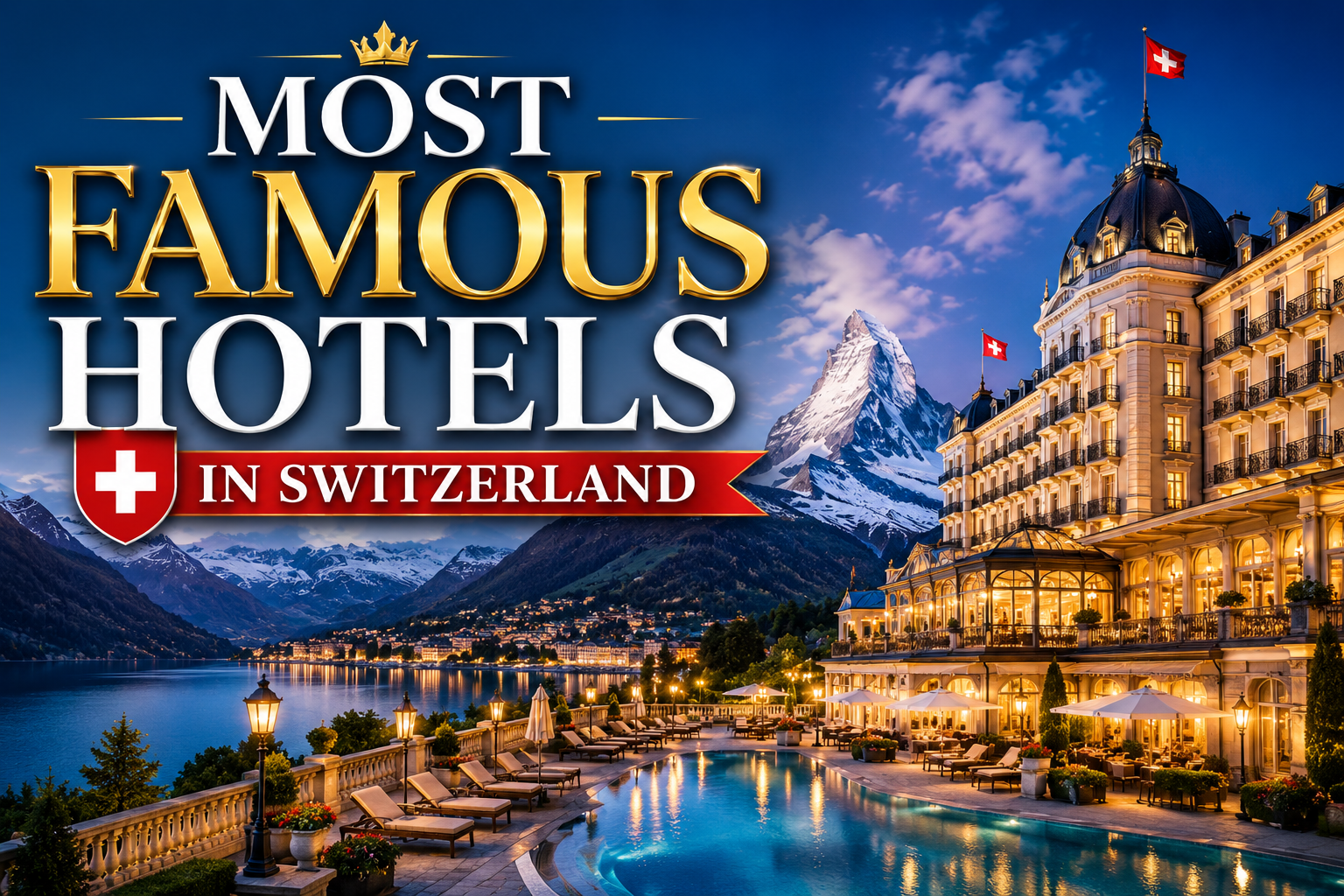
Most Famous Hotels in Switzerland: The Grand Hotels That Shaped Alpine Luxury
For more than a century, Switzerland has occupied a unique place in the history of luxury travel. Long before modern resorts dominated global tourism, Swiss hoteliers were welcoming royalty, industrialists, artists, politicians, and adventurers arriving by rail into the Alps. Some hotels became destinations in their own right, helping transform small mountain villages into internationally recognized resorts.
The most famous hotels in Switzerland are not necessarily the largest or most expensive. Their reputation comes from a combination of historical significance, international recognition, architectural distinction, location, longevity, and cultural influence. Many have helped define the image of Switzerland that travelers know today: elegant lakeside promenades, Belle Époque grandeur, discreet service, and spectacular Alpine scenery.
This editorial selection highlights the Swiss hotels whose names have become inseparable from the country’s tourism identity.
The Hotels That Became Symbols of Switzerland
| Hotel | Location | Opened | Why It Became Famous |
|---|---|---|---|
| Badrutt’s Palace Hotel | St. Moritz | 1896 | Icon of Alpine luxury and winter tourism |
| Gstaad Palace | Gstaad | 1913 | Castle-like landmark associated with celebrity travel |
| Baur au Lac | Zurich | 1844 | Historic city luxury hotel on Lake Zurich |
| Beau-Rivage Palace | Lausanne | 1861 | One of Switzerland’s great lakeside palace hotels |
| Fairmont Le Montreux Palace | Montreux | 1906 | Belle Époque landmark on Lake Geneva |
| Victoria-Jungfrau Grand Hotel & Spa | Interlaken | 1865 | Historic gateway hotel to the Bernese Alps |
| The Dolder Grand | Zurich | 1899 | Architectural and cultural icon overlooking Zurich |
| Mandarin Oriental Palace, Lucerne | Lucerne | 1906 (original palace era) | Historic lakeside luxury landmark |
Rather than ranking them purely by luxury, this list considers how deeply each hotel has influenced Swiss tourism and international perceptions of Switzerland.
Badrutt’s Palace Hotel, St. Moritz: The Hotel That Helped Invent Winter Tourism
•081 837 10 00
If one hotel symbolizes luxury Switzerland more than any other, it is Badrutt’s Palace.
Founded in 1896 by Caspar Badrutt, the hotel became synonymous with St. Moritz and played a crucial role in establishing the Engadin Valley as one of the world’s premier winter destinations. Over the decades, the property welcomed royalty, aristocrats, artists, and international celebrities, becoming a benchmark for grand Alpine hospitality.
Its dramatic position above Lake St. Moritz, surrounded by snow-covered peaks, created one of the most recognizable hotel settings in Europe. The hotel remains family-owned and continues to blend historic grandeur with modern luxury.
The importance of Badrutt’s Palace extends beyond hospitality. Its story is closely tied to the rise of Swiss winter sports, luxury Alpine tourism, and the global reputation of St. Moritz itself.
Gstaad Palace: The Fairytale Castle Above the Valley
•033 748 50 00
Perched on a hill above Gstaad, Gstaad Palace looks less like a hotel and more like a storybook castle.
The hotel opened in 1913 following the arrival of railway connections that transformed Gstaad from a farming village into an emerging tourist destination. Through world wars, economic downturns, and changing travel trends, the hotel survived and evolved into one of Switzerland’s most recognized luxury properties.
Unlike many famous hotels that became part of large international chains, Gstaad Palace remains family-owned. Its towers dominate the skyline above the village, making it one of the most photographed hotels in the Swiss Alps.
Its reputation for discretion has long attracted high-profile guests seeking privacy in one of Switzerland’s most exclusive resort communities.
Baur au Lac: Zurich’s Historic Grand Address
•044 220 50 20
While many famous Swiss hotels are found in mountain resorts, Baur au Lac represents the urban side of Swiss luxury.
Opened in 1844 on the shores of Lake Zurich, it is among the country’s oldest luxury hotels and remains family-operated after more than 180 years. Its location beside Bahnhofstrasse and Lake Zurich places it at the center of Switzerland’s financial and cultural capital.
Generations of political leaders, business executives, artists, and dignitaries have passed through its doors. Unlike Alpine palace hotels known for dramatic mountain scenery, Baur au Lac became famous for elegance, discretion, and continuity.
The hotel’s reputation demonstrates that Switzerland’s luxury hospitality story is not only about mountains but also about sophisticated urban tradition.
Beau-Rivage Palace: Lausanne’s Lakeside Legend
•021 613 33 33
On the northern shore of Lake Geneva stands one of Switzerland’s most distinguished lakeside hotels.
The origins of Beau-Rivage Palace date to the nineteenth century, when Lausanne emerged as an important destination for affluent European travelers. The hotel’s location combines panoramic lake views with a backdrop of Alpine peaks, creating one of the classic Swiss luxury landscapes.
Its long history reflects the evolution of Swiss hospitality itself. Over generations, the property has maintained its standing among the country’s elite grand hotels while adapting to changing expectations in luxury travel.
Today, Beau-Rivage Palace remains a symbol of the elegance associated with the Lake Geneva region.
Fairmont Le Montreux Palace: The Pearl of the Swiss Riviera
•021 962 12 12
Few hotels capture the Belle Époque spirit of Switzerland as effectively as Fairmont Le Montreux Palace.
Built in 1906 along the shores of Lake Geneva, the hotel quickly became one of the defining landmarks of Montreux. Its grand façade, lakeside promenade setting, and views toward the Alps helped establish the town as a major destination on the so-called Swiss Riviera.
The property represents an era when luxury travelers moved between Europe’s great resort cities by rail and steamer, spending seasons in elegant lakeside palaces. More than a century later, it continues to embody that tradition.
Victoria-Jungfrau Grand Hotel & Spa: Gateway to the Bernese Alps
•033 828 28 28
Interlaken’s rise as a global tourism destination is closely linked to the development of grand hotels overlooking the Jungfrau region.
Among them, Victoria-Jungfrau became the most famous. Its commanding position between Lake Thun and Lake Brienz, combined with views toward some of Switzerland’s most celebrated peaks, made it a centerpiece of Alpine tourism.
As tourism expanded in the nineteenth century, Interlaken became a gateway for visitors heading into the Bernese Oberland. Victoria-Jungfrau embodied the scale and confidence of that era, helping define luxury travel in the heart of Switzerland.
The Dolder Grand: Zurich’s Hilltop Icon
•044 456 60 00
The Dolder Grand occupies one of the most striking hotel locations in Switzerland.
Overlooking Zurich from an elevated position above the city, the hotel combines historic architecture with contemporary design. Major renovations by Foster and Partners transformed the property into a modern luxury landmark while preserving its historic identity.
Unlike many palace hotels built around lakes or Alpine valleys, The Dolder Grand became famous through its combination of architecture, art, wellness facilities, and panoramic views over Zurich, Lake Zurich, and the distant Alps.
Its profile demonstrates how Swiss luxury hospitality continues to evolve while respecting its heritage.
Mandarin Oriental Palace, Lucerne: A New Chapter for a Historic Landmark
•041 588 18 88
Lucerne has long been one of Switzerland’s most visited destinations, and its grand lakeside palace hotels have played an important role in that popularity.
The historic Palace on Lake Lucerne has served travelers for generations and recently entered a new era following extensive restoration and reopening under the Mandarin Oriental brand. Its location directly on the waterfront offers views that have attracted visitors to Lucerne since the golden age of European tourism.
The property illustrates how Switzerland’s historic hotel heritage can be preserved while meeting modern luxury standards.
Why These Hotels Became World Famous
Several common characteristics explain why these properties achieved global recognition while thousands of other hotels did not.
Extraordinary Locations
Many sit beside iconic lakes, beneath famous mountain peaks, or within historic city centers. Their settings are inseparable from their identity.
Longevity
Most have survived for more than a century. Their histories span world wars, economic crises, and major shifts in global tourism.
Influence on Swiss Tourism
Several helped transform entire destinations. St. Moritz, Gstaad, Interlaken, Montreux, and Lausanne all benefited from the international attention generated by their flagship hotels.
Architectural Identity
Whether castle-like towers, Belle Époque palaces, or landmark city hotels, each possesses a recognizable visual character.
International Reputation
These hotels became symbols of Switzerland itself, appearing in travel literature, magazines, films, celebrity itineraries, and luxury tourism campaigns for generations.
Switzerland’s Grand Hotel Legacy
The story of Switzerland’s most famous hotels is also the story of Swiss tourism. These properties helped define how the world imagines the country: elegant trains arriving beneath snowy peaks, lakefront terraces overlooking Alpine scenery, historic palaces glowing above mountain villages, and a tradition of hospitality refined over generations.
Many destinations became famous because their hotels became famous first. More than places to stay, these grand hotels remain living landmarks—architectural, cultural, and historical institutions that continue to shape Switzerland’s global identity as one of the world’s great travel destinations.