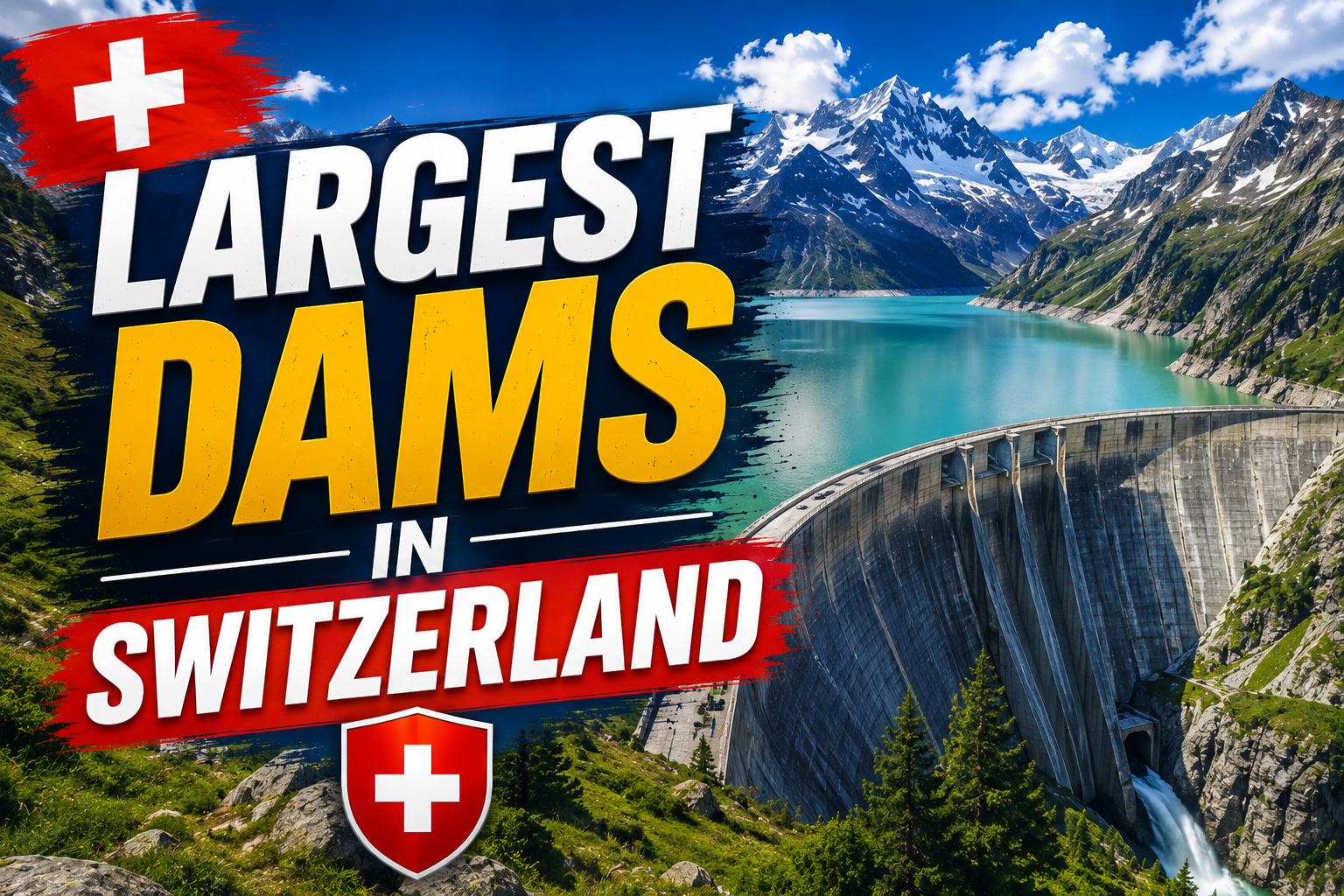
The Giants of the Alps: Switzerland’s Largest Dams and the Engineering Behind Them
High in the Swiss Alps, where glaciers carve valleys and mountain rivers rush toward Europe’s great waterways, some of Switzerland’s most impressive landmarks are not natural at all. Rising from remote alpine landscapes, massive dams transform water into one of the country’s most important resources: renewable energy.
These structures rarely appear on traditional travel itineraries, yet they are among the greatest engineering achievements in Swiss history. Built in challenging terrain and often at remarkable elevations, Switzerland’s largest dams have helped power industries, homes, railways, and communities for decades. They also represent a uniquely Swiss response to geography—using mountainous landscapes to create a reliable source of electricity in a country with limited fossil fuel resources.
The story of Switzerland’s largest dams begins in the canton of Valais, where the scale of alpine engineering reaches its most dramatic expression.
No structure symbolizes Swiss hydropower more than the Grande Dixence Dam. Completed in the 20th century and standing approximately 285 meters (935 feet) high, it remains the tallest gravity dam in the world. Located above the Val d’Hérémence in Valais, the immense concrete wall holds back Lac des Dix, a reservoir fed by water collected from dozens of alpine catchments and glaciers.
Grande Dixence is not merely impressive because of its size. It represents the heart of one of Switzerland’s most important hydroelectric systems. Water gathered from a vast network of mountain valleys is stored and later directed through power stations that help supply electricity across the country. Visitors often describe the dam as one of the most astonishing human-made structures in the Alps, where the scale of construction appears almost impossible against the surrounding peaks.
Further west in Valais stands another giant of Swiss hydropower: Mauvoisin Dam. Completed in the 1950s, this arch dam rises approximately 250 meters above the Bagnes Valley. Surrounded by rugged alpine scenery and glaciers, Mauvoisin creates one of Switzerland’s largest reservoirs.
Unlike gravity dams that rely primarily on their immense weight, arch dams transfer pressure into the surrounding rock walls. Mauvoisin demonstrates how Swiss engineers adapted dam design to the unique geology of mountain valleys. Today, the reservoir remains a critical component of regional energy production while also attracting visitors interested in alpine landscapes and engineering history.
The canton of Ticino hosts one of Switzerland’s most visually dramatic dams. The Contra Dam, often called the Verzasca Dam, gained international recognition after appearing in the opening sequence of the James Bond film GoldenEye. At approximately 220 meters high, the dam forms a striking wall above the Verzasca Valley.
While its cinematic fame attracts tourists, Contra remains an important piece of Swiss energy infrastructure. The contrast between the turquoise waters of the Verzasca region and the towering concrete structure has made it one of the most photographed dams in the country.
Another remarkable example of alpine engineering is the Luzzone Dam in the canton of Ticino. Expanded during the late twentieth century, it became one of Switzerland’s highest dams and plays a major role in regional hydropower generation. The surrounding landscape, characterized by rugged peaks and high-altitude reservoirs, demonstrates how hydropower projects are often integrated into remote mountain environments.
In eastern Switzerland, the Albigna Dam presents a different but equally impressive story. Located in the canton of Graubünden, it rises dramatically above the Bergell Valley. The dam is particularly notable for its location within a steep alpine setting where visitors reach the reservoir via cable car. The combination of engineering achievement and mountain scenery makes Albigna one of the most distinctive hydropower destinations in the country.
Many of Switzerland’s largest dams were constructed during periods of rapid economic development when energy security became a national priority. Throughout the twentieth century, hydropower emerged as one of the foundations of the Swiss electricity system. The country’s mountainous terrain, abundant precipitation, and glacial water resources created ideal conditions for large-scale hydroelectric development.
Unlike many nations that rely heavily on fossil fuels, Switzerland developed an energy strategy that harnessed natural water resources. Today, hydropower remains one of the country’s most important sources of renewable electricity. Large alpine reservoirs act as energy storage systems, allowing water to be released when electricity demand increases.
This role has become even more significant in an era of energy transition. As Europe seeks to reduce carbon emissions and increase renewable generation, Swiss dams continue to provide flexibility and reliability to the electrical grid. Pumped-storage facilities connected to reservoirs can store energy and help balance fluctuations from other renewable sources such as solar and wind power.
Beyond energy production, the reservoirs created by major dams have transformed mountain landscapes. Some valleys that once contained alpine meadows and seasonal settlements now lie beneath vast lakes. At the same time, reservoirs have created new recreational opportunities including hiking, sightseeing, and educational tourism focused on engineering and sustainability.
The cultural significance of these projects is often overlooked. Building large dams in the Alps required extraordinary logistical efforts. Workers transported materials into remote mountain regions long before modern transportation networks reached many valleys. Communities adapted to changing landscapes, while engineers developed solutions capable of withstanding harsh alpine conditions, extreme weather, and immense water pressure.
Today, many dams offer visitor centers, guided tours, panoramic viewpoints, and interpretive exhibitions that explain both their technical functions and historical importance. Grande Dixence, in particular, has become a destination where engineering, geography, and tourism intersect.
The visual impact of these structures also challenges common perceptions of Switzerland. Visitors often arrive expecting medieval towns, lakeside villages, and mountain railways. The country’s largest dams reveal another side of Swiss identity—one built on precision engineering, technical innovation, and long-term planning.
Their presence underscores a broader national characteristic. Switzerland has consistently turned geographic constraints into advantages. Mountain valleys that might have limited development instead became sources of renewable energy. Harsh alpine terrain became the setting for some of the most ambitious engineering projects in Europe.
For travelers exploring Switzerland beyond its famous cities and resort towns, the nation’s largest dams offer a different perspective on the Alps. They are monuments not to conquest of nature but to cooperation with it—structures designed to capture the power of water while operating within one of Europe’s most spectacular natural environments.
Standing before the immense wall of Grande Dixence or gazing across the reservoir behind Mauvoisin, visitors encounter a side of Switzerland that is rarely featured on postcards yet is fundamental to the country’s modern success. These dams are more than infrastructure. They are enduring symbols of how engineering, geography, and renewable energy have become inseparable parts of the Swiss story.