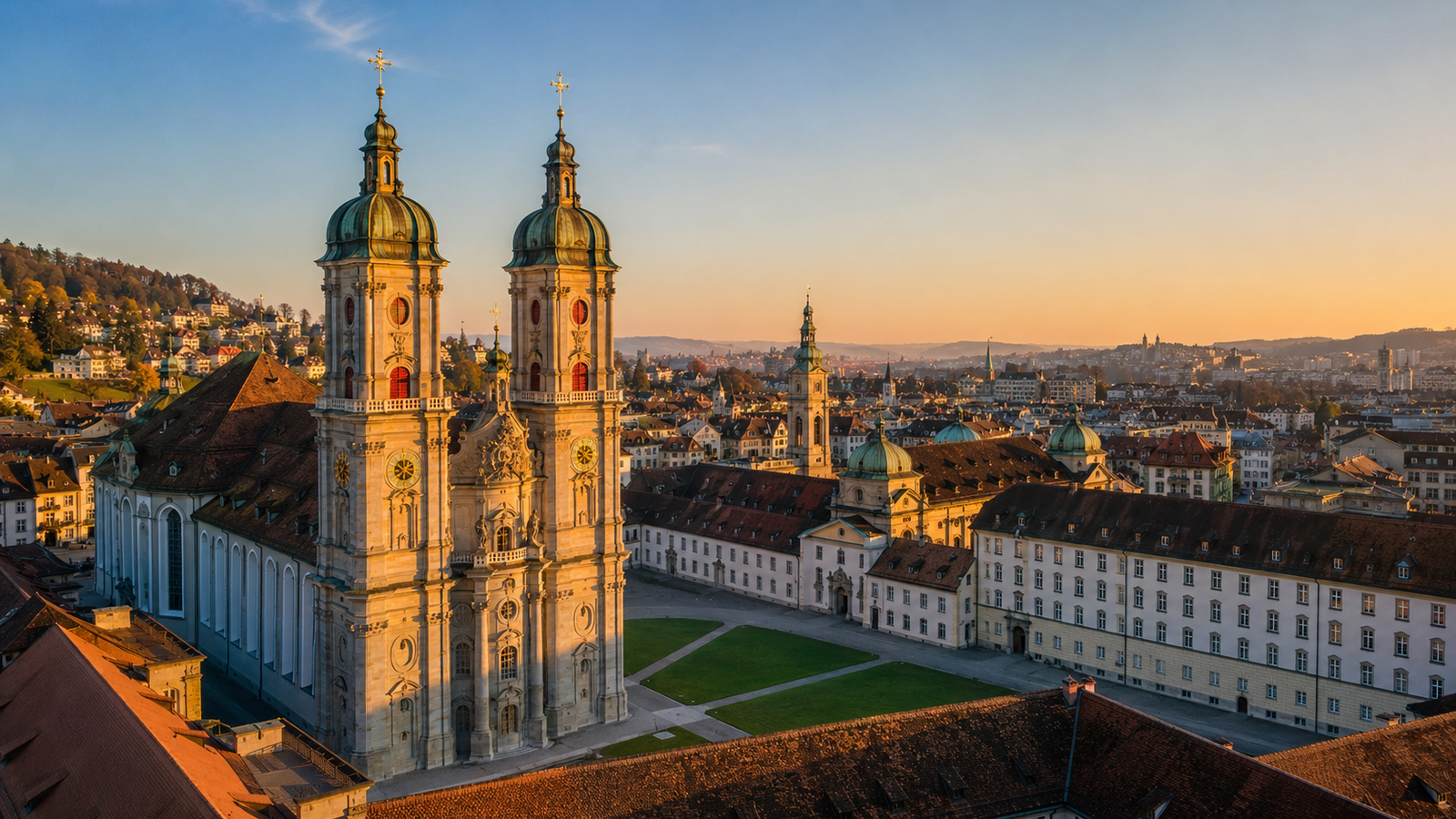
Abbey of Saint Gall, St. Gallen, Switzerland
Abbey of Saint Gall: Switzerland’s UNESCO Treasure of Knowledge, Faith, and Medieval Heritage
In the heart of northeastern Switzerland stands a cultural landmark whose influence extends far beyond its impressive architecture. The Abbey of Saint Gall is not simply an ancient religious complex; it is one of Europe’s most significant centers of learning, scholarship, and cultural preservation.
For more than a millennium, the abbey shaped intellectual life across the continent. Monks copied manuscripts, preserved classical knowledge, developed educational traditions, and created one of the world’s most remarkable collections of medieval documents. Today, visitors encounter a UNESCO World Heritage Site where history is not confined to museum displays but remains visible in libraries, archives, and architectural masterpieces that continue to serve public and cultural life.
The Abbey of Saint Gall tells a story that reaches from the early Middle Ages to the modern era, making it one of Switzerland’s most important historic destinations.
From an Irish Hermit to a Great European Monastery
The origins of Saint Gall trace back to the Irish monk Gallus, who settled in the region during the early seventh century. After his death, a religious community gradually developed around his burial site. In 719, Saint Othmar established the monastery that would become the Abbey of Saint Gall, laying the foundation for a religious institution that would influence European culture for centuries.
As the monastery expanded, it evolved into one of the leading Benedictine centers in Europe. By the Carolingian period, Saint Gall had become renowned for education, manuscript production, and intellectual activity. Scholars, scribes, theologians, and artists contributed to a tradition of learning that reached well beyond the borders of present-day Switzerland.
The city of St. Gallen itself grew around the monastery, creating a close relationship between the religious institution and the urban community that continues today.
A UNESCO World Heritage Site
In 1983, the Abbey of Saint Gall was inscribed on the UNESCO World Heritage List in recognition of its outstanding cultural importance. UNESCO describes the complex as one of the finest surviving examples of a great Carolingian monastery and recognizes its role as a major European cultural center from the eighth century until its secularization in 1805.
What makes the site exceptional is the continuity of its history. The abbey complex reflects more than twelve centuries of religious, architectural, and intellectual development. Multiple historical periods are represented within a remarkably cohesive ensemble that remains one of Switzerland’s most celebrated heritage sites.
Visitors exploring the district quickly realize that this is not merely a preserved monument. It is a living historical environment where religious traditions, cultural institutions, and public functions continue to coexist.
The Magnificent Baroque Cathedral
The most visually striking element of the abbey complex is the Cathedral of Saint Gall.
Constructed during the eighteenth century as part of a major rebuilding campaign, the cathedral represents one of the last monumental Baroque abbey churches constructed in Western Europe. Its elegant twin towers dominate the skyline of St. Gallen, while the interior showcases elaborate decoration, intricate stucco work, frescoes, and harmonious architectural proportions.
Despite its grandeur, the cathedral remains deeply connected to the spiritual traditions that shaped the monastery for centuries. Visitors often find that the building’s atmosphere combines artistic achievement with a sense of calm and contemplation.
The cathedral also serves as an architectural centerpiece that unifies the wider abbey district, linking religious history with the intellectual heritage preserved nearby.
Inside One of the World’s Great Historic Libraries
For many travelers, the highlight of a visit is the Abbey Library of Saint Gall.
Often regarded as one of the oldest and most important monastic libraries in the world, the library preserves an extraordinary collection of manuscripts and historic works. Its holdings include medieval texts, illuminated manuscripts, early printed books, and documents that provide insight into the intellectual development of Europe.
The library’s current hall, created during the eighteenth century, is considered a masterpiece of Rococo design. Ornate woodwork, decorative details, and beautifully crafted shelves transform the room into both a scholarly institution and an artistic achievement.
Yet the true significance of the library lies not only in its beauty but in the knowledge it preserves. Generations of monks collected, copied, and safeguarded texts that might otherwise have been lost, helping to transmit learning across centuries of European history.
The Famous Plan of Saint Gall
Among the abbey’s most celebrated treasures is the Plan of Saint Gall.
This remarkable ninth-century manuscript is widely regarded as the only surviving architectural plan from the Carolingian era. Drawn on parchment, it presents an idealized layout for a Benedictine monastery and offers historians unparalleled insight into medieval monastic planning and organization.
The plan is considered one of the most important documents in architectural history. Scholars continue to study it for evidence of how monasteries functioned as centers of worship, education, agriculture, healthcare, and administration during the early Middle Ages.
Its survival alone would make Saint Gall historically significant. Combined with the library’s broader collections, it elevates the abbey to a place of global cultural importance.
Archives That Span More Than a Millennium
Beyond the library, the Abbey Archives preserve an extensive documentary record of European history.
Together, the archives and library maintain a nearly uninterrupted documentary tradition stretching back approximately 1,300 years. Their collections include charters, manuscripts, administrative records, maps, and historical documents that illuminate religious, political, social, and economic life across centuries.
UNESCO recognized this documentary heritage through inclusion in the Memory of the World Register, highlighting its exceptional value for understanding the development of Western civilization.
Few institutions anywhere in the world can claim such continuity of preservation at their original location.
Exploring the Abbey District Today
The Abbey of Saint Gall is far more than a collection of historic buildings.
The district forms the cultural heart of St. Gallen and remains closely integrated into daily city life. Visitors can explore the cathedral, library, courtyards, squares, and surrounding historic streets while experiencing one of Switzerland’s most important urban heritage environments.
The location is easily accessible by rail, making it a popular destination for travelers exploring eastern Switzerland. Its compact layout allows visitors to combine historical exploration with museums, local cafés, and walks through the old town.
What distinguishes Saint Gall from many heritage sites is the depth of its story. The abbey was not simply a religious institution. It was a center where books were preserved, ideas were exchanged, and knowledge was transmitted across generations.
Standing beneath the cathedral towers or inside the celebrated library hall, visitors encounter more than architectural beauty. They encounter one of the places where Europe’s intellectual memory was carefully protected and passed forward through the centuries. That legacy remains visible today, making the Abbey of Saint Gall not only a Swiss landmark but a monument to the enduring power of learning, culture, and human curiosity.