The History of the Glacier Express
A Journey That Became a Legend
Few rail journeys capture the imagination quite like the Glacier Express. Often described as the world’s slowest express train, it glides through some of the most spectacular landscapes on Earth, linking the famous mountain resorts of Zermatt and St. Moritz across the heart of Switzerland.
For many travelers, the Glacier Express is more than transportation. It is a moving observation deck, a front-row seat to deep valleys, soaring viaducts, remote villages, and snow-covered peaks. Yet behind the panoramic windows and luxury service lies a fascinating story of engineering ambition, regional cooperation, and Switzerland’s determination to connect isolated Alpine communities.
The history of the Glacier Express mirrors the history of modern Switzerland itself—an account of innovation overcoming geography in one of Europe’s most challenging mountain environments.
Connecting a Mountain Nation
During the nineteenth century, Switzerland experienced a railway boom. New rail lines transformed travel across the country, connecting major cities and stimulating economic growth. Yet many Alpine regions remained difficult to access.
The mountain valleys of Graubünden and Valais were separated by some of Europe’s most rugged terrain. Villages depended on winding roads, mule tracks, and seasonal routes that were often closed by snow.
Local leaders and railway visionaries recognized that improved transportation would bring tourism, trade, and prosperity to these remote regions. Throughout the late nineteenth and early twentieth centuries, several independent railway companies began constructing mountain railways that gradually extended deeper into the Alps.
These lines would eventually form the foundation of the Glacier Express route.
The Engineering Challenge of the Alps
Building railways in the Swiss Alps required extraordinary determination. Engineers faced steep gradients, unstable rock faces, deep gorges, and extreme winter weather.
One of the most significant achievements was the creation of the Albula Railway. Completed in 1904, the route featured tunnels, spiral loops, and dramatic stone viaducts that allowed trains to gain altitude while navigating difficult terrain.
Equally important was the development of the Bernina Railway and the railway network serving the upper Rhône Valley.
Together, these routes demonstrated that even the most challenging mountain landscapes could be conquered through careful planning and engineering innovation.
Today, sections of the Albula and Bernina railways are recognized as a UNESCO World Heritage site, highlighting their historical and technical significance.
The First Glacier Express
The Glacier Express officially began service on June 25, 1930.
The launch became possible after the completion of the Furka railway connection, which finally linked railway networks across the central Alps. For the first time, passengers could travel directly between Zermatt and St. Moritz without changing trains multiple times.
The new service immediately attracted attention.
The journey combined several railway systems into one seamless route that crossed mountain passes, river valleys, and dramatic Alpine scenery. Travelers could experience the diversity of Switzerland’s landscapes from a single train.
The name “Glacier Express” reflected the spectacular glaciers visible along parts of the route, especially in the high mountain regions near the Furka Pass.
Through Difficult Decades
The early years of the Glacier Express were not always easy.
Economic uncertainty during the 1930s affected travel throughout Europe. Soon afterward, World War II created additional challenges. Although Switzerland remained neutral, international tourism declined significantly during the conflict.
Despite these obstacles, the Glacier Express survived.
Swiss railway operators continued investing in infrastructure and maintaining services. The train became an important connection between Alpine communities and helped preserve economic activity in mountain regions.
Its continued operation during difficult periods reinforced its reputation as a reliable symbol of Swiss transportation.
Reinventing Alpine Travel
The decades following World War II brought dramatic changes to tourism.
As international travel became more accessible, increasing numbers of visitors arrived in Switzerland seeking mountain scenery and outdoor recreation. Ski resorts expanded, hiking tourism flourished, and railway travel gained renewed popularity.
The Glacier Express adapted to these changing expectations.
New coaches offered improved comfort, larger windows, and better onboard amenities. Rather than competing with faster forms of transportation, the train embraced its role as a scenic experience.
Passengers were encouraged to slow down and appreciate the landscapes unfolding beyond the windows.
This transformation helped turn the Glacier Express from a regional railway service into a world-famous tourist attraction.
Crossing the Roof of Switzerland
One of the most remarkable sections of the journey is the crossing of the Oberalp Pass.
At more than 2,000 meters above sea level, it represents the highest point on the route. Here, passengers experience an environment shaped by snow, rock, and alpine meadows.
The train also traverses nearly 300 bridges and passes through more than 90 tunnels during its journey.
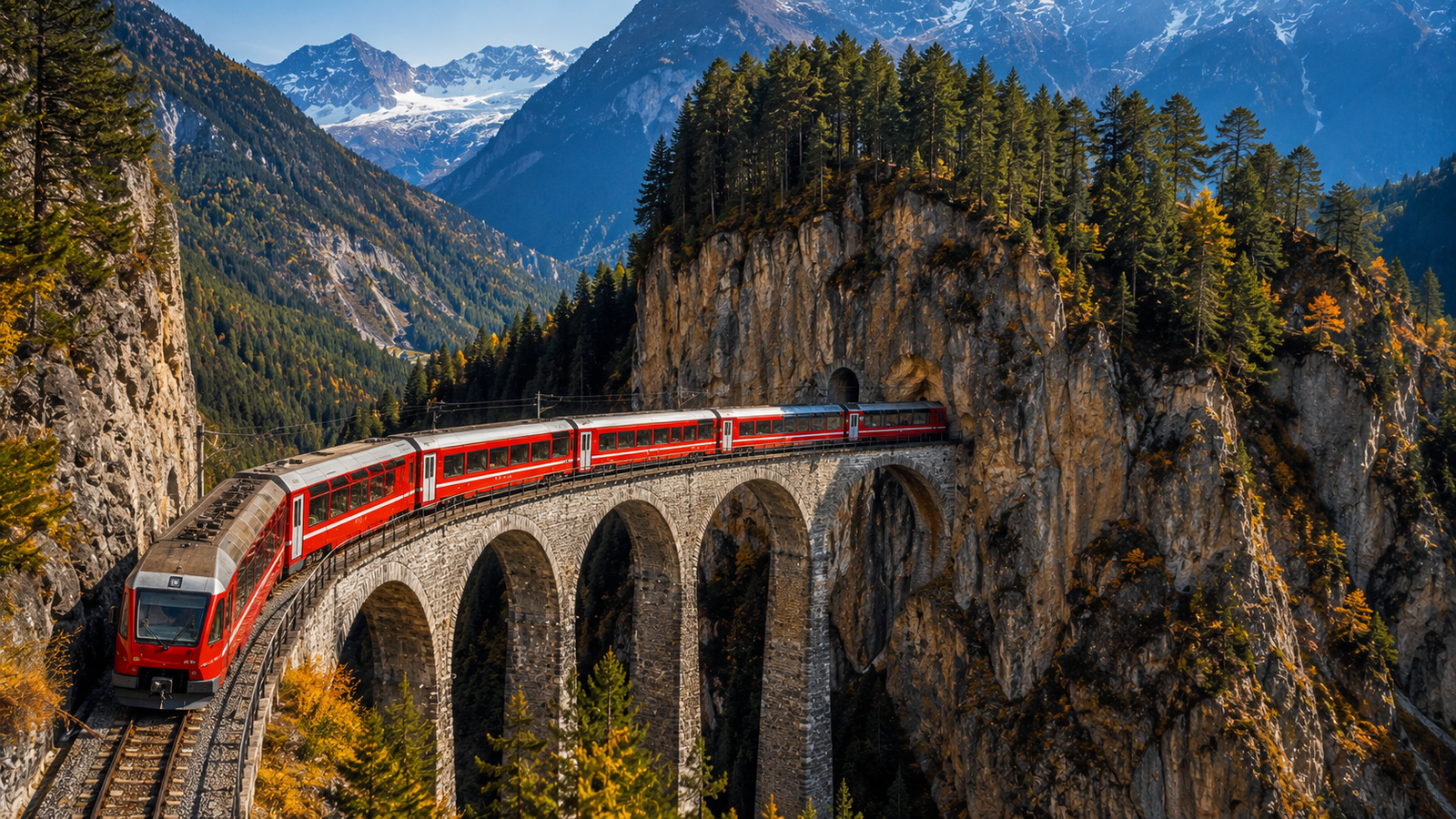
Among the highlights is the breathtaking Landwasser Viaduct, where the railway crosses a towering limestone bridge before disappearing directly into a mountain tunnel.
This iconic structure has become one of the most photographed railway landmarks in Switzerland.
The Furka Base Tunnel Revolution
For many years, heavy snowfall created operational challenges on the original Furka mountain route. Winter conditions frequently forced seasonal closures, limiting service reliability.
A major breakthrough came in 1982 with the opening of the Furka Base Tunnel.
The tunnel allowed trains to bypass the highest and most weather-exposed section of the route. Year-round operation became possible, greatly improving efficiency and passenger convenience.
Although the historic mountain line was eventually preserved as a heritage railway, the new tunnel ensured the Glacier Express could continue operating regardless of winter conditions.
The project represented another example of Swiss engineering adapting to the realities of Alpine geography.
A Train Designed for the View
Modern Glacier Express trains are designed around a simple concept: maximizing the passenger experience.
Panoramic windows extend into the roofline, providing uninterrupted views of mountains, forests, rivers, and villages. Comfortable seating allows travelers to enjoy the scenery during the approximately eight-hour journey.
Onboard dining adds another dimension to the experience. Meals featuring Swiss specialties are served directly at passengers’ seats, allowing travelers to remain immersed in the landscape.
Unlike high-speed rail systems focused on efficiency, the Glacier Express celebrates the journey itself.
Its slower pace has become one of its greatest strengths.
More Than a Tourist Attraction
While the Glacier Express is internationally famous, it also represents an important chapter in Swiss cultural history.
The train reflects the collaboration of multiple regions, languages, and railway companies working toward a common goal. It showcases engineering achievements that transformed isolated mountain communities into accessible destinations.
Its route passes through areas shaped by German, Romansh, and Italian cultural influences, offering passengers a glimpse into the diversity that defines modern Switzerland.
The train therefore serves not only as a scenic attraction but also as a moving introduction to the country’s geography, history, and cultural identity.
Why the Glacier Express Continues to Inspire
Nearly a century after its inaugural journey, the Glacier Express remains one of the world’s most celebrated railway experiences.
Part of its appeal lies in the contrast between modern life and the timeless landscapes beyond the windows. As the train winds through mountain valleys, crosses historic bridges, and climbs toward high Alpine passes, passengers experience Switzerland at a pace that encourages observation rather than haste.
Its enduring success demonstrates that some journeys are valuable not because they are fast, but because they reveal something meaningful along the way.
The Glacier Express began as a practical transportation link connecting remote regions of Switzerland. Over time, it evolved into a symbol of Swiss engineering, Alpine beauty, and the art of slow travel. For travelers from around the world, it remains one of the most memorable ways to experience the heart of the Swiss Alps.