
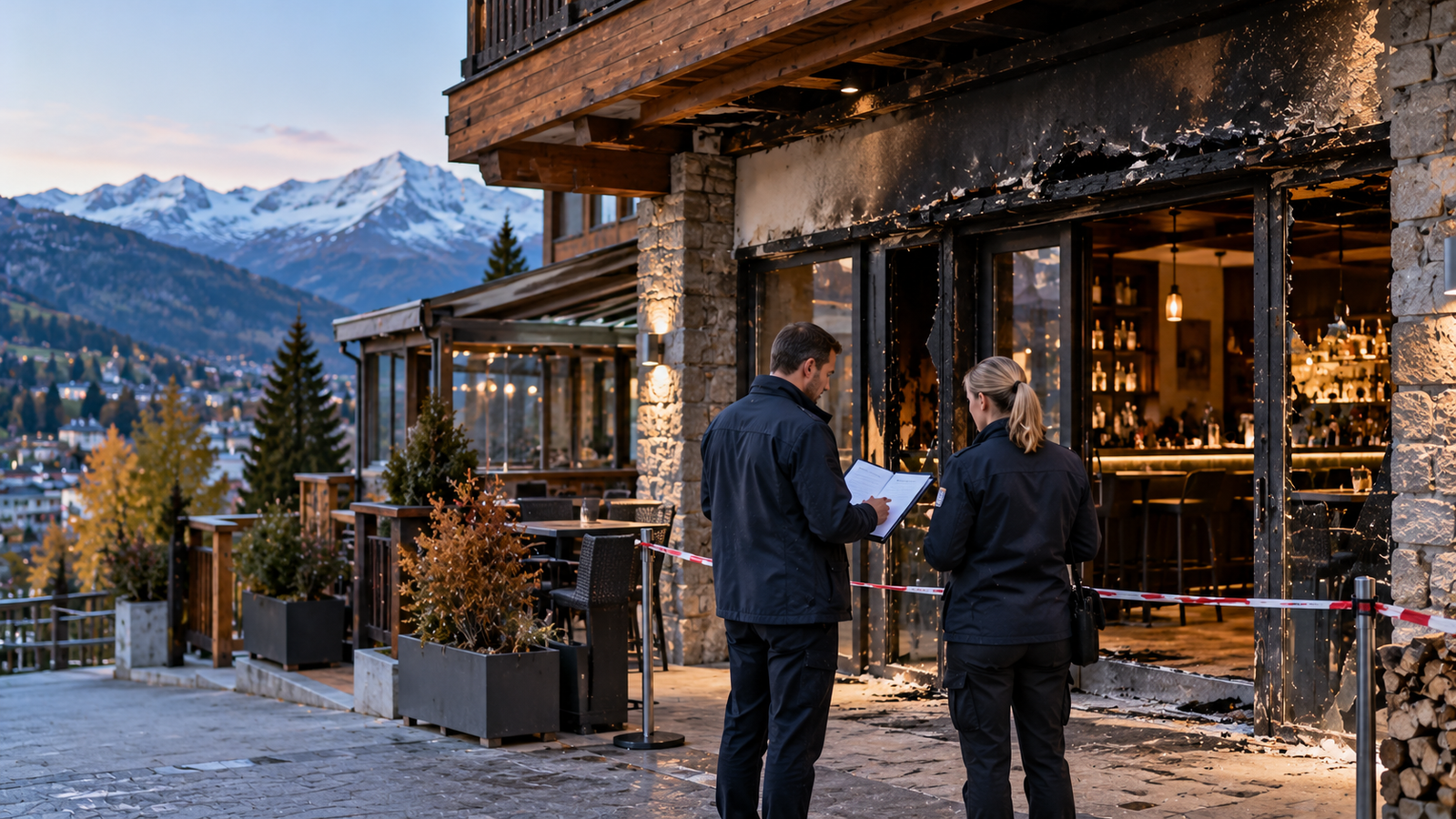
Crans-Montana Fire Investigation Examines Earlier Warnings About Sparklers
A message sent by the owner of Le Constellation bar in Crans-Montana six years before a devastating New Year’s Day fire has become a significant piece of evidence in Switzerland’s ongoing criminal investigation. The November 2019 message warned employees that sparklers could ignite the establishment’s furnishings, raising questions about what the owners understood about the risks associated with the devices used during celebrations.
The message has renewed scrutiny of the conduct of Jacques Moretti and his wife, Jessica Moretti, who operated the bar. Lawyers representing victims’ families argue that the correspondence could support more serious criminal charges. The couple’s defense team rejects that interpretation, maintaining that awareness of a potential fire hazard does not demonstrate acceptance of the risk of causing deaths.
The dispute places a central question before investigators: whether the available evidence establishes negligence or could justify a more serious allegation under Swiss criminal law.
Earlier Messages Draw Attention to Known Fire Risks
The WhatsApp message, dated November 12, 2019, was sent by Jacques Moretti to employees after a guest was reportedly given a sparkler. According to Swiss public broadcaster RTS, which obtained information about the message through the investigation, Moretti warned staff against handing sparklers to customers without proper supervision. He also referred to the possibility of the device falling onto furniture and causing a fire.
A second message, sent by Jessica Moretti approximately a month later, addressed the same issue. She instructed staff to supervise customers using sparklers until the devices had gone out and warned about the possibility of sparks reaching upholstered surfaces or the ceiling.
The correspondence has drawn attention because it predates the fatal fire by several years. Investigators are examining the extent to which the messages demonstrate knowledge of the hazards associated with the establishment’s celebratory practices.
A further piece of evidence cited in RTS reporting dates to January 1, 2020. In a video recorded at the venue, a member of staff can be heard warning customers to be careful of the ceiling foam while they were using sparklers.
Taken together, the messages and video provide investigators with material to examine how the risks were understood and communicated within the business. Their legal significance, however, depends on the complete evidentiary record and the interpretation applied by prosecutors and, if the case proceeds to trial, the courts.
How the January 2026 Fire Unfolded
The fire broke out at Le Constellation during New Year’s celebrations in the early hours of January 1, 2026. The disaster killed 41 people and injured 115, many of whom suffered severe burns, according to Switzerland’s Federal Office of Public Health. The scale of the injuries prompted an extensive emergency response and the transfer of some patients to specialist burn units.
Investigators have examined a leading hypothesis that sparks from bottle-mounted pyrotechnic devices ignited combustible acoustic foam on the ceiling, allowing the fire to spread rapidly through the premises. The precise sequence of events and the potential criminal responsibility of those involved remain matters for the investigation.
The disaster also prompted scrutiny of the establishment’s fire-safety arrangements and the inspections conducted by local authorities.
Crans-Montana’s municipal authorities acknowledged that periodic inspections of Le Constellation had not taken place between 2020 and 2025, despite the requirement for regular controls. The last reported fire-safety inspection had occurred in 2019. The municipality expressed regret over the failure and commissioned additional inspections of public establishments.
These separate lines of inquiry matter because responsibility for a fatal fire may involve questions about business operations, building materials, safety procedures and regulatory oversight. Evidence concerning the owners’ awareness of sparklers is only one part of that broader examination.
Victims’ Families Seek a More Serious Legal Assessment
Several lawyers representing victims’ families believe the earlier messages could justify considering murder with conditional intent rather than relying solely on negligent-homicide allegations.
Under the argument advanced by those lawyers, the correspondence could help establish that the owners knew the use of sparklers posed a serious hazard but continued to permit the practice. They contend that the messages should be assessed alongside the other evidence concerning how the bar operated.
That position remains an allegation advanced by the families’ legal representatives, not a finding of guilt.
The distinction between negligence and conditional intent is important in Swiss criminal law. Negligent homicide concerns causing a death through a failure to exercise the required care. Conditional intent involves a more demanding question: whether a person recognized the possibility of the prohibited outcome and accepted that risk.
Knowing that a fire could occur does not, by itself, establish that someone accepted the possibility of people dying. Prosecutors would need to assess the circumstances, the nature of the risk and the evidence concerning the defendants’ conduct.
The legal issue is therefore not simply whether the owners knew sparklers could start a fire. It is whether the evidence supports the more specific mental element required for the more serious allegation.
Defense Lawyers Reject the Interpretation
The Morettis’ lawyers have offered a different reading of the correspondence. They told RTS that the messages were provided to prosecutors by the defense itself and argued that they demonstrate awareness of ordinary business hazards rather than an acceptance of the possibility of death.
The defense maintains that warning employees about fire risks is evidence of an effort to communicate precautions, not proof that the owners intended or accepted a fatal outcome.
That argument will have to be considered alongside the messages’ context, the operating practices at Le Constellation and the other evidence gathered by investigators.
The existence of a written warning can be relevant in more than one direction. It may demonstrate that a hazard had been identified, while also raising questions about what measures were subsequently taken to control it. Determining the legal significance requires more than examining an isolated sentence.
Neither the messages nor the arguments advanced by either side settle the question of criminal responsibility.
Investigation Extends Beyond the Bar Owners
The proceedings have broadened since the fire. By late August 2026, 17 people had become defendants in the investigation, including the Morettis and current or former municipal officials and employees. Authorities are examining possible failures connected with the establishment’s opening, building work, inspections and safety oversight.
The investigation has not produced a final indictment, and no trial date has been set, according to the latest available procedural information. The defendants remain presumed innocent unless and until a court establishes guilt.
The broader inquiry is significant because the disaster raises questions not only about individual decisions inside the bar but also about how fire risks were assessed and monitored over time.
The Swiss authorities have also introduced measures intended to prevent similar incidents. A national prohibition on the use of pyrotechnic articles in premises open to the public took effect on April 1, 2026, as part of the response to the disaster and changes to fire-protection rules.
Prosecutors Face a Critical Decision
The newly reported messages could influence the assessment of whether the charges against the bar owners should be changed. Prosecutors must evaluate the correspondence alongside witness accounts, technical findings, safety records and other material collected during the investigation.
A decision to pursue more serious charges would not establish guilt; it would mean that prosecutors considered the evidence sufficient to advance a different legal allegation. Any ultimate determination would remain a matter for the courts.
For the victims’ families, the question of accountability remains central to understanding how a night of celebration became one of Switzerland’s deadliest recent fires. For investigators, the challenge is to distinguish between knowledge of a general hazard, failures to take adequate precautions and the more specific legal requirements for establishing criminal intent.
The 2019 messages have brought that distinction into sharper focus. Their ultimate significance will depend on the full evidence and the legal conclusions reached as the proceedings continue.