
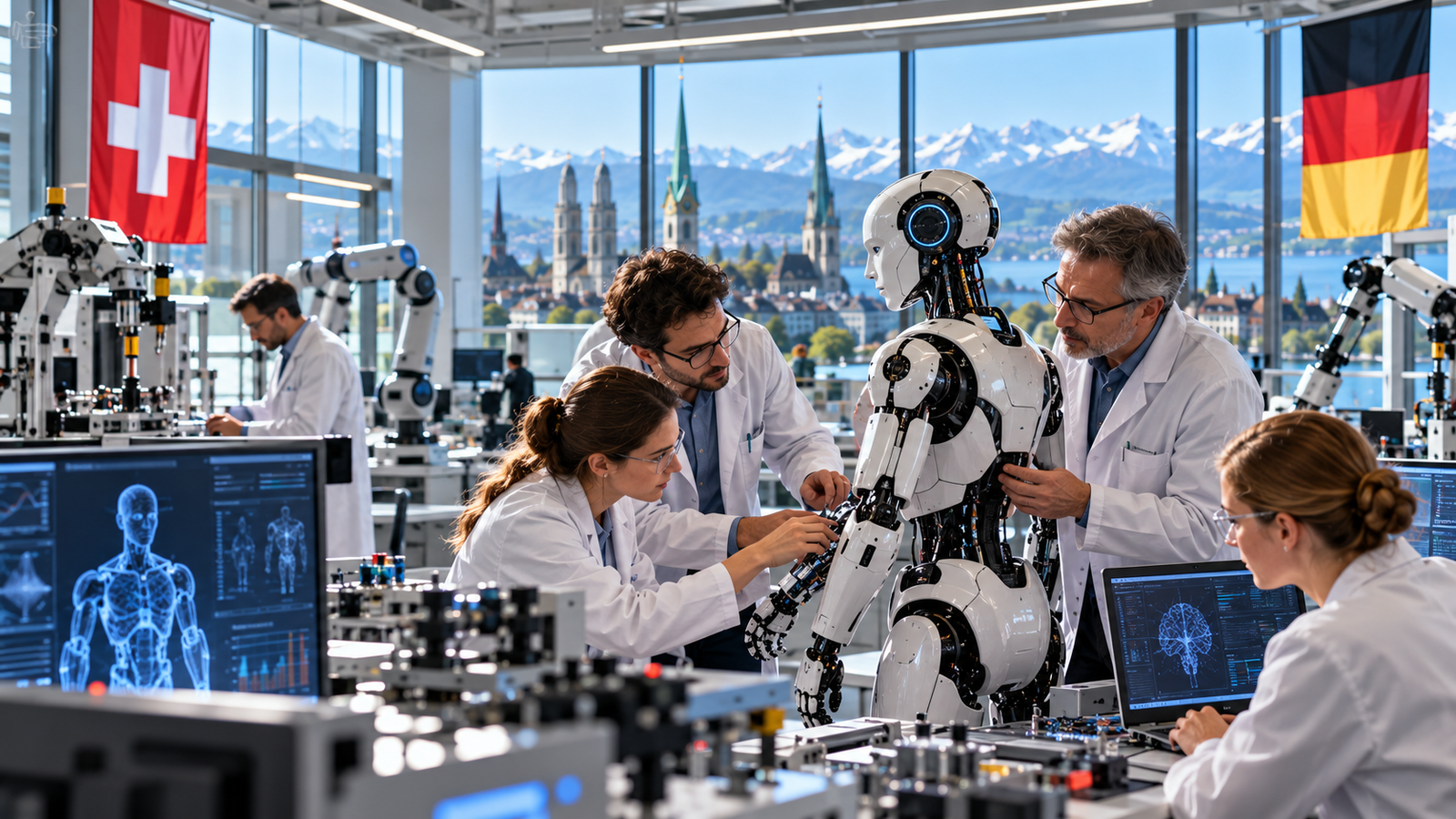
Switzerland and Germany Expand Research Alliance With Focus on AI and Robotics
Switzerland and Germany have agreed to deepen their long-standing scientific partnership through a new cooperation framework centered on artificial intelligence, robotics, digital technologies, and sustainable innovation, reinforcing one of Europe’s most important cross-border research relationships.
Officials from both countries signed a letter of intent in Bern this week during a bilateral meeting dedicated to education, research, and innovation policy. The agreement establishes a roadmap for closer collaboration between researchers, universities, public institutions, and innovation networks as both nations seek to strengthen their positions in rapidly evolving technology sectors.
The initiative arrives at a time when governments across Europe are increasing investments in strategic technologies amid intensifying global competition in artificial intelligence, advanced manufacturing, and next-generation robotics. Policymakers increasingly view international research partnerships as essential for maintaining scientific competitiveness and accelerating technological breakthroughs.
Focus on Emerging Technologies
According to officials involved in the discussions, the renewed partnership will prioritize cooperation in several key fields, including artificial intelligence, robotics, digital transformation, and sustainability-related technologies. The agreement is designed to encourage greater exchanges between research institutions and support the development of joint scientific projects.
The collaboration builds on an already extensive research relationship. Germany remains Switzerland’s most significant international partner in education, research, and innovation activities. Existing cooperation spans universities, government-funded research initiatives, scientific institutions, and industry partnerships.
The two countries have maintained regular high-level meetings on research policy for decades. The latest gathering brought together Swiss State Secretary for Education, Research and Innovation Martina Hirayama and German State Secretary Marcus Pleyer, along with representatives from scientific and innovation organizations from both nations.
Strong Existing Foundation
The new agreement is being built upon a substantial foundation of ongoing collaboration.
Under the European Union’s Horizon Europe research framework, nearly 1,300 joint Swiss-German projects have already been completed. Meanwhile, since 2020, the Swiss National Science Foundation has supported more than 4,600 projects involving German research partners. Those figures illustrate the scale of scientific cooperation already taking place between the neighboring countries.
Research leaders say such partnerships have become increasingly important as scientific challenges grow more complex and interdisciplinary. Advances in artificial intelligence, robotics, climate technologies, and digital infrastructure often require expertise from multiple institutions and countries.
The latest agreement aims to make those collaborations easier by creating a stronger framework for knowledge exchange and future joint initiatives.
AI and Robotics Becoming Strategic Priorities
Artificial intelligence and robotics have emerged as central priorities for both countries as governments, universities, and private companies race to develop technologies expected to transform industries ranging from manufacturing and transportation to healthcare and education.
Switzerland has become a recognized center for AI and robotics research through institutions such as ETH Zurich and EPFL, while Germany maintains one of Europe’s largest research ecosystems and industrial technology sectors. Both countries view innovation in these fields as essential for long-term economic competitiveness.
Recent developments highlight the growing importance of robotics research within Switzerland. Researchers and startups are increasingly developing systems that combine advanced hardware with artificial intelligence, allowing machines to adapt to real-world environments and perform increasingly sophisticated tasks. These technologies are being explored for applications ranging from industrial automation and infrastructure inspection to autonomous mobility and advanced manufacturing.
At the same time, discussions around AI governance, transparency, and responsible deployment have become more prominent as governments seek to balance innovation with regulatory oversight. Swiss institutions have recently hosted forums focused on ensuring that AI development remains aligned with democratic values, accountability standards, and public trust.
European Innovation Strategy
The agreement between Switzerland and Germany also reflects broader efforts across Europe to strengthen scientific cooperation amid increasing technological competition from the United States and China.
European policymakers have repeatedly emphasized the need to maintain leadership in advanced technologies while reducing dependence on external innovation ecosystems. Collaborative research programs are viewed as one way to pool expertise, share infrastructure, and accelerate scientific progress.
Switzerland continues to rank among the world’s leading innovation economies, supported by strong universities, research institutions, and private-sector investment. Artificial intelligence has become an increasingly important contributor to research activity and venture capital investment across the country.
The partnership with Germany is expected to further enhance opportunities for researchers working in emerging fields by facilitating cross-border projects and strengthening links between academic and industrial research communities.
Looking Ahead
While the newly signed agreement does not announce specific funding commitments or individual projects, it establishes a framework for expanded cooperation in areas that are expected to shape future technological development.
For researchers, universities, and innovation agencies, the partnership signals continued political support for international collaboration at a time when scientific competition is intensifying worldwide. It also underscores the importance both countries place on artificial intelligence, robotics, and digital technologies as drivers of future growth.
As Switzerland and Germany move forward with the initiative, attention will likely focus on how the agreement translates into concrete research programs, institutional partnerships, and technological innovations. With thousands of collaborative projects already linking the two nations, the latest accord represents less a new beginning than a significant expansion of one of Europe’s most established scientific relationships.