

Swiss Franc (CHF)
What is the Swiss Franc (CHF)? A Complete Guide to Switzerland’s Currency
The Swiss Franc (CHF) is one of the world’s most respected and stable currencies. Whether you are planning a trip to Switzerland, studying its economy, or simply curious about global currencies, understanding the Swiss Franc provides valuable insight into the country itself. This guide covers everything from its history and banknotes to exchange rates, payment methods, and practical travel tips.
Quick Facts About the Swiss Franc
| Fact | Details |
|---|---|
| Currency Name | Swiss Franc |
| Currency Code | CHF |
| Symbol | CHF / Fr. |
| Introduced | 1850 |
| Used In | Switzerland and Liechtenstein |
| Central Bank | Swiss National Bank (SNB) |
| Subunit | 100 Rappen / Centimes |
| Coin Producer | Swissmint |
| Official Languages on Currency | German, French, Italian, Romansh |
What is the Swiss Franc (CHF)?
The Swiss Franc (CHF) is the official currency of Switzerland and Liechtenstein. It is the only legal tender used throughout Switzerland and is recognized worldwide for its stability and reliability.
The abbreviation CHF comes from the Latin name of Switzerland:
Confoederatio Helvetica Franc
Switzerland uses a Latin abbreviation because the country has four national languages—German, French, Italian, and Romansh—and Latin serves as a neutral national identifier.
One Swiss Franc is divided into 100 centimes, 100 Rappen, 100 centesimi, or 100 rap, depending on the language being used.
Today, the Swiss Franc is considered one of the world’s strongest currencies and is often viewed as a safe-haven currency during periods of global uncertainty.
The History of the Swiss Franc
Before 1850
Before Switzerland adopted a national currency, the country had a highly fragmented monetary system. Individual cantons, cities, and regions issued their own coins, while many foreign currencies also circulated throughout the country.
This created significant difficulties for trade, taxation, and commerce.
The Birth of the Swiss Franc
Following the creation of the modern Swiss Confederation in 1848, the federal government gained authority over monetary policy.
In 1850, Switzerland officially introduced the Swiss Franc as a national currency.
The new currency replaced hundreds of regional coins and helped create a unified economy across the country.
This marked a major milestone in Switzerland’s development as a modern nation.
The Creation of the Swiss National Bank
In 1907, Switzerland established the Swiss National Bank (SNB).
The SNB became responsible for:
- Issuing banknotes
- Conducting monetary policy
- Maintaining price stability
- Managing currency reserves
- Supporting the Swiss financial system
Today, the SNB remains one of the most respected central banks in the world.
Modern Swiss Franc
Over the decades, the Swiss Franc has become known for stability, low inflation, and strong international confidence.
Modern Swiss banknotes introduced between 2016 and 2019 feature advanced security technologies and innovative designs that reflect Swiss culture, science, communication, creativity, and humanitarian values.
Why Is the Swiss Franc So Strong?
The Swiss Franc has built a reputation as one of the strongest and most stable currencies in the world.
Several factors contribute to its strength.
Political Stability
Switzerland has one of the world’s most stable political systems and a long tradition of neutrality.
Strong Economy
Switzerland is globally known for:
- Banking and finance
- Pharmaceuticals
- Biotechnology
- Precision engineering
- Luxury watches
- High-tech manufacturing
Low Inflation
Switzerland has historically maintained relatively low inflation compared with many other countries.
Global Confidence
During periods of economic uncertainty, investors often move funds into Swiss Francs because of confidence in Switzerland’s economy and institutions.
For this reason, CHF is often described as a safe-haven currency.
Swiss Franc Coins
Swiss coins are produced by Swissmint, the official mint of Switzerland.
Coins Currently in Circulation
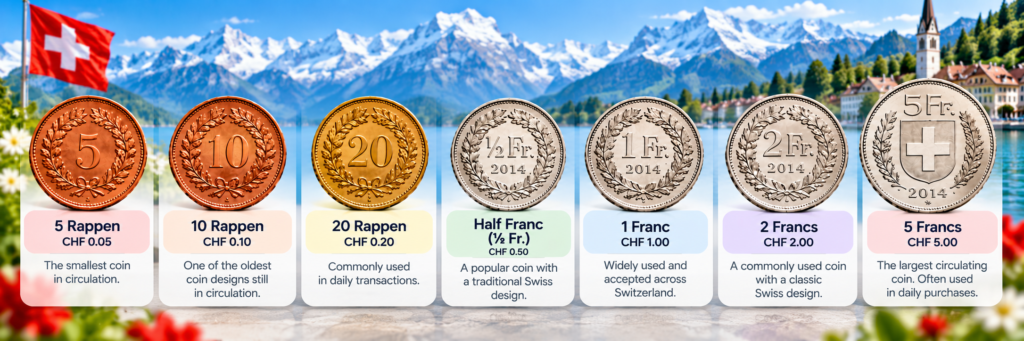
Many Swiss coin designs have remained largely unchanged for decades.
The 10-Rappen coin is particularly notable because it is one of the oldest coin designs still actively used anywhere in the world.
Swiss Franc Banknotes
Swiss banknotes are internationally recognized for their artistic designs and advanced security features.
Banknotes Currently in Circulation

The current series of Swiss banknotes was introduced between 2016 and 2019.
Each note highlights a specific theme that represents Swiss values and achievements.
The Swiss National Bank (SNB)
The Swiss National Bank is Switzerland’s central bank.
Its primary mission is to maintain price stability while supporting the Swiss economy.
The SNB’s key responsibilities include:
- Issuing Swiss banknotes
- Conducting monetary policy
- Managing foreign currency reserves
- Supporting financial system stability
- Monitoring economic developments
The SNB plays a crucial role in maintaining confidence in the Swiss Franc.
Cash vs Card in Switzerland
Switzerland offers one of Europe’s most advanced payment environments.
Credit and Debit Cards
Cards are widely accepted at:
- Hotels
- Restaurants
- Cafés
- Supermarkets
- Shopping centres
- Museums
- Railway stations
- Public transportation
Visa and Mastercard are accepted almost everywhere.
When Cash Is Useful
Cash remains useful in:
- Small villages
- Local markets
- Mountain huts
- Rural regions
- Small independent businesses
Many visitors choose to carry a small amount of Swiss Francs while using cards for most purchases.
Can You Use Euros in Switzerland?
In some locations, yes.
Many tourist-oriented businesses accept euros, particularly near border regions and popular tourist destinations.
However:
- Prices are usually listed in CHF
- Exchange rates may not be favourable
- Change is often given in Swiss Francs
For the best value, using Swiss Francs is generally recommended.
How to Get Swiss Francs
ATMs
ATMs are widely available across Switzerland and are often the easiest way to obtain local currency.
Banks
Swiss banks provide currency exchange services and cash withdrawals.
Exchange Offices
Exchange counters can commonly be found at:
- Airports
- Railway stations
- Tourist centres
Travel Cards
Multi-currency travel cards have become increasingly popular among international visitors.
Interesting Facts About the Swiss Franc
One of Europe’s Oldest National Currencies
The Swiss Franc has been Switzerland’s national currency since 1850.
Used Beyond Switzerland
The Swiss Franc is also the official currency of neighbouring Liechtenstein.
High-Value Banknotes
Switzerland continues to issue a CHF 1,000 banknote, one of the highest-value banknotes commonly circulating in the world.
Four Languages, One Currency
Switzerland’s four national languages all have different names for the currency’s subdivisions.
A Symbol of Stability
The Swiss Franc is widely associated with Switzerland’s reputation for stability, precision, reliability, and financial strength.
Swiss Franc Travel Tips
Carry Some Cash
Although cards are widely accepted, carrying a small amount of cash is always useful.
Compare Exchange Rates
Check exchange rates before converting money, especially at airports.
Pay in Local Currency
When offered a choice between currencies, paying in Swiss Francs often provides better value.
Inform Your Bank Before Travel
If you are visiting from abroad, notify your bank before using your card in Switzerland.
Watch for Foreign Transaction Fees
Some international cards charge additional fees for overseas purchases.
Frequently Asked Questions
What does CHF stand for?
CHF stands for Confoederatio Helvetica Franc, derived from the Latin name of Switzerland.
Is CHF the same as the Swiss Franc?
Yes. CHF is the official international currency code for the Swiss Franc.
Who issues Swiss Franc banknotes?
The Swiss National Bank (SNB).
Who produces Swiss coins?
Swissmint, the official mint of Switzerland.
Is the Swiss Franc used outside Switzerland?
Yes. It is also the official currency of Liechtenstein.
Are cards accepted everywhere in Switzerland?
Cards are widely accepted, but cash remains useful in certain situations.
Can tourists use euros?
Some businesses accept euros, but Swiss Francs are generally preferred.