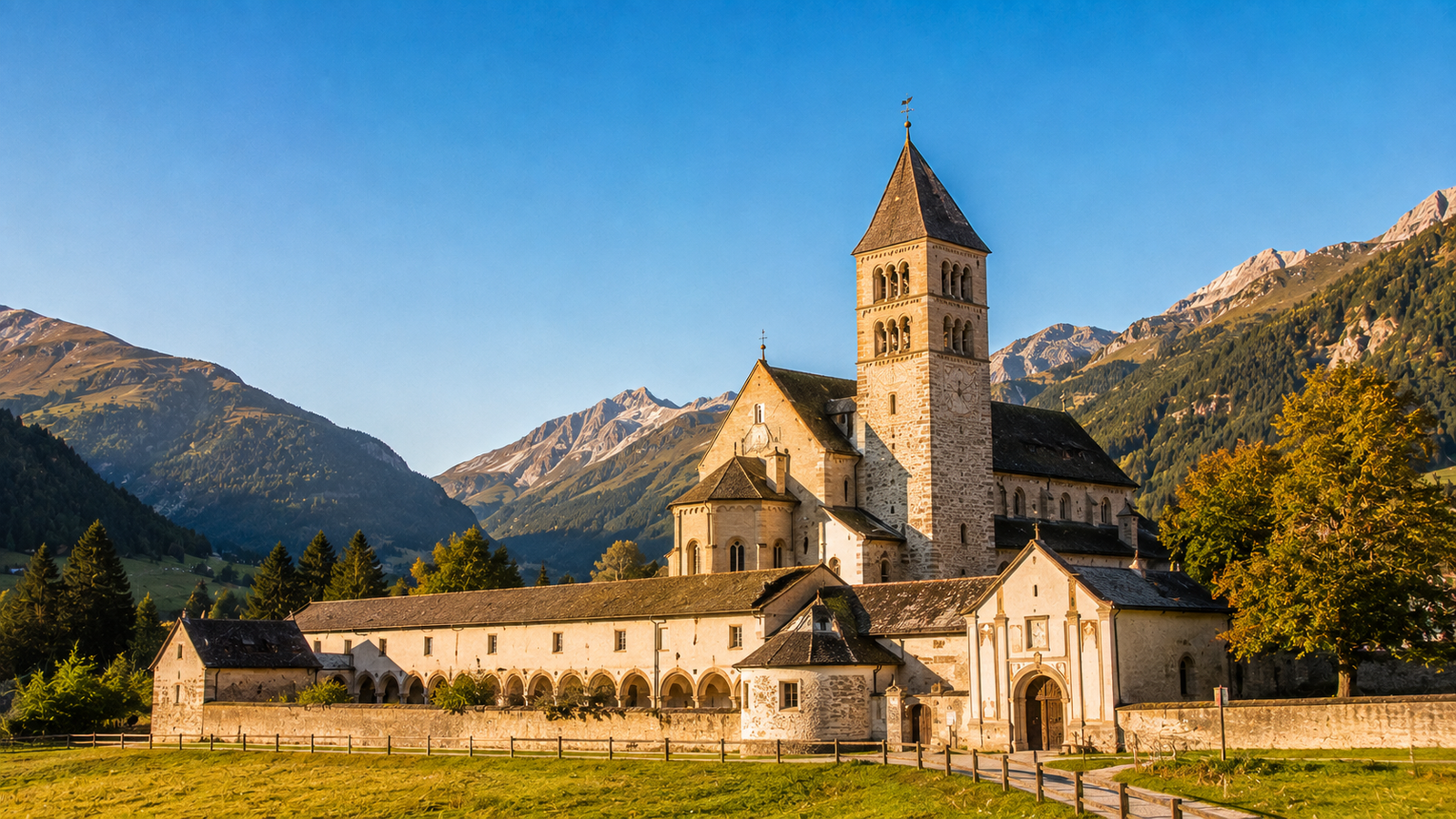
Convent of St. John at Müstair, Müstair, Switzerland
Convent of St. John at Müstair: Switzerland’s Remarkable Window Into the Carolingian World
In the far southeastern corner of Switzerland, near the border with Italy, the quiet village of Müstair guards one of Europe’s most important surviving monuments from the early Middle Ages. Surrounded by the landscapes of the Val Müstair valley, the Convent of St. John stands as a rare link to the Carolingian era, a period that helped shape medieval Europe.
While Switzerland is often celebrated for alpine scenery and lakeside cities, this remarkable monastery offers a very different experience. Visitors arrive not for mountain thrills but for a journey into more than twelve centuries of religious, artistic, and architectural history. The site’s extraordinary preservation and cultural importance earned it recognition as a UNESCO World Heritage Site in 1983.
A Legacy Connected to Charlemagne
The origins of the convent reach back to around the late eighth century. Historical and archaeological evidence indicates that the monastery was founded around 775, likely under the influence or direction of Charlemagne, the ruler whose empire transformed much of Western Europe.
Its location was strategically important. The Val Müstair formed part of an alpine route linking regions north and south of the mountains, making the monastery both a spiritual center and a significant outpost within the Carolingian realm. Over centuries, the complex evolved while maintaining its religious purpose.
By the early ninth century, it was established as a Benedictine institution. During the first half of the twelfth century, it became a women’s abbey, and religious life has continued uninterrupted on the site ever since. Today, Benedictine sisters still reside within the convent, preserving a living tradition that stretches back more than a millennium.
Why UNESCO Recognized Müstair
Many historic churches possess ancient artwork, but few preserve such an extensive collection from the Carolingian age. UNESCO considers the convent one of the most complete examples of Carolingian architecture and artistic expression remaining anywhere in Europe.
The monastery’s greatest distinction lies within the walls of its church. Here visitors encounter Switzerland’s largest collection of figurative murals from around the year 800. These paintings form one of the most significant surviving cycles of early medieval Christian art preserved in their original location.
The murals illustrate scenes from the life of Christ and other biblical narratives. Rather than existing as isolated paintings, they create a continuous visual story that unfolds throughout the church interior. For historians and art scholars, the frescoes provide invaluable insight into religious imagery during a period from which relatively little artwork survives.
Exploring the Convent Complex
Although the church receives most of the attention, the entire convent complex reveals layers of history accumulated over centuries.
The site includes the Carolingian convent church, the Chapel of the Holy Cross, residential buildings, cloisters, courtyards, and historic structures associated with both religious and administrative functions. Visitors can observe how different architectural periods coexist within the same enclosure, reflecting centuries of adaptation without destroying the original foundations.
One of the most notable structures is the Planta Tower, often regarded as one of the oldest surviving secular towers in the Alpine region. Dating from the tenth century, it now houses museum exhibitions that help visitors understand the monastery’s long development and its role in regional history.
Walking through the grounds, travelers encounter an environment that feels more authentic than many restored heritage attractions. The convent was never completely destroyed and rebuilt. Instead, it gradually evolved through centuries of use, creating a fascinating architectural record of changing eras.
The Artistic Masterpiece Inside the Church
The church interior remains the emotional center of any visit.
The Carolingian frescoes cover large sections of the walls and are among the best-preserved examples of their kind. Art historians consider them essential for understanding medieval Christian iconography and the visual culture of the early Middle Ages. UNESCO specifically highlights their importance for studying the development of themes such as the Last Judgment and other biblical narratives.
Later centuries also left their mark. Romanesque frescoes and decorative elements were added, creating an unusual artistic dialogue between different periods of European history. Instead of replacing earlier works entirely, many additions became part of the evolving story of the building.
For visitors unfamiliar with medieval art, the church remains accessible because the paintings communicate through imagery rather than text. Even without specialized knowledge, travelers can appreciate the scale, craftsmanship, and historical significance of the artwork surrounding them.
A Living Religious Community
Unlike some historic monuments preserved solely as museums, the Convent of St. John remains an active religious institution.
The Benedictine sisters who live there continue traditions that connect the present to the site’s medieval origins. This continuity contributes significantly to the convent’s authenticity and cultural value. UNESCO recognizes not only the physical preservation of the buildings but also the uninterrupted religious function of the monastery.
This living dimension adds depth to a visit. Guests are not simply entering a historical exhibit; they are stepping into a place where spiritual life has continued through political changes, social transformations, and centuries of European history.
The Landscape of Val Müstair
The setting contributes greatly to the convent’s appeal.
Val Müstair lies within the canton of Graubünden, one of Switzerland’s most scenic and culturally distinctive regions. The valley sits near the borders of Italy and the Engadin area, surrounded by mountains, forests, and traditional villages.
The peaceful environment helps explain why monastic life flourished here for centuries. Visitors often combine a visit to the convent with exploration of the surrounding valley, hiking routes, and cultural attractions found throughout the region.
Unlike Switzerland’s busiest tourist destinations, Müstair offers a quieter experience where heritage and landscape remain closely connected.
Visiting the Convent Today
Travelers can reach Müstair through the Swiss transport network, often via connections through the Engadin region and the nearby town of Zernez. The convent is one of the cultural highlights of Graubünden and a key stop for visitors interested in history, architecture, religion, and art.
The site rewards slow exploration. Time spent examining the frescoes, visiting the museum spaces, and walking through the historic grounds reveals details that are easy to miss during a brief stop.
For many visitors, the greatest impression comes not from a single artwork or building but from the extraordinary continuity of the place itself. Few locations in Switzerland allow travelers to stand within walls that have witnessed more than 1,200 years of European history while still serving the purpose for which they were originally created.
Hidden within an alpine valley far from the country’s most famous urban landmarks, the Convent of St. John at Müstair remains one of Switzerland’s most profound cultural experiences—a destination where medieval art, religious tradition, and historical memory continue to exist side by side in remarkable harmony.