
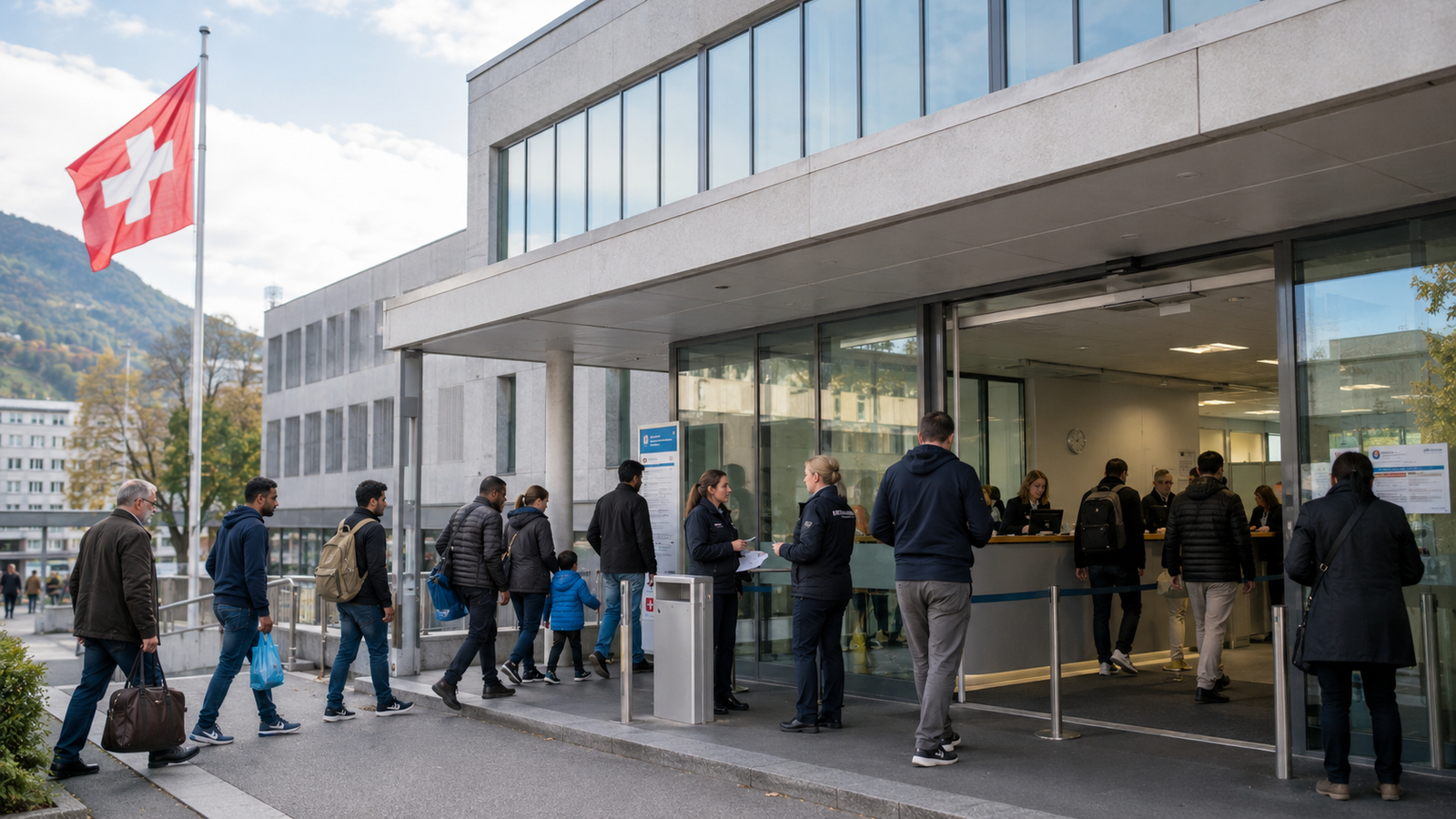
Swiss Authorities Lower Asylum Forecast as New Applications Continue to Decline
Switzerland has reduced its forecast for asylum applications this year after a sustained decline in new arrivals prompted federal migration authorities to revise their expectations downward.
The State Secretariat for Migration (SEM), the federal agency responsible for asylum and immigration matters, now expects approximately 22,000 asylum applications during 2026. The revised projection marks a notable reduction from the previous estimate of 26,000 applications and reflects lower-than-anticipated arrival numbers recorded during the first half of the year.
The updated outlook provides one of the clearest signs yet that migration pressures facing Switzerland have eased compared with recent years. Officials said the revision was based on application trends observed since January, with registrations remaining below earlier forecasts. According to the SEM, asylum requests during the opening months of the year fell to levels not seen since 2022.
While asylum claims have declined, authorities report that enforcement activities involving rejected applicants have moved in the opposite direction. Forced returns have increased over recent years, reflecting ongoing efforts by Swiss authorities to carry out removal decisions after asylum claims are denied and legal procedures have been completed. The number of forced removals rose from 1,654 in 2021 to approximately 2,400 in 2025, according to migration officials.
The changing figures highlight an important shift in Switzerland’s migration landscape. For much of the past decade, European countries faced elevated asylum pressures driven by conflicts, political instability and humanitarian crises in several regions. Switzerland, which participates in European asylum cooperation frameworks while maintaining its own national asylum system, has frequently adjusted reception capacity and administrative resources in response to changing migration flows.
Data released by Swiss authorities indicate that the decline in applications has not been evenly distributed across all nationalities. Applications from Afghanistan, Turkey and Eritrea have fallen significantly compared with previous periods, while authorities have recorded modest increases in requests from applicants originating from Ethiopia and Iraq.
The reduction in Swiss asylum applications mirrors broader developments across parts of Europe. Recent European statistics show a decline in first-time asylum applications across European Union countries compared with the previous year, suggesting that migration pressures have moderated in several destinations. Although Switzerland is not a member of the EU, migration trends on the continent often influence asylum patterns within the country because of geographic proximity and interconnected migration routes.
Federal migration data also show that monthly asylum applications in Switzerland have remained below year-earlier levels during much of 2026. In July alone, authorities registered 1,915 asylum applications, representing a decline of nearly 23% compared with the same month in 2025. Officials have cited these lower monthly figures as one reason behind the revised annual forecast.
The latest projection follows a broader downward trend that had already emerged in recent years. Independent asylum-monitoring reports indicate that Switzerland received fewer asylum applications in 2025 than in 2024. The decline continued into 2026, strengthening confidence among officials that earlier estimates overstated expected arrivals for the current year.
Despite the reduction, migration remains a significant policy issue in Switzerland. The SEM continues to oversee asylum processing, refugee protection, returns, and broader immigration matters in cooperation with cantonal authorities. Decisions involving asylum applicants can have implications for housing, social services, labor-market integration and public spending, making annual forecasts an important planning tool for governments at both federal and regional levels.
Swiss authorities also continue to manage separate protection programs for people displaced by international conflicts, including beneficiaries of Switzerland’s special protection arrangements for Ukrainians. As a result, asylum statistics alone do not capture the full picture of humanitarian migration into the country. Policymakers must balance traditional asylum procedures with other forms of temporary protection and refugee assistance.
For municipalities, cantons and federal agencies, the revised forecast could ease some pressure on reception facilities and administrative resources. Lower application volumes may allow authorities to process cases more efficiently and allocate resources differently than originally anticipated. At the same time, officials continue to monitor international developments that could influence migration flows later in the year.
Migration forecasts remain inherently uncertain because they are influenced by geopolitical events, armed conflicts, economic conditions and humanitarian emergencies that can change rapidly. Swiss authorities therefore regularly review projections and update estimates when significant shifts emerge in application patterns.
For now, however, the latest figures point toward a year in which Switzerland receives substantially fewer asylum applications than originally expected. With arrivals continuing to trend below forecast levels, the government’s revised estimate of around 22,000 applications reflects a migration environment that appears calmer than many policymakers anticipated at the start of 2026.