
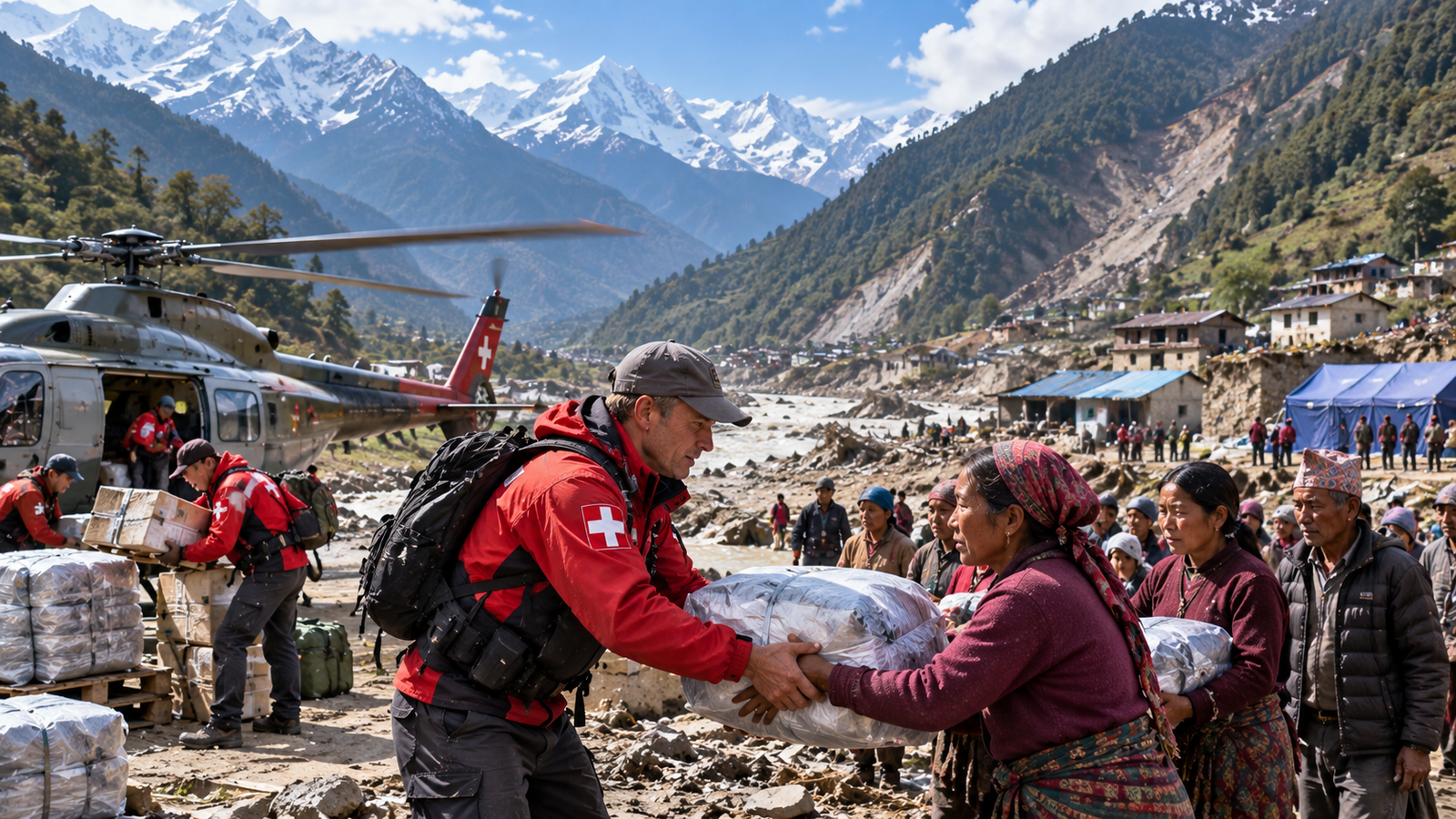
Switzerland Expands Nepal Relief Mission With New Funding and Disaster Experts
Switzerland is increasing its humanitarian response in Nepal by committing additional financial assistance and deploying specialized experts to support recovery efforts following one of the worst natural disasters to strike the Himalayan nation in recent years.
The move comes as Nepal continues to grapple with the aftermath of catastrophic flooding and landslides triggered by a major glacial collapse along the Nepal-China border in late August. The disaster has caused widespread destruction across mountain communities, damaged critical infrastructure, displaced thousands of residents, and launched a large-scale international relief operation. Switzerland’s latest measures are intended to strengthen emergency assistance while helping local authorities address increasingly complex recovery challenges.
According to the Swiss government, an initial emergency contribution of $1 million was released immediately after the disaster through humanitarian channels. Bern has now approved an additional $1 million in response to a United Nations appeal aimed at expanding relief operations in affected regions. The funding is being directed toward urgent needs including shelter, food assistance, clean drinking water, healthcare services, and psychosocial support for survivors.
Swiss officials have also authorized the deployment of disaster-management specialists to Nepal. The expert team is expected to assist with humanitarian coordination, infrastructure assessment, and technical support for relief operations. Such deployments are a long-established element of Switzerland’s international humanitarian strategy, which combines financial assistance with field expertise during major emergencies.
The additional support arrives as the scale of the disaster continues to emerge. Nepalese authorities report more than a thousand fatalities, while thousands of people remain missing. Search-and-rescue teams are still operating across heavily damaged regions where destroyed roads, collapsed bridges, and unstable terrain have complicated access to affected communities. International teams from multiple countries have joined the effort as officials race to locate survivors and provide aid to isolated settlements.
One of the most difficult challenges has been the extensive damage to hydropower facilities located along river valleys. Rescue operations have focused on several power projects where workers were trapped after floodwaters and debris inundated tunnels and construction sites. Recent rescues of survivors found days after the disaster have provided rare moments of optimism amid an otherwise grim recovery effort.
Humanitarian organizations warn that immediate relief remains only the first stage of a much larger recovery challenge. Tens of thousands of homes have reportedly been destroyed or rendered uninhabitable. Entire communities in some mountain districts suffered extensive losses, while transportation networks, water systems, schools, and health facilities require significant reconstruction. Nepalese officials estimate that rebuilding costs will reach billions of dollars.
Switzerland’s response reflects a long-standing relationship between the two countries. Swiss development cooperation in Nepal dates back decades and has included projects in rural development, employment, infrastructure, governance, and disaster resilience. The partnership has often focused on mountain regions, where both countries share expertise related to alpine environments and natural hazard management.
The latest assistance is part of a broader international mobilization. Governments, aid agencies, and multilateral organizations have announced emergency support packages in response to the crisis. The European Union has increased humanitarian funding, while neighboring countries including India and China have deployed relief supplies, technical specialists, and rescue personnel. International organizations such as the United Nations, the World Health Organization, and humanitarian NGOs are coordinating large-scale operations on the ground.
Aid agencies are particularly concerned about conditions facing displaced families. Access to clean water, sanitation facilities, emergency shelter, and healthcare remains a priority as authorities attempt to prevent secondary humanitarian crises. Children, elderly residents, and people living in remote mountain communities are considered among the most vulnerable groups requiring assistance.
Climate and disaster experts have also pointed to the broader significance of the catastrophe. The flooding has renewed concerns about the growing risks associated with glacial instability in the Himalayas, a region increasingly affected by rising temperatures and changing weather patterns. International organizations have warned that similar hazards could threaten millions of people living downstream from mountain glaciers across South Asia in the coming decades.
Swiss authorities say their response is designed to address both immediate humanitarian needs and longer-term recovery requirements. By combining financial support with specialized expertise, officials aim to help relief organizations operate more effectively while strengthening local recovery efforts.
As Nepal moves from emergency response toward reconstruction, international assistance is expected to remain critical. Switzerland’s expanded commitment underscores the importance many donor nations place on sustaining support beyond the initial days of a disaster, particularly when recovery is likely to require years of investment and coordination.