
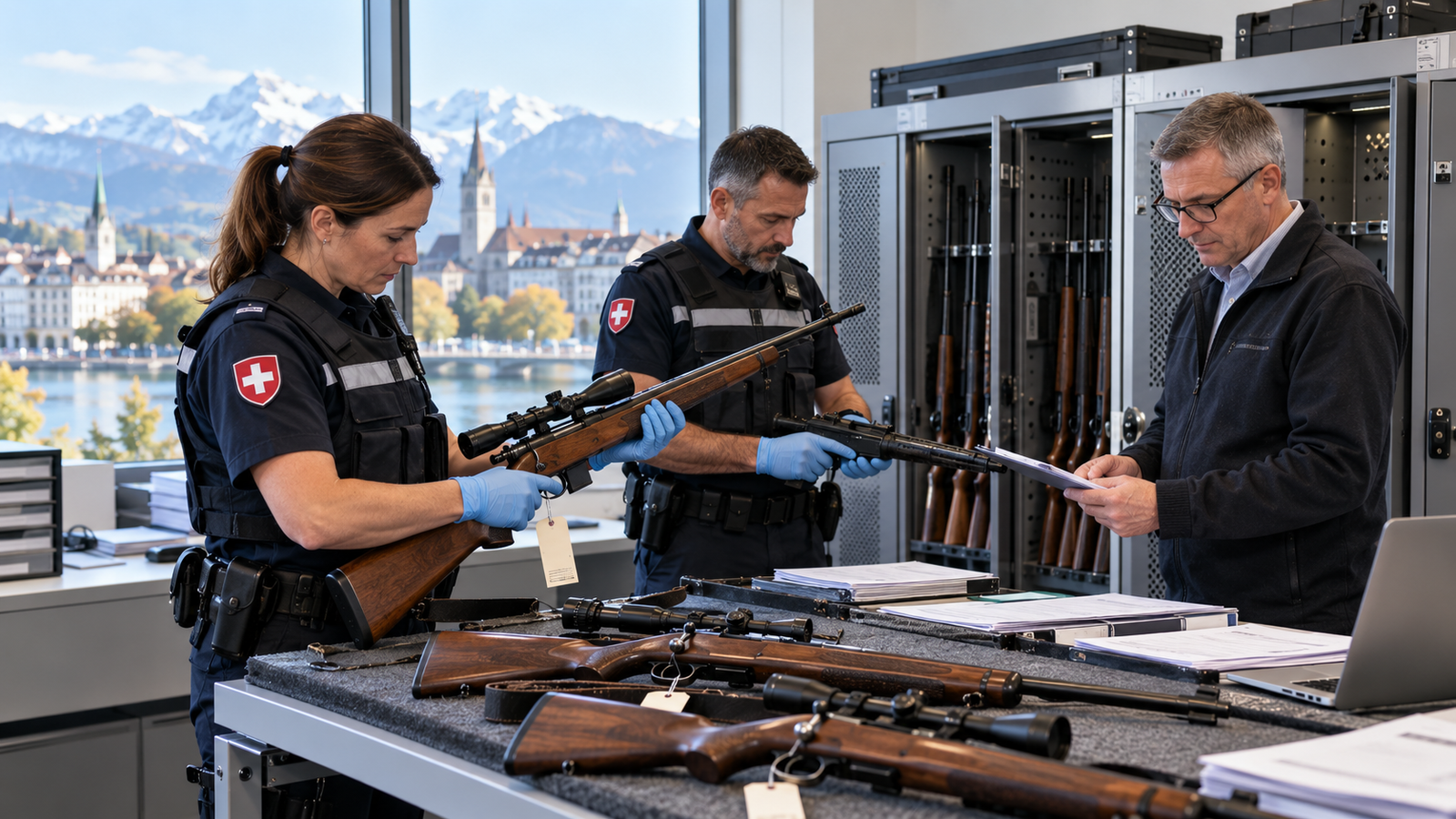
Thousands of Restricted Rifles Remain in Swiss Civilian Hands Through Permit Exemptions
Seven years after Switzerland tightened its firearms legislation to comply with European security standards, restricted semi-automatic rifles continue to circulate widely through a permit system that allows sports shooters and collectors to acquire weapons otherwise barred from ordinary purchases.
New data gathered from cantonal authorities indicate that thousands of exemptions have been granted since the reforms took effect in 2019, highlighting how a law intended to limit access to certain high-capacity firearms has evolved into a framework that still permits legal ownership under specific conditions. The findings have renewed discussion about the balance Switzerland seeks to maintain between public safety, sporting traditions, and individual firearm ownership.
The issue has attracted attention following a recent shooting in the canton of Aargau that prompted renewed scrutiny of firearms regulations and ownership practices in a country known for its unusually high rate of civilian gun possession combined with relatively low levels of gun violence. Authorities have not suggested that the broader permit system was responsible for that incident, but the event has intensified public debate over how restricted firearms are regulated.
Switzerland revised its weapons legislation in 2019 after voters approved measures aligning the country with updated European firearms rules linked to the Schengen security framework. The reforms introduced tighter controls on certain semi-automatic firearms equipped with large-capacity magazines. Rather than imposing a complete prohibition, however, lawmakers created exemptions that allow qualified individuals to obtain such weapons for recognized sporting activities or collecting purposes.
According to information collected from multiple cantons, the exemption system has been used extensively. In Zurich alone, nearly 20,000 restricted firearms were reportedly sold under special permits over the past several years. Other cantons also reported substantial numbers of authorizations, demonstrating that legal demand for these firearms has remained significant despite the legislative changes.
Because Switzerland lacks a comprehensive national firearms registry, determining the precise number of restricted rifles currently in civilian possession remains difficult. Firearm records are managed primarily at the cantonal level, and not all cantons maintain identical statistical reporting systems. As a result, estimates rather than exact nationwide figures are often used when assessing ownership trends. Available information nevertheless suggests that tens of thousands of firearms covered by the post-2019 restrictions may have entered the civilian market through legally approved exemptions.
The continued circulation of these firearms reflects the distinctive nature of Swiss gun policy. Unlike many countries where ownership itself is the primary focus of regulation, Switzerland historically has concentrated on controlling acquisition and transfer while allowing lawful owners to retain firearms under defined legal conditions. The country’s long-standing militia tradition, competitive shooting culture, and hunting heritage have shaped public attitudes toward firearms for generations.
Supporters of the current framework argue that the permit system demonstrates how stricter oversight can coexist with established sporting traditions. Applicants seeking restricted firearms must meet legal requirements and obtain authorization from cantonal authorities. For sport shooters, continued eligibility may require evidence of participation in shooting activities over time, while collectors must satisfy separate criteria. Advocates contend that these safeguards provide accountability without imposing a blanket ban on ownership.
Critics, however, question whether a large volume of exemptions undermines the intended effect of the 2019 reforms. They argue that when restricted firearms remain broadly obtainable through special permits, the practical difference between a restriction and a prohibition becomes less clear. Public safety advocates have periodically called for more centralized oversight and improved national record-keeping to better understand firearm ownership patterns across the country.
The debate illustrates a broader challenge facing policymakers throughout Europe. Following terrorist attacks and security concerns in several countries, governments and international organizations sought tighter controls on certain categories of firearms. Yet nations with deep-rooted shooting traditions have often pursued compromise solutions that preserve legal sporting activities while strengthening regulatory oversight. Switzerland’s 2019 reforms emerged from that wider European conversation and continue to serve as an example of a middle-ground approach.
Despite the prominence of firearms in Swiss culture, gun-related violence remains comparatively uncommon. Analysts frequently point to strict acquisition procedures, mandatory military training traditions, and social factors as contributing elements. Major shootings attract significant public attention precisely because such incidents remain relatively rare in the Swiss context.
The latest figures on permit exemptions are unlikely to settle the debate. Instead, they provide a clearer picture of how the post-2019 regulatory framework operates in practice. While the law formally restricted access to certain semi-automatic rifles, the exemption mechanism has allowed a substantial number of those firearms to remain available through legal channels.
As lawmakers, security experts, and shooting organizations continue to assess the effectiveness of Switzerland’s firearms policies, the discussion is expected to focus less on whether restricted rifles exist in civilian hands and more on whether the current permit structure delivers the balance between security and tradition that voters endorsed when the reforms were adopted.