Rare Aurora Lights Up Swiss Night Sky During Geomagnetic Storm
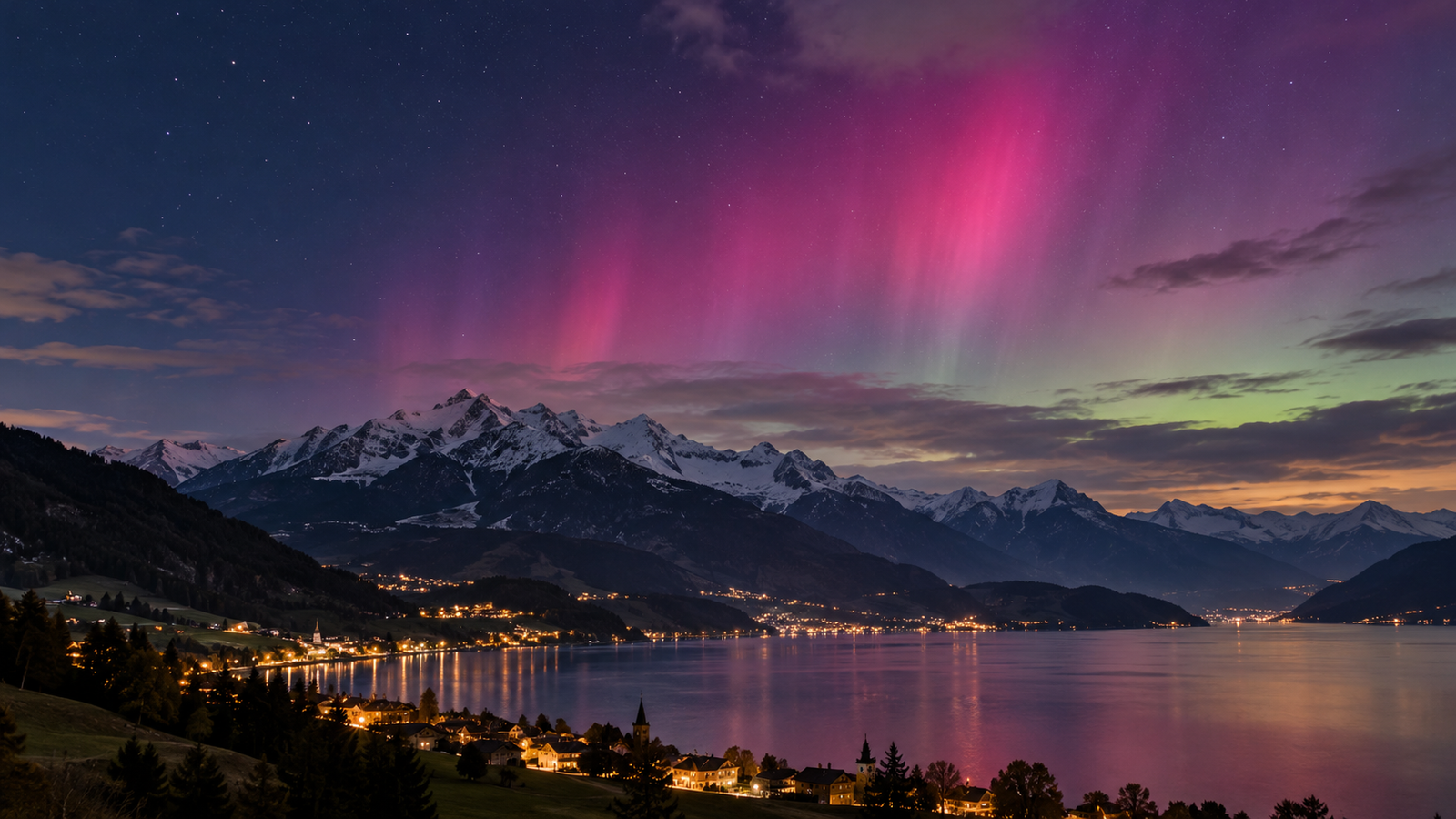
A rare celestial display appeared over Switzerland on Saturday evening, October 10, as faint northern lights became visible in parts of the country during heightened geomagnetic activity. The aurora was recorded by several webcams operated by the Swiss Federal Office of Meteorology and Climatology, known as MeteoSwiss, while observers and photographers shared sightings from different locations. The event offered a glimpse of a phenomenon usually associated with regions much farther north.
The lights were relatively weak, but meteorologist Daniel Gerstgrasser of MeteoSwiss confirmed that the aurora was clearly identifiable in some observations. Visibility varied with local cloud cover, meaning that the spectacle could not be seen equally well across the country. Reports and photographs highlighted sightings around the Jura region and near Lake Thun, while clearer skies in parts of western Switzerland provided opportunities to observe the display.
The appearance coincided with a geomagnetic storm following the arrival of a coronal mass ejection from the Sun, according to the US National Oceanic and Atmospheric Administration’s Space Weather Prediction Center. The storm increased the likelihood of auroral activity at latitudes where the northern lights are normally uncommon.
A rare sight beyond the usual aurora zone
The aurora borealis is most commonly observed at high northern latitudes, including parts of Scandinavia, Iceland, Canada and Alaska. Switzerland lies considerably farther south, making visible northern lights an unusual occurrence rather than a regular feature of the country’s night sky.
That does not mean the phenomenon is impossible in the Alps. During sufficiently strong geomagnetic disturbances, the region where auroras can be observed may extend toward lower latitudes. When that happens, observers in central Europe can sometimes see colored light near the northern horizon or capture it in photographs.
Swiss news reports documented the October 10 display using images from weather cameras and photographs submitted by observers. SRF meteorologist Jürg Zogg reported that cloud cover prevented some people from seeing the aurora, while gaps in the clouds allowed observations in parts of western Switzerland. Images from areas including Galmiz in Fribourg and Krattigen in Bern showed the phenomenon against the night sky.
For people hoping to witness an aurora, the event demonstrated the importance of both space weather and local conditions. Strong geomagnetic activity can create the opportunity, but clouds, light pollution and the observer’s location still influence whether the lights are visible.
What triggered the display?
The northern lights are produced through interactions between electrically charged particles and Earth’s upper atmosphere. Solar activity can send large quantities of charged material into space. When a coronal mass ejection reaches Earth, it can disturb the planet’s magnetic environment and contribute to a geomagnetic storm.
Earth’s magnetic field guides many of these energetic particles toward the polar regions. Interactions involving atmospheric gases then release energy as light, producing the shifting colors associated with auroras. Oxygen and nitrogen play important roles in the process, with the resulting colors depending partly on the gases involved and the altitude of the interaction.
The NOAA Space Weather Prediction Center reported that a coronal mass ejection reached Earth on October 10. Its monitoring systems detected the disturbance in the solar wind, and NOAA issued a warning for a moderate G2 geomagnetic storm before later reporting conditions reaching the stronger G3 level. A G2 watch remained in effect for October 11.
These classifications describe the strength of geomagnetic disturbances on a scale used to assess space-weather conditions. Higher levels can make auroras visible farther from the poles, although a particular storm’s effects on visibility depend on several factors.
The timing of the storm helps explain why the lights appeared over Switzerland. However, geomagnetic activity alone cannot guarantee a visible display at a specific location or time.
Why the colors can look different in photographs
Auroras may appear green, red, pink or in combinations of these colors. The precise appearance depends on the atmospheric conditions and the energy of the particles involved. Green light is commonly associated with oxygen at lower auroral altitudes, while red emissions can occur higher in the atmosphere.
The October sightings included faint reddish colors in some photographs. Such colors can be easier to distinguish in camera images than with the unaided eye because cameras can collect light over a longer exposure. A photograph may therefore show more color and detail than a person could perceive while standing outdoors.
This difference can lead to varying descriptions of the same event. Someone watching the sky might notice a pale glow, while a camera captures a more clearly colored structure. Neither observation necessarily means the display changed dramatically between the two views.
Weather conditions also matter. Switzerland’s mountainous terrain and changing cloud cover create significant differences in visibility over relatively short distances. Even during a period of strong solar activity, one area may have a clear view while another remains completely overcast.
A reminder of the Sun’s influence on Earth
Auroras are among the most visible effects of space weather, but geomagnetic storms can have consequences beyond the night sky. Strong disturbances may affect satellite operations, radio communications, navigation systems and electrical infrastructure, depending on their intensity and the systems involved.
NOAA’s warnings on October 10 reflected the elevated geomagnetic activity associated with the incoming solar material. The warnings do not mean that widespread disruption necessarily occurred in Switzerland. They describe the expected or observed space-weather conditions and the potential for impacts.
For most observers, however, the main effect of the storm was an unusual opportunity to see a natural light display at a latitude where it is rarely visible.
Switzerland has witnessed northern lights during previous periods of elevated solar activity. A notable display in November 2025, associated with a much stronger geomagnetic storm, also produced auroral colors visible on webcams in the Swiss Alps. The recurrence of such events illustrates how changes in solar activity can occasionally bring the aurora into view across central Europe.
Can the northern lights be seen again?
The NOAA forecast included a geomagnetic storm watch for October 11, indicating that elevated activity remained possible beyond Saturday’s display. That does not guarantee another aurora over Switzerland: the storm’s development, darkness, cloud cover and local viewing conditions all affect the chances.
Anyone hoping to see the lights should monitor current space-weather forecasts and local cloud conditions. A location away from bright city lights with a clear view of the northern sky can improve the chances of spotting a faint aurora. Weather webcams may also help confirm whether the sky is clear, although they cannot guarantee that the lights will appear.
Saturday’s display was a reminder that a distant event on the Sun can create a visible spectacle across the Swiss night sky. For those who caught it, the faint glow offered an uncommon view of the aurora. For everyone else, it demonstrated why monitoring solar activity can sometimes lead to unexpected sights much farther south than the northern lights’ usual range.