
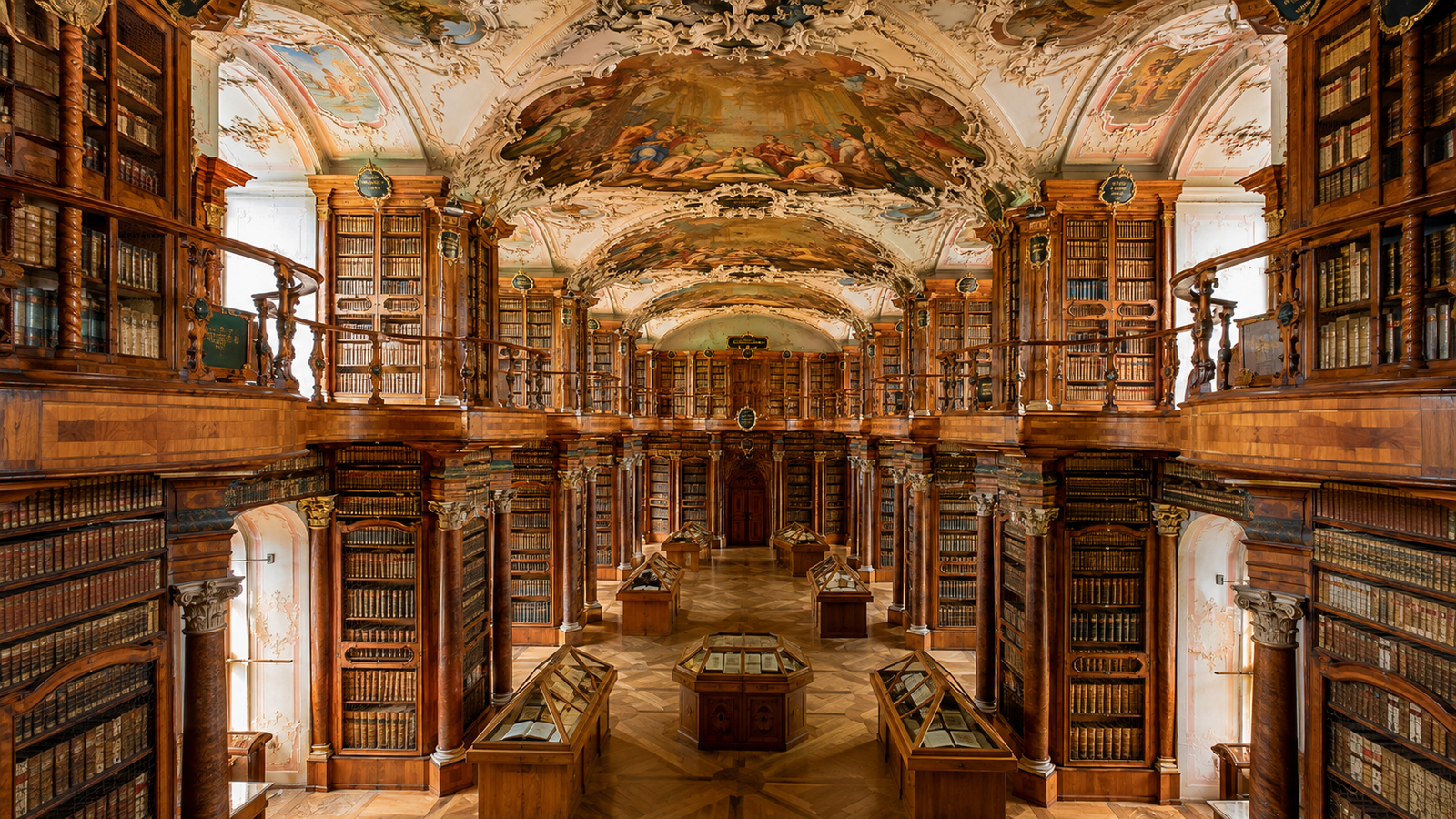
Abbey Library of St. Gall, St. Gallen, Switzerland
Inside the Abbey Library of St. Gall: Switzerland’s Remarkable Treasure House of Medieval Knowledge
Travelers visiting Switzerland often arrive in search of alpine scenery, mountain railways, and lakeside cities. Yet in the northeastern city of St. Gallen stands one of the country’s most extraordinary cultural landmarks—a place where centuries of intellectual history survive behind carved wooden doors and beneath richly decorated ceilings.
The Abbey Library of St. Gall is more than a historic library. It is one of the world’s most significant collections of medieval manuscripts and a centerpiece of the UNESCO-listed Abbey District of St. Gallen. For scholars, historians, architecture enthusiasts, and curious travelers alike, it offers a rare opportunity to step into a living archive of European civilization.
Within its walls are treasures that document the development of religion, science, literature, music, and education across more than a thousand years. Combined with its remarkable Baroque interior, the library ranks among Switzerland’s most important cultural attractions.
A Legacy Rooted in Early Medieval Europe
The story of the Abbey Library begins with the foundation of the Monastery of St. Gall, which developed around the hermitage of the Irish monk Gallus during the early Middle Ages.
Over the centuries, the monastery became one of Europe’s leading centers of learning. Monks copied texts by hand, preserved ancient knowledge, and created manuscripts that would become invaluable historical records. The abbey’s scriptorium gained a reputation for producing some of the finest manuscripts in medieval Europe.
As the monastery expanded, so did its collection of books and documents. By the Middle Ages, St. Gall had established itself as an important intellectual center, attracting scholars from across the continent.
The significance of this heritage ultimately contributed to the Abbey District being inscribed on the UNESCO World Heritage List in 1983, recognizing its exceptional role in European cultural and religious history.
Entering One of the World’s Most Beautiful Libraries
For many visitors, the first glimpse of the library’s interior becomes the defining memory of their visit.
Completed in the eighteenth century, the present library hall is widely regarded as one of the finest examples of Baroque library architecture in Europe. The room combines artistic elegance with scholarly purpose, creating a space that feels both majestic and intimate.
Curved wooden galleries rise along the walls, while elaborate carvings, decorative stucco work, and painted ceiling frescoes draw the eye upward. Every detail reflects the belief that knowledge and faith were deeply connected.
The warm tones of the woodwork create a welcoming atmosphere despite the grandeur of the surroundings. Unlike many historic institutions that feel distant from modern visitors, the Abbey Library remains remarkably accessible and inviting.
Walking through the hall often feels less like entering a museum and more like stepping into a preserved chapter of European history.
The Treasures Hidden Behind the Shelves
The library’s international reputation rests largely on its extraordinary collection.
The Abbey Library preserves one of the most important collections of early medieval manuscripts in the world. Its holdings include manuscripts dating back more than a thousand years, many of which survived periods of political upheaval, war, and social change.
Among the collection are illuminated manuscripts, theological texts, historical records, scientific works, and early literary documents. These manuscripts provide valuable insights into medieval education, religion, language, and culture.
Particularly significant are texts produced during the Carolingian period, a time when monasteries played a central role in preserving and transmitting knowledge throughout Europe.
Researchers continue to study these materials because they offer direct evidence of how ideas were recorded, copied, and shared during the Middle Ages.
The collection also includes early musical manuscripts that help historians understand the development of Western musical traditions and liturgical practices.
The Famous Egyptian Mummy
One of the library’s most unexpected attractions is a genuine Egyptian mummy.
Known as Schepenese, the mummy arrived in St. Gallen during the nineteenth century and has become one of the institution’s most intriguing exhibits. Originating from ancient Egypt, Schepenese provides visitors with a fascinating connection between European monastic history and one of the world’s oldest civilizations.
The presence of the mummy surprises many visitors who expect only books and manuscripts. Yet it reflects the broad curiosity that shaped historic collections and demonstrates how cultural institutions evolved over time.
Today, Schepenese remains one of the most discussed and photographed objects associated with the library.
A UNESCO World Heritage Masterpiece
The Abbey Library cannot be separated from its wider surroundings.
The library forms part of the Abbey District of St. Gallen, one of Switzerland’s most important UNESCO World Heritage Sites. The district includes the cathedral, monastery buildings, archives, and historic structures that collectively represent centuries of religious, cultural, and educational development.
The cathedral itself is considered a masterpiece of Baroque architecture. Together, the cathedral and library create a remarkable ensemble that attracts visitors from around the world.
UNESCO recognized the site because it represents an outstanding example of a large Carolingian monastery and illustrates the historical importance of monastic culture in Europe.
Exploring the entire district provides context for understanding the library’s role within a much larger historical landscape.
Digital Preservation Meets Ancient Knowledge
Although the library preserves centuries-old manuscripts, it is also engaged in modern preservation efforts.
Many important works have been digitized, allowing scholars worldwide to study fragile manuscripts without risking damage to the originals. This combination of traditional conservation and modern technology ensures that the collection remains accessible to future generations.
Digital archives have expanded the global reach of the institution while helping protect irreplaceable historical documents.
The library’s approach demonstrates how historic cultural institutions can balance preservation with public accessibility.
What Visitors Can Expect
A visit to the Abbey Library offers far more than a quick look at old books.
The experience combines architecture, history, art, religion, and scholarship into a single attraction. Informational exhibits help explain the development of the monastery, the significance of the manuscripts, and the role of St. Gallen in European intellectual history.
Visitors are typically provided with protective slippers to preserve the historic wooden floors, a small detail that reinforces the sense of entering a carefully protected heritage site.
The atmosphere inside remains notably quiet and respectful, encouraging visitors to slow down and appreciate the surroundings.
Photography opportunities are plentiful, although many guests find themselves spending more time observing details than taking pictures. The craftsmanship of the interior rewards careful attention, from the decorative carvings to the symbolic artwork integrated throughout the space.
Exploring St. Gallen Beyond the Library
The city surrounding the library deserves attention as well.
St. Gallen’s historic center features attractive streets, traditional architecture, museums, cafés, and cultural venues. The city has long balanced its religious and educational heritage with a vibrant modern identity.
Visitors often combine the Abbey Library with the nearby cathedral, local museums, and walks through the old town. The compact nature of the city makes it easy to explore on foot.
For travelers interested in Swiss culture beyond the country’s famous mountain destinations, St. Gallen offers a rewarding alternative centered on history, architecture, and intellectual heritage.
Standing beneath the ornate ceiling of the Abbey Library, surrounded by manuscripts that have survived for centuries, visitors gain a rare perspective on the endurance of human knowledge. The attraction is not simply a repository of books; it is a monument to learning itself. In an age defined by digital information and rapid change, the Abbey Library of St. Gall remains a powerful reminder that ideas preserved with care can outlast generations and continue shaping the future long after they were first written.