Why Swiss People Speak Four Languages
A Country United by Diversity
Visitors arriving in Switzerland often notice something unusual almost immediately.
Train announcements may be made in several languages. Road signs can change from one region to another. Menus, newspapers, and conversations sound different depending on where you are in the country.
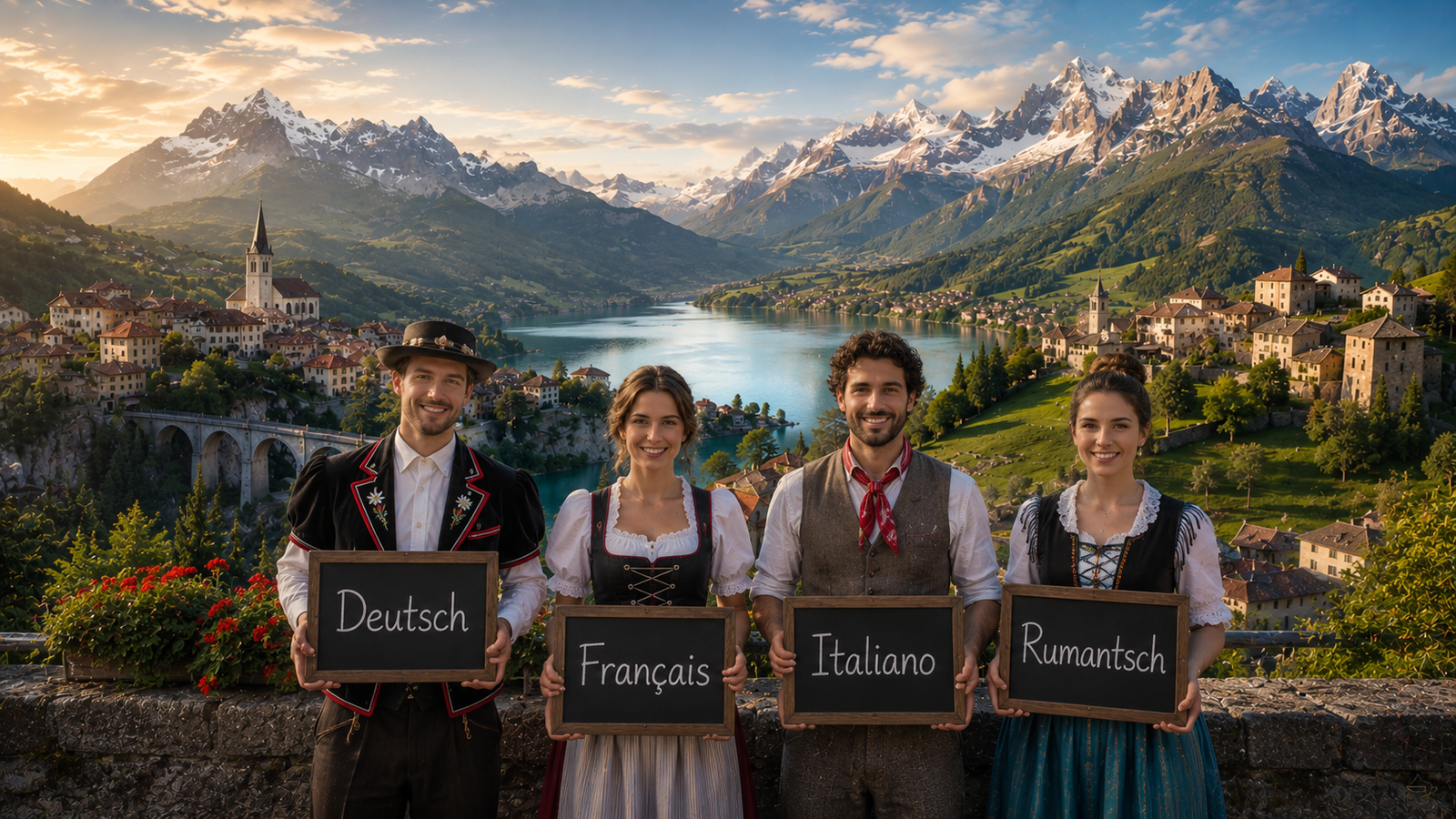
In one part of Switzerland, German dominates daily life. Travel west and French becomes the language of cafés, schools, and local government. Head south across the Alps and Italian fills town squares and markets. Venture into a handful of Alpine valleys and you may hear Romansh, one of Europe’s oldest living languages.
For many travelers, this raises an intriguing question: Why do Swiss people speak four languages?
The answer lies in centuries of geography, history, politics, and cultural cooperation. Rather than forcing a single national language, Switzerland developed a unique model that embraces linguistic diversity as one of its greatest strengths.
A Landscape That Shaped Communities
Switzerland’s geography played a major role in creating its multilingual identity.
The country sits at the crossroads of Western and Central Europe. It borders Germany, France, Italy, Austria, and Liechtenstein, placing it directly between some of the continent’s most influential cultural regions.
The Alps, while beautiful, historically made travel difficult. Mountain ranges often separated communities for generations.
As a result, different regions developed strong cultural and linguistic connections with neighboring areas beyond Switzerland’s borders.
Communities in the north maintained close ties with German-speaking territories. Western regions interacted with French-speaking populations. Southern valleys shared cultural connections with northern Italy.
Instead of merging into a single linguistic culture, these regions preserved their distinct identities.
The Birth of a Multilingual Confederation
Switzerland did not emerge as a nation-state in the same way many European countries did.
The early Swiss Confederation grew gradually through alliances between independent communities and cantons. Each region retained significant autonomy and local traditions.
As new territories joined the confederation over centuries, they often brought different languages and cultural customs with them.
Rather than demanding linguistic uniformity, Swiss leaders generally allowed regions to maintain their own languages.
This approach helped preserve stability within a country that was becoming increasingly diverse.
By the time modern Switzerland emerged in the nineteenth century, multilingualism was already deeply rooted in the national character.
The Four National Languages
Today, Switzerland officially recognizes four national languages.
German: The Majority Language
German is the most widely spoken language in Switzerland.
Roughly two-thirds of the population lives in German-speaking regions, including major cities such as Zurich, Bern, and Basel.
However, everyday speech differs from standard German.
Most residents use Swiss German dialects in daily conversation while standard German is commonly used in education, media, and official documents.
For visitors, this can be surprising because Swiss German often sounds quite different from the German spoken in Germany.
French: Switzerland’s Western Voice
French is spoken primarily in western Switzerland.
This region, often known as Romandy, includes cities such as Geneva, Lausanne, and Neuchâtel.
French-speaking Switzerland has its own cultural traditions, cuisine, architecture, and media landscape while remaining fully integrated into the Swiss Confederation.
The influence of French culture is visible throughout the region, yet it retains a distinctly Swiss identity.
Italian: The Southern Connection
Italian is the primary language of the canton of Ticino and parts of southern Graubünden.
The region enjoys a noticeably Mediterranean atmosphere compared with much of the country.
Palm trees, lakeside promenades, and Italian-inspired architecture contribute to its distinctive character.
Italian-speaking Switzerland serves as an important cultural bridge between northern and southern Europe.
Romansh: A Rare Cultural Treasure
Romansh is Switzerland’s smallest national language.
Spoken mainly in parts of the canton of Graubünden, Romansh evolved from the Latin once spoken in the Roman Empire.
Although only a small percentage of the population uses Romansh today, Switzerland officially recognizes and protects the language.
For many Swiss citizens, Romansh represents an important part of the country’s cultural heritage and historical diversity.
Unity Without One National Language
Many countries use a single national language to strengthen unity.
Switzerland took a different path.
The country developed a political system based on cooperation rather than linguistic assimilation.
Citizens are encouraged to respect regional differences while participating in shared national institutions.
This approach has allowed multiple language communities to coexist successfully for generations.
The result is a national identity built not on language alone but on shared values such as democracy, federalism, neutrality, and civic participation.
In many ways, Switzerland demonstrates that unity does not require cultural uniformity.
How Language Shapes Everyday Life
Language influences daily life throughout Switzerland.
Schools generally teach students in the language of their region while also introducing additional national languages during their education.
Government publications often appear in multiple languages. National organizations, public services, and transportation networks regularly operate across linguistic boundaries.
Television, newspapers, and radio stations frequently serve different language communities while contributing to a broader national conversation.
Many Swiss citizens grow up speaking more than one language, particularly in regions near linguistic borders.
This multilingual environment helps foster cultural awareness and adaptability.
The Invisible Borders of Switzerland
One of the most fascinating aspects of Swiss multilingualism is the existence of linguistic boundaries.
These borders are often surprisingly subtle.
A traveler may pass from a German-speaking town into a French-speaking community within a short train journey.
Road signs, local newspapers, restaurant menus, and everyday conversations gradually shift from one language to another.
Yet despite these differences, there is rarely a sense of division.
Instead, language regions function as complementary parts of a larger national mosaic.
This balance between local identity and national unity is one of Switzerland’s most distinctive characteristics.
What Visitors Discover Beyond the Languages
Travelers exploring Switzerland quickly realize that language is connected to much more than words.
Different linguistic regions offer unique culinary traditions, architectural styles, festivals, and cultural experiences.


4
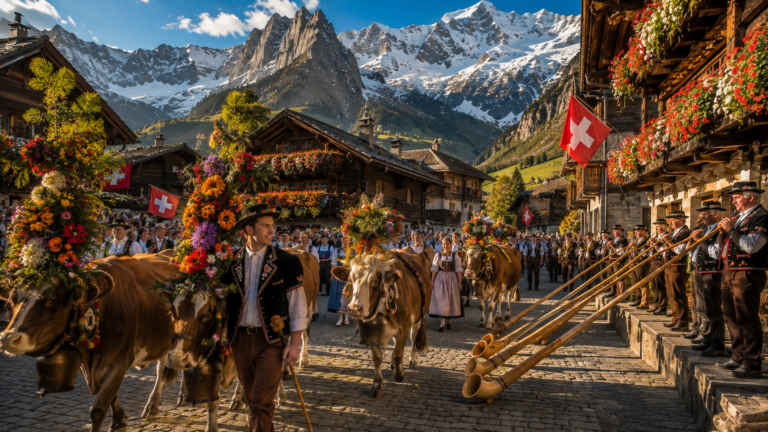
German-speaking regions showcase historic market towns and Alpine traditions. French-speaking areas feature elegant lakeside cities and international institutions. Italian-speaking communities provide Mediterranean charm. Romansh-speaking valleys preserve centuries-old customs rarely found elsewhere in Europe.
Together, these experiences reveal the remarkable cultural richness of Switzerland.
A Multilingual Legacy That Defines the Nation
The story of why Swiss people speak four languages is ultimately the story of Switzerland itself.
Geography brought different cultures together. History allowed them to retain their identities. Political wisdom encouraged cooperation rather than assimilation.
Over time, multilingualism became one of the country’s defining strengths.
Far from creating division, German, French, Italian, and Romansh have helped shape a society that values diversity, mutual respect, and local autonomy.
For visitors, this linguistic landscape adds depth to every journey through the Swiss Alps, lakeside cities, and mountain villages. It offers a reminder that Switzerland’s greatest achievement may not be its mountains, banks, or inventions—but its ability to unite multiple cultures within a single nation while allowing each one to flourish.