
Swiss Growth Outlook Improves as Raiffeisen Signals a Possible Rate Hike
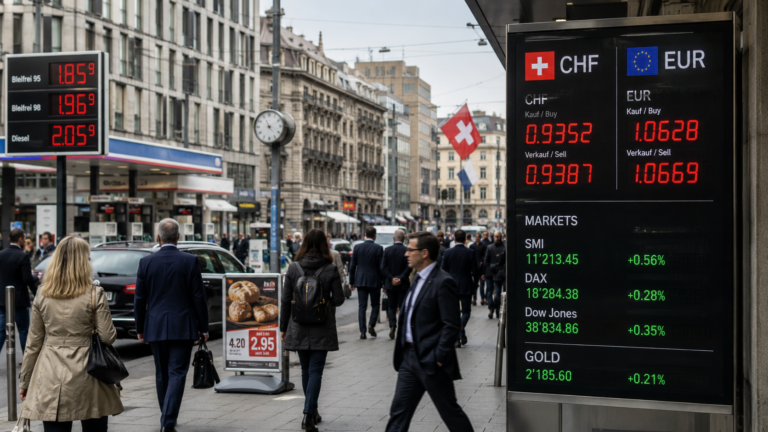
Switzerland’s economic outlook has improved more sharply than previously anticipated, prompting Raiffeisen’s economists to revise their growth forecast for 2026 and warn that the Swiss National Bank (SNB) may soon need to reconsider its zero-interest-rate policy. The bank now expects the country’s gross domestic product (GDP), excluding major sporting-event effects, to expand by 1.7% this year, up from its previous estimate of 0.8%.
The revised outlook reflects stronger-than-expected economic activity during the second quarter, particularly in the pharmaceutical sector, alongside resilient business confidence. However, Raiffeisen’s expectation of a possible interest-rate increase remains a forecast, not an announced decision by Switzerland’s central bank.
The distinction matters for households, businesses and investors assessing the country’s financial outlook as inflationary pressures and uncertainty in international markets continue to influence monetary policy.
Stronger Growth Changes the Economic Picture
Raiffeisen’s latest assessment points to a Swiss economy recovering more firmly than its earlier projections suggested. Its economists have retained their forecast of 1.3% growth for 2027, indicating that the upward revision applies primarily to the current year rather than signalling a comparable acceleration next year.
The second quarter provided an important reason for the change. Switzerland recorded exceptionally strong GDP growth, supported by a substantial contribution from chemicals and pharmaceuticals. The Swiss National Bank has also acknowledged that the sector’s unusually strong performance made the headline economic figures look stronger than the underlying momentum alone would suggest.
That qualification is important when interpreting the revised forecast. A strong quarter can improve the annual growth calculation without necessarily indicating that every industry is expanding at the same pace.
The SNB nevertheless reported that economic activity had been solid and broad-based even after accounting for the exceptional contribution from chemicals and pharmaceuticals. Its September assessment anticipated full-year growth of between 1.5% and 2% in 2026, broadly consistent with Raiffeisen’s new projection.
Inflation and Energy Costs Complicate the Outlook
Economic growth is only one part of the monetary-policy equation. Inflation has also moved higher, creating a more complicated environment for the central bank.
Raiffeisen has increased its forecast for Swiss inflation in 2026 from 0.5% to 0.7%. For 2027, it now expects inflation of 1.1%, compared with its previous estimate of 0.8%. The bank attributes the revised outlook partly to energy costs remaining elevated for longer than previously expected.
A weaker Swiss franc and increased price pressures from abroad are additional concerns identified by Raiffeisen’s economists. When imported goods and energy become more expensive, domestic price pressures can increase even if inflation remains relatively low compared with other countries.
The SNB’s own figures provide context for the change. Swiss inflation rose from 0.6% in May to 0.8% in August 2026, with higher prices for oil products contributing to the increase. Nevertheless, the central bank said its medium-term inflation outlook had changed only slightly and remained consistent with its definition of price stability.
Switzerland defines price stability as inflation between 0% and 2%. Inflation within that range does not automatically require higher interest rates. The SNB also considers economic conditions, expected future price developments and risks to growth when setting monetary policy.
Why Raiffeisen Expects the SNB to Reconsider Zero Rates
The SNB left its policy rate unchanged at 0% at its September 24, 2026, monetary-policy assessment. Its stated position was that the existing policy remained appropriate to maintain price stability and support economic development.
Raiffeisen takes a different view of how the outlook may evolve over the coming months. Its economists argue that the economy is operating close to its potential and that maintaining an exceptionally accommodative interest-rate policy may become less appropriate if the recovery continues.
The bank expects the SNB could raise rates at its next monetary-policy assessment, scheduled for December 10, 2026. That timing depends on how economic activity, inflation and external conditions develop between now and the meeting.
The central bank has not confirmed that it will raise rates in December. In its September communication, the SNB emphasized that uncertainty remained high, particularly because of developments in the Middle East, energy prices and international trade policy. It also said it would adjust its policy if necessary to maintain appropriate monetary conditions.
The difference between the two positions highlights the uncertainty surrounding the next decision. Raiffeisen is interpreting stronger growth and higher inflation forecasts as reasons to anticipate a policy shift, while the SNB’s official position remains conditional on the evidence available at each assessment.
Government Forecasts Also Point to a Stronger Economy
Raiffeisen’s revised outlook is not an isolated assessment. On September 17, 2026, the Swiss government’s Expert Group on Business Cycles raised its forecast for economic growth to 1.7% for 2026, from 0.9% in its June projection. It maintained its 2027 forecast at 1.6%.
The government’s assessment also identified risks that could weaken the recovery, including the conflict involving Iran, elevated energy prices and continued uncertainty over trade policy. It warned that the exceptionally strong second-quarter figures could overstate the underlying pace of expansion and that some correction was possible during the second half of the year.
These forecasts suggest that Switzerland’s near-term outlook has improved, but they do not eliminate the possibility of slower growth later in the year. The performance of export-oriented industries, international demand and energy markets will remain important factors.
The SNB’s September assessment similarly projected growth of between 1.5% and 2% for 2026, followed by growth of around 1.5% in 2027. The broad agreement among these projections strengthens the case that the outlook has improved, although each institution uses its own assumptions and assessment methods.
What Higher Interest Rates Could Mean for Households
Any future increase in the SNB’s policy rate could affect Swiss households and businesses through borrowing costs, savings returns and financial-market conditions.
Homeowners with mortgages linked to short-term market rates could be particularly attentive to changes in expectations. Fixed-rate mortgage offers can also respond to movements in longer-term interest rates before the SNB makes an official decision.
Raiffeisen’s October assessment notes that rates on longer-term fixed mortgages have already increased moderately as financial markets anticipate a possible departure from zero interest rates. The bank expects that limited rate adjustments would not necessarily produce a dramatic further increase in those mortgage costs.
However, the effect on an individual borrower would depend on the mortgage product, the timing of refinancing and the lender’s terms. A possible policy-rate increase should not be treated as confirmation that every mortgage will become more expensive by the same amount.
Businesses could also face higher financing costs if rates rise, while savers might benefit from improved returns on some deposits. The overall economic effect would depend on the scale of any adjustment and the conditions prevailing when it occurs.
December Decision Remains the Key Milestone
For now, Switzerland’s economy is entering the final months of 2026 with stronger growth expectations but continuing uncertainty over inflation and international developments.
Raiffeisen’s forecast places a potential SNB rate increase firmly on the economic agenda, while the government’s and central bank’s projections provide broader context for the recovery. The next monetary-policy assessment on December 10 will offer the clearest indication of whether the SNB believes conditions justify a change.
Until then, the central issue is whether the improvement in economic activity can be sustained without creating stronger inflationary pressure. Switzerland’s low inflation rate gives the central bank room to assess the situation carefully, but higher energy prices and changes in the exchange rate could influence its calculations.
The latest forecasts therefore point to a stronger Swiss economy, not a guaranteed interest-rate increase. For households, companies and investors, the coming months will be important in determining whether the recovery continues and whether the SNB begins moving away from its zero-rate policy.