
Ancient Lunar Dynamo May Have Generated Moon’s Lost Magnetic Shield, Study Finds
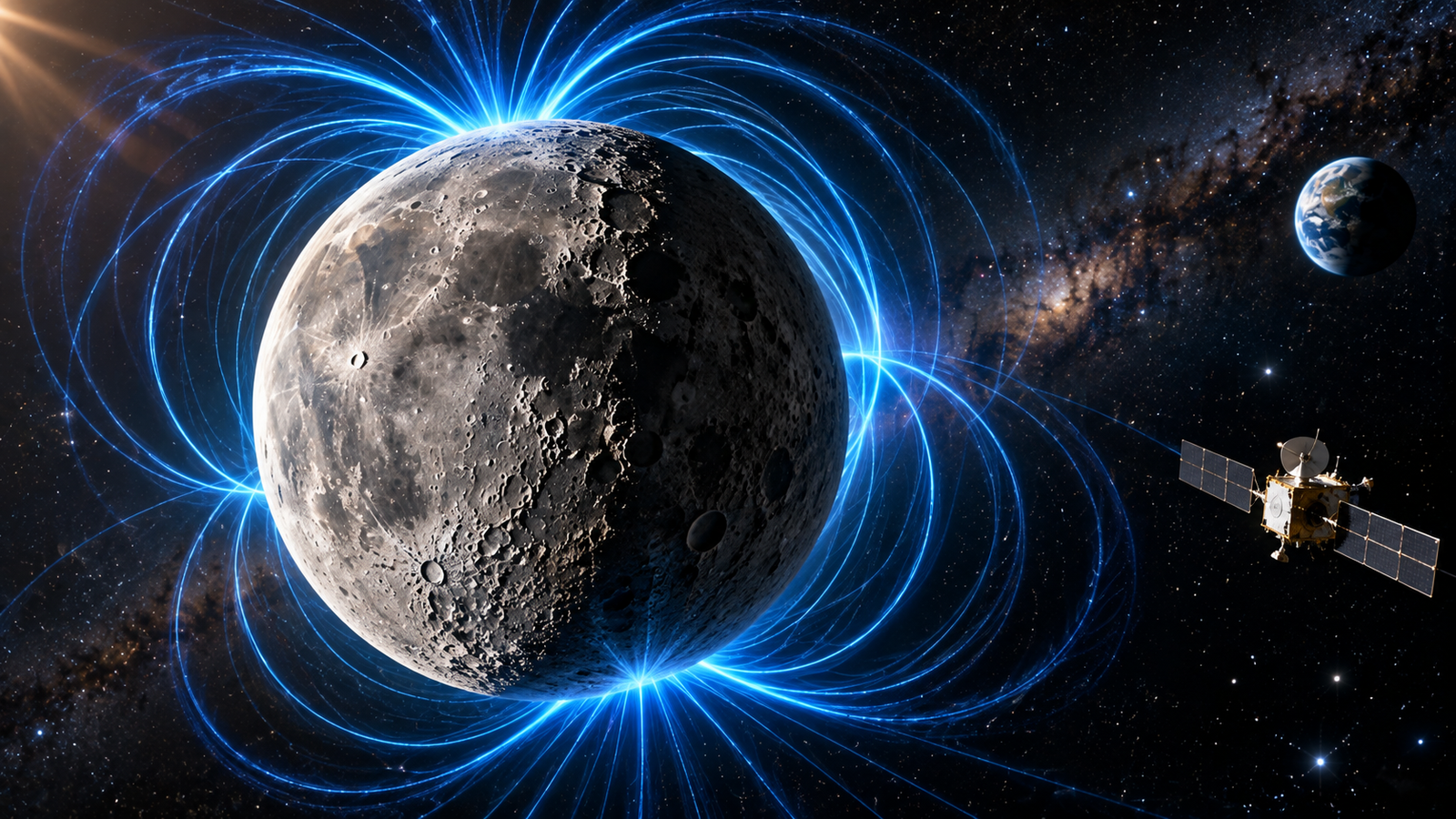
The Moon today is a quiet world lacking a global magnetic shield, but new research suggests that was not always the case. Scientists analyzing data from the lunar far side have found evidence supporting the theory that Earth’s natural satellite once generated its own magnetic field billions of years ago, providing fresh insight into the Moon’s mysterious early history.
The findings come from a study led by researchers at ETH Zurich and collaborating institutions, who examined gravitational and magnetic measurements collected by spacecraft orbiting the Moon. Their analysis focused on a little-studied region known as Dewar crater on the lunar far side, an area that appears to preserve traces of ancient magnetic activity. According to the researchers, the results support the long-debated idea that the Moon once possessed an internally generated magnetic field produced by movement within its core.
For decades, planetary scientists have debated whether the Moon ever operated a “dynamo” similar to the one inside Earth. On Earth, circulating liquid iron in the outer core generates a magnetic field that helps shield the planet from harmful solar radiation. The Moon currently lacks such a global field, but magnetized lunar rocks discovered during the Apollo era hinted that a magnetic shield may have existed in the distant past.
Those rock samples, however, produced conflicting interpretations. Some studies suggested the Moon once hosted a strong magnetic field lasting hundreds of millions of years, while others found little evidence supporting such a long-lived system. The disagreement became one of the most enduring mysteries in lunar science.
Rather than relying solely on rock samples returned to Earth, the new research used orbital measurements to investigate what lies beneath the lunar surface. Scientists combined gravity data from NASA’s GRAIL mission with magnetic field observations collected by previous lunar spacecraft. By reconstructing the subsurface structure of the Dewar region, they found evidence that ancient crustal rocks retained magnetic signatures consistent with the presence of a significant magnetic field roughly 4.2 billion years ago.
The study’s conclusions strengthen the case that the Moon once generated magnetism internally rather than acquiring it solely through external events such as large asteroid impacts. Some researchers have argued that giant collisions could have temporarily magnetized lunar rocks. While impact processes may explain certain localized magnetic anomalies, the new findings indicate that an internal dynamo remains the most convincing explanation for the magnetic patterns observed in the Dewar region.
The results also arrive during a period of renewed interest in the Moon’s magnetic history. Earlier research published this year by scientists at the University of Oxford suggested that both sides of the long-running debate may have been partly correct. Their analysis of Apollo samples found that the Moon experienced brief episodes of exceptionally strong magnetism, potentially even exceeding Earth’s field at times, but that those powerful phases were relatively short-lived. For much of its early history, the Moon’s magnetic field may have been considerably weaker.
Together, the studies are helping researchers build a more detailed picture of the Moon’s evolution. Scientists believe the lunar dynamo, if it existed, likely operated during the first billion years after the Moon formed. Over time, as the lunar interior cooled and conditions within the core changed, the mechanism responsible for generating magnetism gradually weakened and eventually disappeared.
Understanding when and how the Moon lost its magnetic field is important for more than historical curiosity. Magnetic fields play a crucial role in shaping planetary environments. They can protect atmospheres from erosion by solar wind and influence the long-term evolution of planetary surfaces. Researchers studying the Moon hope that understanding its magnetic past will provide broader clues about how rocky worlds develop and why some retain magnetic shields while others lose them.
The findings may also influence future lunar exploration. Several upcoming missions aim to investigate regions of the Moon that have received limited scientific attention. Improved knowledge of lunar magnetism could help identify promising locations for geological research and provide context for future sample-return missions. Scientists are particularly interested in areas where ancient magnetic signatures remain preserved because they offer a direct record of conditions that existed billions of years ago.
Despite the progress, important questions remain unanswered. Researchers are still working to determine exactly how strong the Moon’s magnetic field was, how long it persisted, and what ultimately caused its disappearance. Additional spacecraft observations and future lunar samples may be needed to resolve those uncertainties fully.
What is becoming increasingly clear is that the Moon was once a far more dynamic world than its quiet appearance suggests today. Evidence from orbital measurements, Apollo samples, and modern computer modeling continues to reveal a complex early history marked by geological activity, internal evolution, and, quite possibly, a magnetic shield that once surrounded Earth’s closest celestial neighbor.