
Swiss Researchers Unveil Vibration-Dampening Technology for Future Space Missions
A team of Swiss researchers and aerospace engineers has developed a new technology designed to reduce the intense vibrations that satellites experience during rocket launches, a breakthrough that could help protect delicate onboard instruments and expand the capabilities of future space missions.
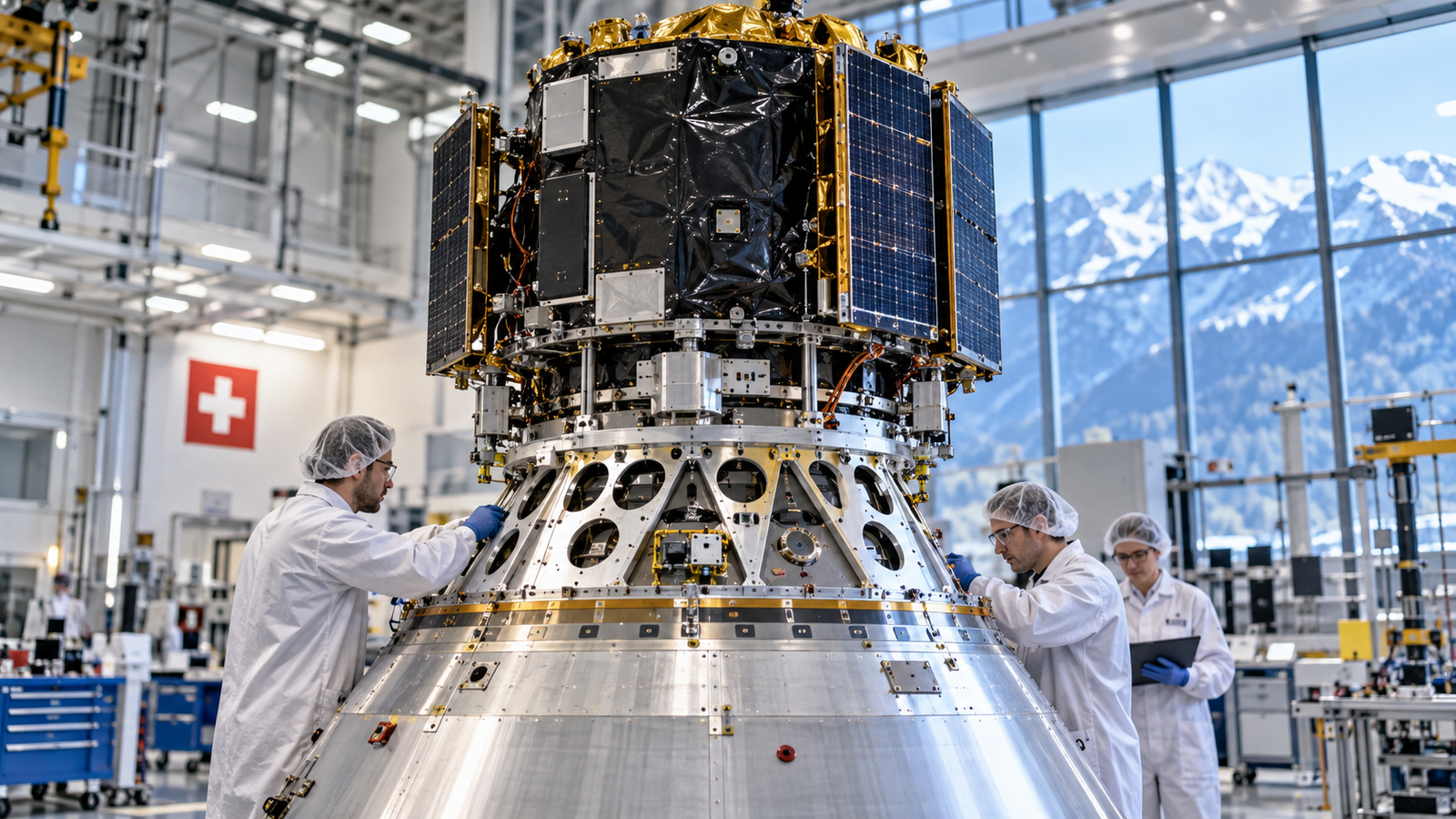
The innovation centers on a newly engineered payload adapter—the structural component that connects a satellite to a launch vehicle. Developed through collaboration between the Swiss Federal Laboratories for Materials Science and Technology (Empa) and Swiss aerospace company Beyond Gravity, the adapter is intended to absorb and redirect damaging vibration energy before it reaches sensitive spacecraft systems.
Rocket launches expose satellites to extreme mechanical forces. One of the most challenging phases occurs during stage separation, when sections of a rocket detach and continue their journey independently. These events generate powerful vibrations that can travel through the launch vehicle and into the payload, potentially affecting electronics, sensors, and scientific instruments.
Engineers say reducing these forces is becoming increasingly important as satellites carry more advanced and highly sensitive technologies. Modern spacecraft often include precision measurement equipment, imaging systems, communications hardware, and scientific instruments that require a stable environment to function properly.
According to researchers involved in the project, improving vibration protection could allow future missions to carry instruments that are currently difficult or costly to launch safely. Empa researcher Andrea Bergamini said stronger protection against launch-induced vibrations could enable more sensitive measurement systems to be deployed in space.
A Different Approach to Vibration Control
Rather than relying on conventional damping materials alone, the Swiss team redesigned the adapter using principles associated with so-called phononic crystals. These specially engineered structures can manipulate the way mechanical waves travel through a material.
In the new design, harmful longitudinal vibrations are transformed into rotational motion through integrated aluminum ring structures. This process dissipates energy and reduces the amount of vibration transferred toward the satellite. The concept effectively redirects mechanical forces away from critical payload components before they can cause damage.
Researchers describe the system as a structural solution rather than an add-on component, meaning the vibration-control function is built directly into the adapter itself. This approach could offer advantages in weight, efficiency, and integration compared with some traditional vibration-mitigation methods.
Promising Test Results
Empa reported that the concept has already demonstrated encouraging results during simulations and prototype testing. Early evaluations showed that the redesigned structure was capable of significantly reducing the transmission of harmful vibrations through the adapter.
While the technology remains under development, the successful testing phase represents an important milestone. Engineers are now focused on refining and optimizing the design before it can be qualified for use in actual launch missions.
The commercial potential of the innovation has also drawn attention. Beyond Gravity has filed a patent application covering the technology, signaling confidence that the concept may eventually become part of future launch systems and satellite deployment infrastructure.
Growing Importance for the Space Industry
The development comes at a time when global investment in space technology continues to increase. Governments, research institutions, and private companies are launching larger numbers of satellites for communications, Earth observation, navigation, climate monitoring, and scientific research.
As payloads become more sophisticated, the need to protect sensitive equipment during launch has become a critical engineering challenge. Damage does not necessarily require catastrophic failure; even small mechanical disturbances can affect calibration, measurement accuracy, or long-term reliability.
Reducing launch vibrations can also influence mission economics. Better protection may lower testing requirements, reduce the need for additional protective hardware, and allow satellite designers greater flexibility when incorporating advanced instruments.
Switzerland has built a reputation for precision engineering and high-value aerospace technologies despite not operating its own launch vehicles. Companies and research institutions in the country contribute components, scientific expertise, and specialized systems to international space programs.
Beyond Gravity, which has extensive involvement in global space projects, supplies structures and technologies used in launch vehicles and satellites worldwide. The company’s collaboration with Empa highlights the growing role of partnerships between research institutions and industry in advancing space engineering solutions.
Path Toward Future Missions
Before the adapter can fly aboard a rocket, additional testing and optimization will be required. Aerospace hardware must undergo rigorous qualification procedures to verify performance under real-world launch conditions, including extreme temperature variations, vibration loads, and operational stresses.
Researchers remain optimistic that the technology can progress from prototype demonstrations to operational deployment. If successful, the vibration-dampening adapter could become a valuable tool for protecting next-generation satellites and expanding the range of scientific instruments that can safely reach orbit.
The project illustrates how advances in materials science and structural engineering continue to shape the future of space exploration. By addressing one of the most persistent challenges of rocket launches, Swiss researchers hope to make space missions safer, more reliable, and better equipped for increasingly demanding scientific objectives.