
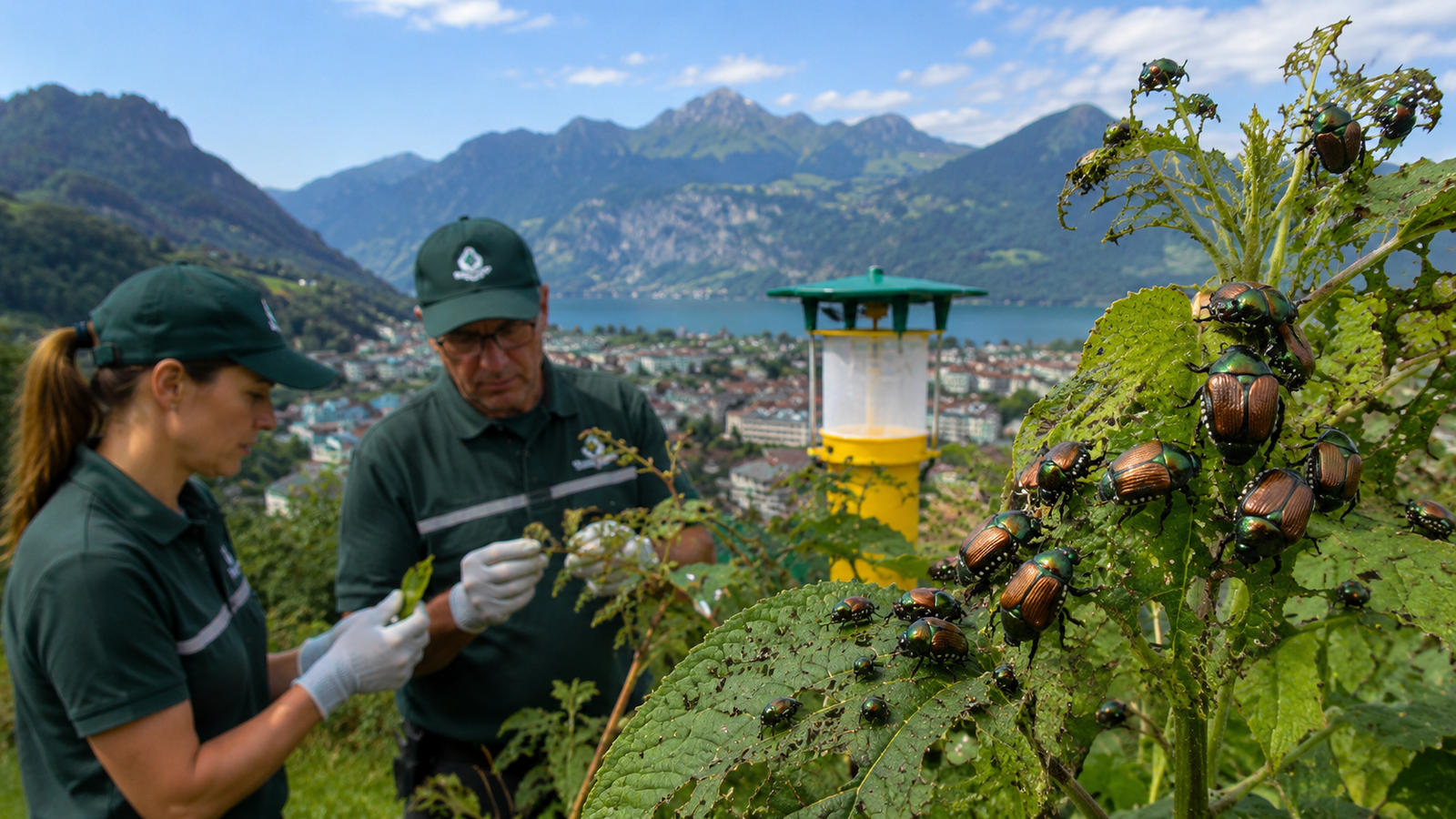
Invasive Japanese Beetle Population Confirmed in Interlaken as Bern Expands Containment Effort
Swiss authorities have confirmed a new outbreak of the invasive Japanese beetle in the Bernese Oberland, marking the latest expansion of a pest that has steadily spread across parts of the country in recent years.
The discovery of an established beetle population in Interlaken has prompted the Canton of Bern to introduce containment measures aimed at slowing further dispersal of the insect, which poses a threat to agriculture, horticulture and natural ecosystems. Officials announced the measures after confirming the presence of the species in the popular tourism hub located between Lakes Thun and Brienz.
According to cantonal authorities, restrictions are being implemented under guidelines developed by Switzerland’s Federal Office for Agriculture. The measures are designed to reduce the risk of inadvertently transporting the beetle to unaffected areas through soil, plant material, garden waste and other potential carriers. Authorities are urging residents, businesses and visitors to follow the regulations closely while monitoring efforts continue.
The Interlaken detection represents another step in the northward spread of a species that has become one of Europe’s most closely watched agricultural pests. Native to Japan, the beetle is capable of feeding on more than 400 plant species, including fruit trees, grapevines, ornamental plants, vegetables and various forest species. Adult beetles consume leaves, flowers and fruit, while larvae damage root systems beneath the soil.
Swiss authorities first detected the species in the southern canton of Ticino in 2017 after it had already become established in northern Italy. Since then, monitoring networks and trapping programs have documented its gradual spread into other regions of Switzerland. The first confirmed population north of the Alps was discovered near Zurich Airport in 2023, raising concerns among agricultural and environmental agencies about the pest’s ability to move through transportation corridors and urban areas.
The latest findings in Interlaken follow a series of detections elsewhere in the Canton of Bern. Earlier this year, authorities confirmed infestations in Spiez, Bern and Köniz, leading to emergency measures across multiple municipalities. Those restrictions included designated outbreak zones and buffer areas intended to limit the movement of potentially contaminated materials. The emergence of a new population in Interlaken suggests that eradication efforts remain challenging despite intensive surveillance.
Scientists and plant protection officials have increasingly emphasized the importance of early detection. Research examining Swiss beetle populations has found evidence that the species has entered the country through multiple pathways. Genetic analyses conducted by researchers indicate that some populations are linked to infestations in northern Italy, while others appear to have arrived through separate introduction routes associated with transportation networks. Those findings have strengthened efforts to monitor roads, rail corridors and travel hubs viewed as potential dispersal channels.
Concern about the beetle extends beyond Switzerland. Across Europe, authorities have intensified monitoring as the insect expands its range. The species has been classified by the European Union as a priority quarantine pest because of its potential economic and environmental consequences. Experts warn that unmanaged populations can damage agricultural production, ornamental landscapes and biodiversity across large geographic areas.
Switzerland has responded with a combination of public-awareness campaigns, trapping systems and movement restrictions. Earlier this year, the Federal Office for Agriculture launched a nationwide initiative encouraging travelers returning from infested regions to inspect vehicles, luggage and transported goods for signs of the beetle. Officials say human-assisted transport remains one of the most significant factors in the insect’s spread. Adult beetles can travel unnoticed in vehicles and cargo, while eggs and larvae may be moved in soil attached to plants or garden materials.
The new outbreak presents a particular challenge because Interlaken serves as one of Switzerland’s busiest tourism destinations. The town functions as a gateway to the Jungfrau region and attracts visitors from around the world throughout the year. High visitor volumes increase the importance of preventive measures designed to stop the accidental movement of beetles beyond the outbreak area.
Authorities have not indicated that the discovery poses a direct threat to human health. The concern centers on economic and ecological impacts, particularly for agriculture, vineyards, fruit production and ornamental landscaping. Experience in other countries has shown that established populations can be difficult and costly to manage once they become widespread.
For now, officials are focusing on containment and surveillance. Additional monitoring in and around Interlaken is expected to help determine the extent of the infestation and whether further restrictions may be necessary. The success of those efforts could play a significant role in limiting the beetle’s expansion into other parts of the Bernese Oberland and beyond.