
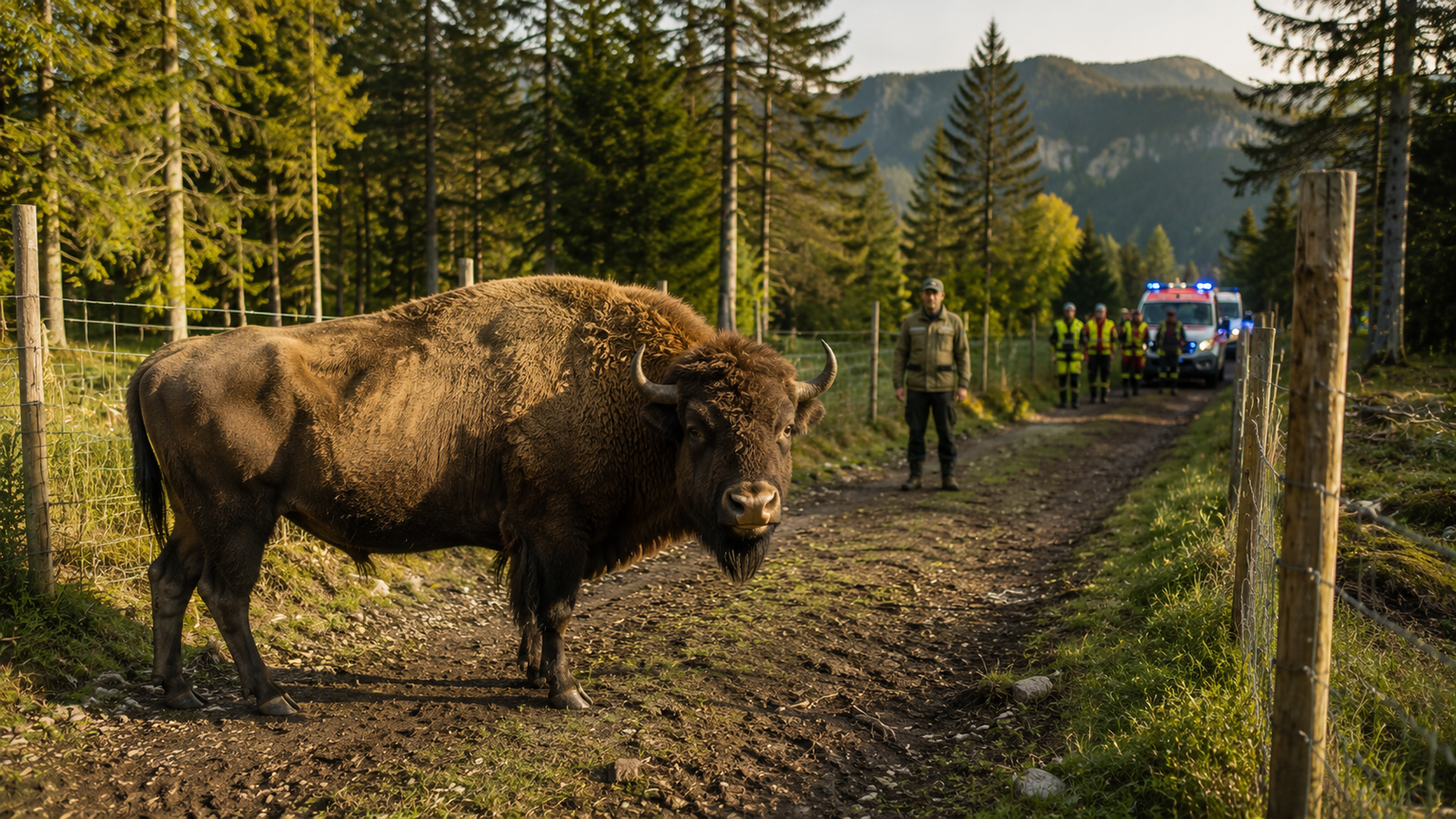
Ranger Injured by European Bison During Research Project in Swiss Jura
A wildlife ranger was hospitalized after an incident involving a European bison at a conservation site in northwestern Switzerland, drawing attention to the challenges of managing large wild animals during ecological restoration projects.
The accident occurred at a fenced research enclosure near Welschenrohr in the canton of Solothurn, where conservationists are conducting a long-term study to evaluate whether European bison can once again live sustainably in parts of Switzerland. The injured ranger was transported to a hospital by helicopter rescue services after being knocked to the ground by an adult male bison, according to information released by the organization overseeing the project.
Project officials said the incident happened when the experienced ranger attempted to move the animal away and approached much closer than the recommended safety distance. The bison reportedly did not retreat and reacted after feeling confined by the encounter. Organizers emphasized that the event was not considered a deliberate attack but rather a defensive response by a large wild animal that perceived pressure in a close-range situation.
The accident has renewed discussion about the balance between wildlife conservation efforts and human safety as Switzerland explores the possible return of species that disappeared from the country centuries ago.
The European bison, also known as the wisent, once roamed large parts of Europe but vanished from Switzerland during the Middle Ages. Conservationists have spent decades working to restore populations across the continent after the species was pushed to the brink of extinction. Switzerland’s current experiment is part of a broader European movement aimed at reintroducing native wildlife and increasing biodiversity.
The Solothurn project began with a small herd introduced to a managed enclosure in 2022. Researchers are studying how the animals interact with forests, grasslands, agriculture, and local communities. The trial is scheduled to continue through 2027 and is expected to provide scientific data that will help authorities decide whether larger-scale reintroduction efforts are feasible in the Jura region.
Conservation experts view the European bison as an important ecological species because of its ability to influence vegetation patterns and create habitats that support a wider range of plants and animals. Similar projects in Eastern and Central Europe have been promoted as examples of successful wildlife restoration, although they often require extensive monitoring and public engagement.
The enclosure involved in the incident covers approximately 100 hectares and remains accessible to the public under established safety rules. Visitors are instructed to maintain significant distances from the animals and avoid behavior that could disturb them. Researchers have long stressed that European bison generally avoid human contact and are not considered naturally aggressive. However, like other large mammals, they can become dangerous if they feel threatened or cornered.
Previous guidance associated with the project emphasized a minimum safety distance of roughly 50 meters when observing the animals. Conservation managers have repeatedly highlighted that respecting space is essential for both animal welfare and visitor safety. The latest incident appears to reinforce that message.
Wildlife specialists note that encounters involving large herbivores can sometimes be underestimated because such animals are not predators. Yet species including bison, elk, buffalo, and cattle are capable of causing serious injuries when startled or pressured. Conservation programs therefore rely heavily on strict operating procedures and staff training to reduce risks. While incidents remain relatively uncommon, experts say they are an important reminder that rewilding projects involve working with powerful animals whose behavior cannot be completely controlled.
The event has not altered the project’s broader objectives, according to information released by organizers. Agricultural and forestry activities continue within the wider study area, and public access has remained unchanged following the accident. Researchers are expected to continue monitoring both the animals and their environmental impact as the trial progresses.
The conservation initiative has already attracted international interest because it represents one of the most significant attempts to evaluate whether European bison could eventually live with greater freedom in Switzerland. Earlier milestones included the birth of bison calves within the project area, events that conservationists described as historic given the species’ centuries-long absence from the country.
As authorities and researchers review the circumstances surrounding the ranger’s injury, the incident is likely to serve as an additional case study in wildlife management. Supporters of the project argue that understanding such interactions is part of the scientific process needed to determine whether large mammals can successfully coexist with modern human activity.
For conservationists, the episode underscores a central lesson of rewilding efforts across Europe: restoring species to landscapes from which they disappeared may deliver ecological benefits, but it also requires ongoing attention to safety, education, and responsible human behavior around wildlife. With several years remaining in the Swiss trial, researchers will continue gathering evidence to assess whether the European bison has a long-term future in the Jura Mountains.