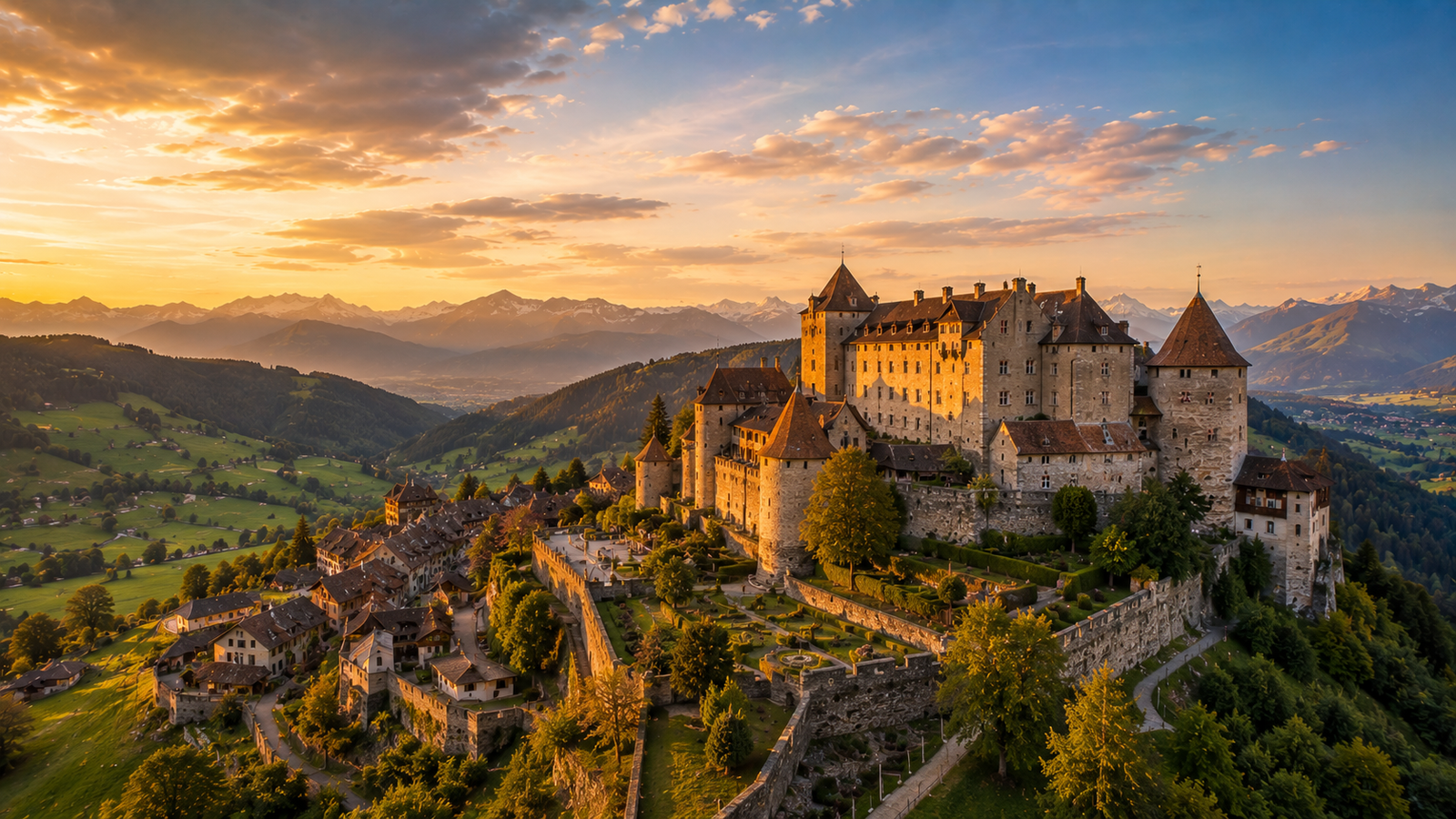
Château de Gruyères, Gruyères, Switzerland
Château de Gruyères: The Medieval Castle That Shaped a Swiss Legend
Rising above one of Switzerland’s most picturesque villages, Château de Gruyères dominates the landscape much as it did centuries ago when powerful noble families governed the surrounding region. Perched atop a green hill overlooking the Gruyère countryside, the castle is far more than a scenic landmark. It is a living record of political ambition, artistic reinvention, regional identity, and nearly eight centuries of Swiss history.
For many travelers, the first glimpse of the castle is unforgettable. The fortified silhouette appears above the medieval village of Gruyères, framed by rolling pastures and the distant peaks of the Fribourg Pre-Alps. The setting feels timeless, yet the castle’s story reveals a place that has continuously evolved since the Middle Ages. Today, visitors encounter a remarkable blend of architecture, historical collections, gardens, and cultural heritage that makes Château de Gruyères one of Switzerland’s most significant historic attractions.
The Birth of a Medieval Stronghold
Historical records first mention the castle in 1244, when it served as the principal residence of the Counts of Gruyère, one of the most influential noble families in western Switzerland. Constructed during the 13th century, the fortress followed the “Savoyard square” design, a military architectural model favored by the House of Savoy, to whom the counts owed allegiance.
The original structure was designed for defense. Strong walls enclosed the hilltop residence, while towers and fortified elements protected its inhabitants and asserted the authority of the ruling family. From this strategic location, the Counts of Gruyère governed extensive territories on both sides of the Sarine River and maintained influence across a significant portion of present-day western Switzerland.
The castle’s commanding position was not chosen merely for aesthetics. It provided visibility across important routes and fertile agricultural lands that sustained the region’s economy. In an era when political control depended heavily on geography, the fortress served as both a symbol and instrument of power.
From Fortress to Noble Residence
By the late 15th century, military requirements began to change, and Château de Gruyères underwent a remarkable transformation. Count Louis initiated extensive renovations that converted the fortress into a more comfortable aristocratic residence.
Stone galleries replaced portions of earlier wooden structures, large windows brought additional light into interior spaces, and decorative architectural elements reflected the increasing importance of prestige and refinement. A chapel dedicated to Saint John the Baptist was incorporated into a former defensive tower, symbolizing how the castle was evolving from a purely military installation into a sophisticated noble home.
These changes created a structure that balanced security with elegance. Visitors today can still observe how medieval defensive features coexist with later residential enhancements, offering a visual timeline of architectural development across centuries.
The Fall of the Counts
Despite their influence, the fortunes of the Counts of Gruyère eventually declined. Financial difficulties increasingly burdened the dynasty, culminating in the bankruptcy of Count Michel in 1554. As a result, his territories were confiscated by his principal creditors, Bern and Fribourg, effectively ending centuries of rule by the Gruyère family.
The end of the dynasty marked a turning point in the castle’s history. Rather than falling into ruin, the fortress entered a new phase under the administration of the Canton of Fribourg.
The Era of the Bailiffs
Following the collapse of the county, Fribourg assumed control of the region and established its representatives, known as bailiffs, within the castle. Between 1555 and 1798, dozens of bailiffs administered local affairs from the historic residence. Their responsibilities included overseeing justice, collecting taxes, managing finances, and governing the surrounding territory.
The bailiffs left a lasting mark on the castle. Interior decorations from the Ancien Régime period introduced artistic and decorative styles that contrasted with the building’s medieval origins. Painted ceilings, heraldic motifs, murals, and ornamental furnishings reflected the tastes of the era and transformed portions of the castle into an administrative residence of considerable sophistication.
During this period, Gruyère’s cheese production expanded significantly, contributing to the region’s growing economic importance and strengthening the association between the area and the cheese that would eventually become world famous.
Reinvented by Artists
A particularly fascinating chapter began in the 19th century. After the prefecture moved to nearby Bulle, the castle was sold and purchased by the Geneva-based Bovy family in 1849. Rather than treating the property solely as a residence, the new owners transformed it into a vibrant artistic center.
The castle became home to an artists’ colony that attracted painters, writers, musicians, and intellectuals. Inspired by Romantic-era fascination with medieval culture, these artists reimagined several interior spaces and created decorative works that remain part of the castle’s identity today.
Among the most notable artistic connections is the presence of works by French painter Jean-Baptiste Camille Corot, whose landscapes continue to enrich the castle’s collections. This artistic period ensured that Château de Gruyères preserved not only medieval history but also an important chapter of European cultural heritage.
Treasures Inside the Castle
Today, Château de Gruyères functions as a museum that guides visitors through its many historical eras. Each room reveals a different layer of the castle’s long story.
Medieval artifacts illustrate the period of the counts, while rare stained-glass windows from the 15th century demonstrate exceptional craftsmanship. Historic objects associated with the Burgundian Wars are also displayed, including Burgundian capes connected to events surrounding the Battle of Murten in 1476.
The chapel, decorative halls, guard rooms, and noble apartments provide insight into everyday life across different centuries. Meanwhile, artistic additions from the 19th-century colony create a unique dialogue between historical preservation and creative reinterpretation.
Rather than presenting a single period in isolation, the museum allows visitors to experience the castle as a continuously evolving place shaped by changing generations.
Gardens Above the Countryside
Beyond its interiors, Château de Gruyères offers exceptional outdoor spaces. The castle gardens and ramparts provide sweeping views across the Gruyère region, revealing why the site was chosen centuries ago.
French-style gardens add elegance to the medieval setting, while pathways along the walls offer panoramic perspectives of the surrounding countryside. From these viewpoints, visitors can admire forests, agricultural landscapes, and distant mountain ranges that define the character of the canton of Fribourg.
The relationship between the castle and the landscape remains one of its greatest attractions. The scenery is not simply a backdrop but an integral part of the experience.
A Symbol of Swiss Cultural Heritage
The State of Fribourg reacquired the castle in the late 1930s and opened it to the public in 1939, ensuring the preservation of one of Switzerland’s most important historic monuments. Today, Château de Gruyères continues to welcome visitors from around the world while serving as a guardian of regional history and culture.
Its significance lies not only in its architecture but also in the remarkable continuity of its story. Few places illustrate so clearly the transition from medieval lordship to government administration, from private residence to artistic refuge, and finally to a modern museum dedicated to preserving the past.
Standing on its ramparts, overlooking the same landscapes once observed by counts, bailiffs, artists, and travelers, visitors encounter a destination where history remains visible in every stone, gallery, and tower—a place where the legend of Gruyères continues to unfold centuries after it first began.