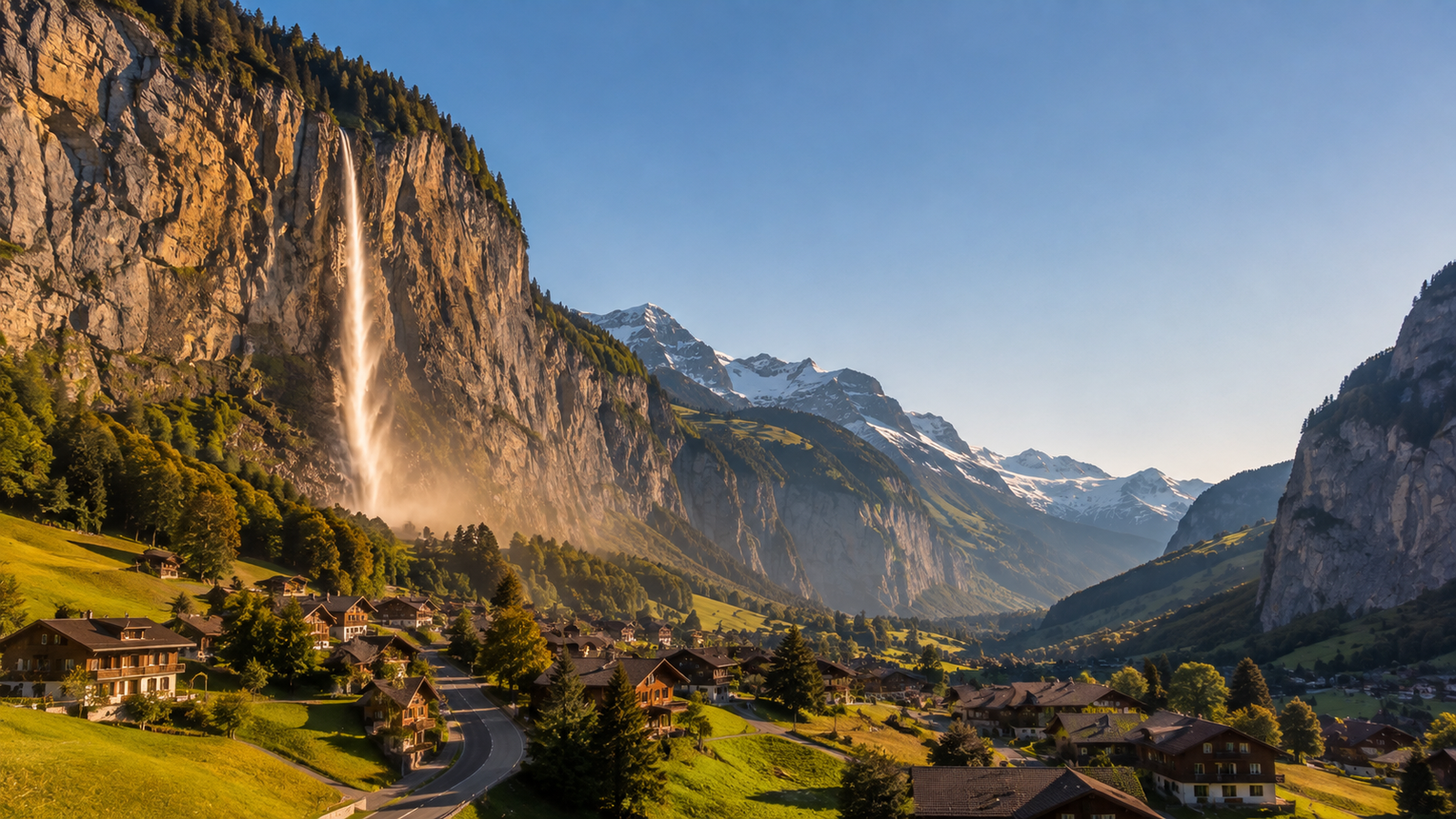
Staubbach Falls, Lauterbrunnen, Switzerland
Staubbach Falls: The Waterfall That Defines Switzerland’s Most Dramatic Valley
Long before visitors arrive at the foot of Staubbach Falls, they usually hear it. A faint rush of water drifts through the Lauterbrunnen Valley, echoing from towering limestone cliffs that rise dramatically above the village below. Then the waterfall comes into view—a slender white ribbon plunging from a hanging valley nearly 300 meters above the valley floor.
Staubbach Falls is more than a scenic landmark. It is the natural symbol of Lauterbrunnen, one of Switzerland’s most celebrated alpine valleys, and one of the country’s most recognizable waterfalls. Its combination of height, setting, and cultural significance has inspired artists, writers, photographers, and travelers for generations.
While the Bernese Oberland is filled with spectacular mountain attractions, few are as immediately accessible and visually striking as this waterfall that appears to descend directly from the sky.
A Waterfall Suspended Above the Valley
Staubbach Falls descends approximately 297 meters over a near-vertical cliff west of the village of Lauterbrunnen. It is widely recognized as the highest free-falling waterfall in Switzerland and among the highest free-falling waterfalls in Europe. The water originates from streams above the cliff before plunging uninterrupted toward the valley floor.
Its name comes from the German word Staub, meaning dust. During warm weather, rising air currents often catch the falling water, breaking it into countless droplets that drift through the air like mist. This effect gives the waterfall its distinctive appearance and explains why it has fascinated visitors for centuries.
Unlike many waterfalls hidden deep within mountain landscapes, Staubbach Falls stands directly beside the village. It dominates the skyline of Lauterbrunnen and remains visible from numerous points throughout the valley.
The Valley of 72 Waterfalls
To understand Staubbach Falls, it helps to understand its setting.
Lauterbrunnen Valley is often called the Valley of 72 Waterfalls, a designation that reflects the remarkable concentration of waterfalls cascading from the surrounding cliffs. Meltwater from glaciers, seasonal snowfields, and alpine streams flows over the steep valley walls, creating countless waterfalls throughout the region.
Among these waterfalls, Staubbach remains the most iconic. While other waterfalls in the valley may carry greater water volumes or descend from greater overall heights, Staubbach’s dramatic free fall and central location have made it the defining image of Lauterbrunnen.
The surrounding landscape contributes just as much to the experience. Sheer rock walls, alpine meadows, traditional Swiss chalets, and distant views of snow-covered peaks create a setting that feels almost theatrical. The waterfall serves as the visual centerpiece of this remarkable natural amphitheater.
Following the Water Into the Cliff
Many visitors are surprised to learn that Staubbach Falls can be experienced from more than just the valley floor.
A pathway leads from the base of the waterfall into the cliff itself, allowing visitors to reach the Staubbach Gallery, a viewing area positioned behind and beside the falling water. Accessible during the warmer months, the route passes through a tunnel and along a secured path carved into the rock.
Standing inside the gallery offers a completely different perspective. The waterfall becomes a curtain of moving water, while the valley opens beyond in a panoramic view of meadows, mountains, and the village below. Fine droplets drift through the air, creating a cool mist that adds to the sensory experience.
This close encounter helps visitors appreciate the scale of the waterfall in a way that photographs rarely capture.
A Source of Artistic Inspiration
Staubbach Falls holds an important place in European cultural history.
In 1779, German writer Johann Wolfgang von Goethe visited the Lauterbrunnen Valley. The sight of the waterfall inspired his poem Song of the Spirits over the Waters (Gesang der Geister über den Wassern), one of his notable reflections on nature and the movement of water. Today, Goethe’s connection to the waterfall remains one of the most frequently cited cultural associations linked to the site.
The waterfall also became a popular subject during the rise of Alpine tourism in the eighteenth and nineteenth centuries. Artists and landscape painters frequently depicted the falls, helping introduce the scenery of Switzerland to audiences across Europe. Historical artworks featuring Staubbach Falls remain preserved in Swiss collections and archives.
Its influence extends beyond literature and painting. The broader Lauterbrunnen landscape has often been cited as one of the alpine settings that inspired imaginative depictions of mountain worlds in later literature.
How the Seasons Transform the Falls
Staubbach Falls is a year-round attraction, but its character changes significantly throughout the year.
In late spring and early summer, melting snow from the surrounding mountains increases water flow, making the waterfall particularly powerful. This period often produces the dramatic spray effects that gave the waterfall its name.
Summer offers the easiest access to the viewing gallery and hiking routes around Lauterbrunnen. During peak season, the waterfall is often illuminated in the evening, creating a striking visual display against the dark cliff face.
Autumn introduces golden colors across the valley, while winter can transform portions of the waterfall into ice formations. Snow-covered cliffs and frozen sections of the cascade create a completely different atmosphere from the lush landscapes of summer.
Because the waterfall remains visible throughout the year, each season offers a distinct interpretation of the same landscape.
Exploring Beyond the Waterfall
Many travelers visit Staubbach Falls as part of a broader exploration of the Jungfrau Region.
The waterfall sits only a short walk from Lauterbrunnen’s center and railway station, making it one of the region’s most accessible natural attractions. Visitors often combine the waterfall with walks through the valley, excursions to nearby mountain villages such as Wengen and Mürren, or visits to the famous Trümmelbach Falls deeper within the valley.
Numerous hiking trails also begin near the waterfall. Some remain on the valley floor, while others climb into the surrounding mountains, revealing elevated viewpoints over Lauterbrunnen and the surrounding peaks.
Photographers frequently return throughout the day because changing light conditions dramatically alter the appearance of the waterfall. Morning sunlight, afternoon shadows, drifting mist, and evening illumination each create distinct visual moods.
Few natural attractions in Switzerland combine accessibility, geological drama, cultural significance, and alpine scenery as effectively as Staubbach Falls. Rising above one of the country’s most beautiful valleys, the waterfall remains a reminder that some of Switzerland’s most memorable experiences are not found on a mountain summit, but in the simple act of watching water fall through open air against a backdrop shaped by the Alps over thousands of years.