Swiss Swimming Pools Move to Restrict Camera-Equipped Smart Glasses
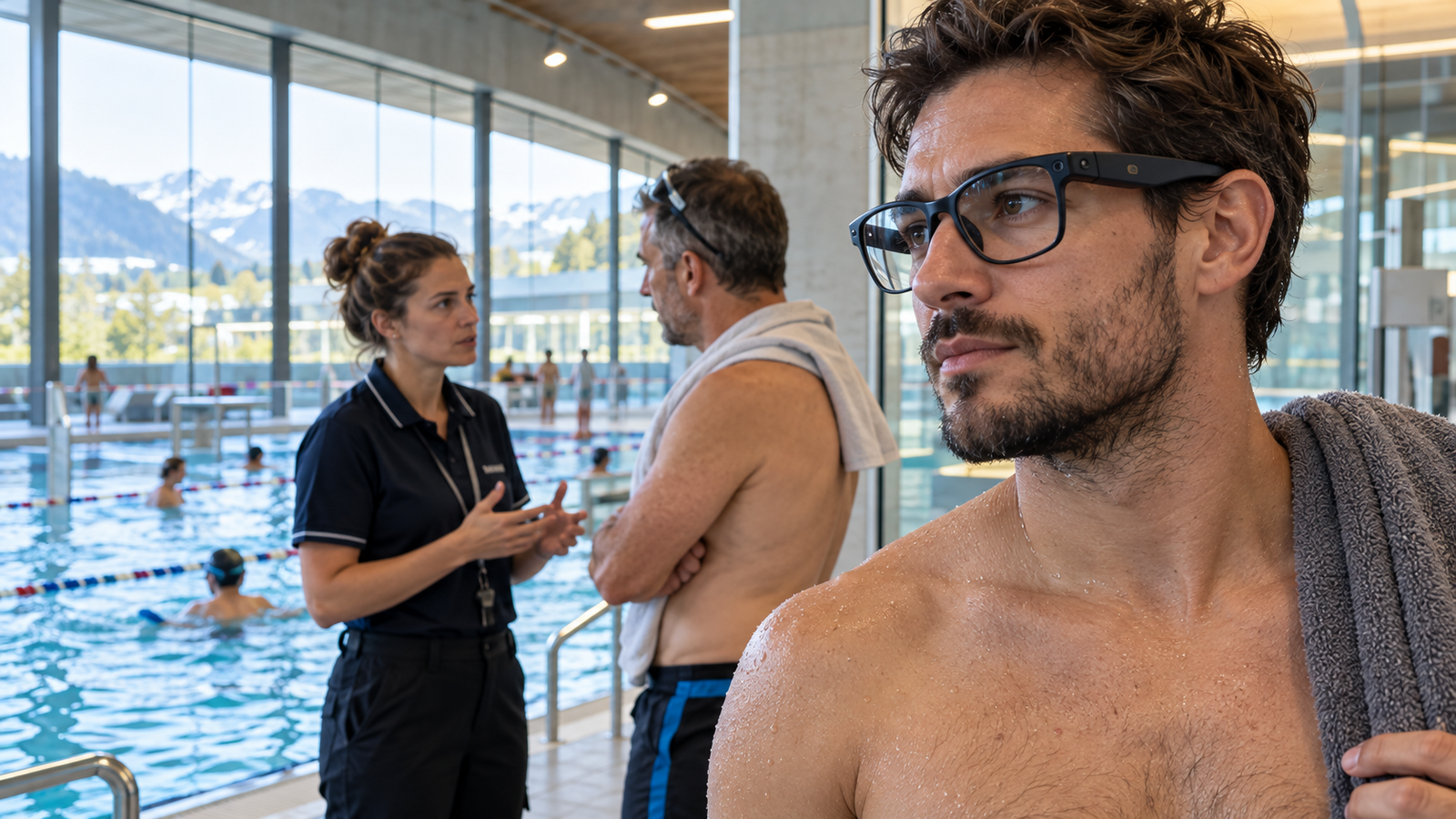
Swiss swimming pool and sauna associations are urging local authorities to prohibit camera-equipped smart glasses throughout their facilities, warning that the devices create new privacy risks in places where people expect a high degree of personal privacy. The call, announced on October 12, 2026, targets eyewear capable of recording photographs or videos discreetly, including in changing rooms and other sensitive areas.
The organizations are asking municipalities to strengthen their facility rules and have prepared guidance for employees and information posters for visitors. Their initiative comes as smart glasses become more common in Switzerland and political representatives in several cities consider restrictions on their use in public swimming pools and sports facilities.
The immediate issue is not whether people should be allowed to wear ordinary prescription sunglasses. It is how facilities can prevent unauthorized recording when cameras and microphones are built into eyewear that looks much like conventional glasses.
Associations call for a facility-wide prohibition
The Swiss association of swimming instructors, the association representing indoor and outdoor swimming pools, and the Swiss Sauna Federation have jointly warned about the risks associated with camera-equipped eyewear. Their announcement focuses on German-speaking Switzerland and calls for recording-capable optical devices to be prohibited throughout swimming pool premises.
The associations want towns and municipalities to update their swimming pool regulations rather than rely solely on existing restrictions on photography. They have also prepared practical guidance intended to help staff identify the issue and explain the rules to visitors.
The approach reflects a difficulty for facility operators: a conventional camera or smartphone is usually recognizable, while a miniature camera integrated into a pair of glasses may be difficult to notice. Staff cannot reliably determine whether someone is recording simply by looking at ordinary eyewear.
A facility-wide rule would establish a clearer standard for visitors and employees. It could also reduce the need for staff to decide whether a particular person is actively recording, although enforcing any prohibition would still require clear rules and consistent procedures.
The initiative does not amount to a single nationwide statutory ban enacted by the Swiss government. Swimming facilities operate under local regulations, and the associations are asking municipal authorities to revise those rules.
Why changing rooms raise particular concerns
Swimming pools, saunas and changing areas are environments where visitors may be wearing little clothing or changing in the presence of others. People can reasonably expect that images of them will not be captured or shared without their knowledge.
Camera-equipped glasses complicate that expectation because recording can take place without someone visibly holding a phone or pointing a conventional camera. A person wearing such glasses may appear to be having an ordinary conversation while a device is capturing images or sound.
The associations say this makes existing photography restrictions harder to enforce. Their concern is not limited to the act of recording: images or videos could subsequently be circulated online, potentially extending the harm well beyond the facility where they were captured.
Children and other vulnerable visitors are a particular concern in the wider debate over covert recording. However, the latest joint announcement does not provide a quantified estimate of incidents across Swiss pools, nor does it establish how frequently smart glasses have been used for unlawful filming at these venues.
That distinction matters. The associations’ call is a preventive response to a technology that can make unauthorized recording more difficult to detect, rather than evidence that every wearer is misusing the devices.
Political pressure is growing in Swiss cities
The associations’ announcement follows a series of political initiatives concerning smart glasses. In September, representatives in Zurich asked the cantonal government to examine restrictions on camera-equipped eyewear in swimming pools and other public facilities. The proposal also raised questions about whether rules should extend to sports halls and certain privately operated venues open to the public.
Bern has also seen a motion seeking to incorporate restrictions on smart glasses into municipal rules governing indoor and outdoor swimming pools. Similar discussions have emerged in other Swiss municipalities, including Lucerne, Wil and Basel.
These initiatives show that the debate is moving beyond individual complaints toward questions of facility management and regulation. Local authorities must decide whether existing rules are sufficient, whether a specific prohibition is necessary and how such a rule could be enforced fairly.
A clear ban may be easier for staff to communicate than a rule that depends on proving whether a device is recording at a particular moment. But it also creates practical questions for visitors who use specialized eyewear, including people who rely on assistive technology.
The latest association announcement does not set out a comprehensive list of exceptions. Any municipality implementing a prohibition would need to define its scope and communicate how it applies in practice.
Smart glasses are becoming more popular
The debate is unfolding as demand for wearable technology grows. Swiss online retailer Galaxus reported that sales of smart glasses rose by 307% in the first part of 2026 compared with the same period a year earlier. The retailer said several thousand pairs had been ordered between January and September.
The devices can offer functions beyond photography, including audio playback, hands-free communication and features designed to make information more accessible. Some models can support people with visual impairments by providing spoken descriptions of their surroundings, while audio functions can assist certain users with hearing difficulties.
Those benefits complicate calls for restrictions. A policy intended to prevent covert filming needs to distinguish the privacy risk created by recording hardware from the legitimate uses of wearable technology.
The associations’ proposal focuses on eyewear with recording capabilities, rather than treating every digital wearable as equivalent. Even so, local rules will need to make clear which devices are covered and how staff should handle disagreements with visitors.
Switzerland’s data protection authority has already issued warnings
The Federal Data Protection and Information Commissioner has identified smart glasses as a potential privacy concern because their cameras and microphones can collect information about people other than the wearer. The authority notes that such recordings can occur without the knowledge of the individuals being filmed and may be shared quickly through connected services.
Swiss data protection principles require transparency when personal data is processed. Secretly capturing images or voices in circumstances that fall within another person’s private sphere may also violate provisions of Swiss criminal law, depending on the facts and the location.
That does not mean every photograph taken with smart glasses is automatically illegal. The legal assessment depends on the circumstances, the information collected, the setting and the way it is used or shared.
The authority advises users to consider privacy settings, data storage and the handling of information collected by wearable devices. For pool operators, however, the challenge is more immediate: they must establish conditions that protect visitors before a recording occurs, not merely respond after footage has circulated.
Rules differ across Switzerland
The current response is not uniform throughout the country. The association representing swimming pools in French-speaking Switzerland and Ticino told Keystone-SDA that it was not introducing new measures at this stage. It said it had not received specific reports concerning the relatively new phenomenon, although staff had been trained and made aware of the issue.
This regional difference highlights the limits of an association-led approach. Municipalities may adopt different rules, and the policies in force at individual facilities will determine what visitors can wear on the premises.
For swimmers and sauna users, the practical advice is to check a facility’s rules before visiting rather than assume that the same policy applies everywhere. For operators, clear signage and consistent staff guidance will be important if restrictions are introduced.
The challenge ahead
Smart glasses are creating a new test for privacy rules designed before miniature cameras became commonplace in everyday eyewear. Swimming pools and saunas are among the places where the consequences of covert recording can be especially serious, because visitors have limited control over who may be observing them.
The associations’ initiative puts responsibility on local authorities to decide whether existing restrictions remain adequate. Its success will depend on how clearly rules are written, how consistently they are applied and whether visitors understand the reasons behind them.
The broader question is how Switzerland can accommodate useful wearable technology without weakening people’s ability to control the recording and distribution of images of themselves. For now, swimming pool associations are seeking a straightforward preventive measure. Whether that becomes a consistent rule across the country will depend on decisions by municipalities and regional operators in the weeks and months ahead.