
Swiss Research Team Reports Progress in Experimental Vision-Restoration Therapy
Researchers connected to Basel, Switzerland, have reported encouraging results from an experimental treatment designed to restore limited visual perception in people who have lost their sight because of advanced retinitis pigmentosa. The small clinical study found improvements in light sensitivity and object detection in some participants, offering further evidence that damaged visual systems may retain pathways that can be used to recover certain aspects of sight. The findings do not mean that the treatment restores normal vision, and further research will be needed before its benefits can be established more broadly.
The study, published in the New England Journal of Medicine on October 8, 2026, involved an international research team led by José-Alain Sahel of the University of Pittsburgh and Botond Roska of the Institute of Molecular and Clinical Ophthalmology Basel (IOB). The work builds on an earlier demonstration involving one patient in 2021 and extends the investigation to a group of 10 people with advanced retinal disease.
The approach combines gene therapy with specialized goggles. Rather than repairing every damaged light-sensing cell in the retina, it aims to make surviving retinal nerve cells responsive to light, allowing them to transmit visual information toward the brain.
What the clinical study found
The researchers’ primary objective was to evaluate the safety of the treatment. According to the IOB’s October 7 announcement, the therapy was considered safe in all 10 participants for the study’s primary endpoint. Researchers also assessed whether the treatment produced measurable changes in visual function.
Seven of the 10 participants experienced increased light sensitivity when using the specialized goggles. Six achieved a level of improvement that met the study’s predefined threshold for clinical significance.
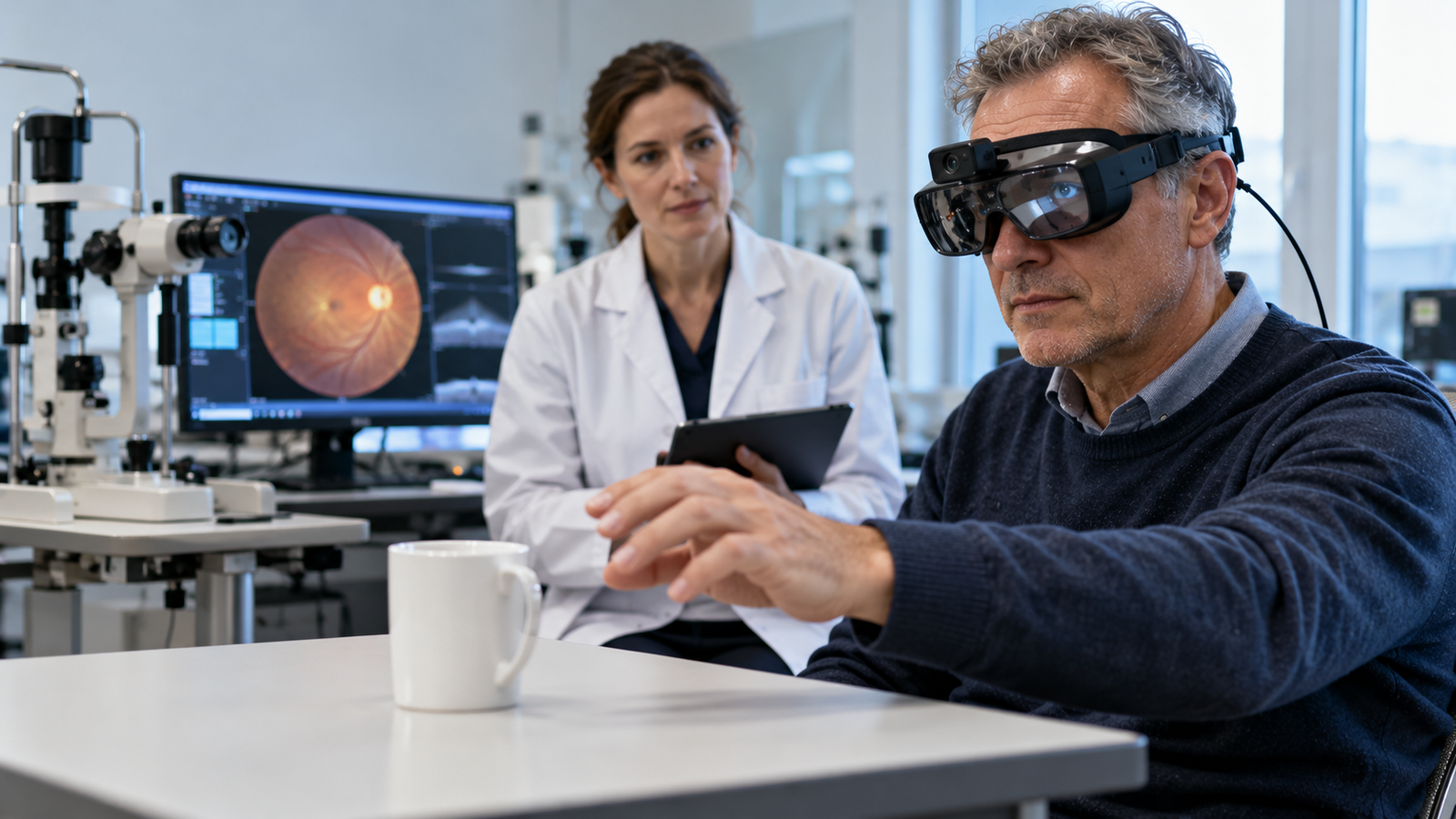
Eight participants completed a series of object-detection and location tests. Four showed consistent improvements across several of these assessments. Tasks included detecting objects and identifying where they were positioned. The findings suggest that the intervention can provide useful visual information for some people, although responses varied among participants.
These results represent an important distinction in blindness research: detecting light, identifying an object’s location and recognizing its shape are different abilities from reading text or recognizing faces.
The study did not demonstrate that participants recovered ordinary sight. Instead, it showed that an experimental combination of genetic modification and light stimulation could restore selected aspects of visual function in some people whose retinal disease had progressed to an advanced stage.
How the treatment works
Retinitis pigmentosa is a group of inherited retinal disorders in which light-sensitive photoreceptor cells progressively deteriorate. The disease can lead to severe visual impairment and, in advanced cases, blindness. Different genetic changes can cause the condition, making treatments directed at a single mutation unsuitable for many patients.
The experimental approach uses optogenetics, a technique that enables cells to respond to light by introducing genetic instructions for a light-sensitive protein.
In this study, a gene therapy delivered instructions for producing a protein called ChrimsonR in surviving retinal ganglion cells. These cells normally transmit visual signals from the retina toward the optic nerve, but they do not ordinarily perform the same light-detection role as photoreceptors. The treatment is intended to give them a new light-responsive function.
Special goggles complete the system. A camera captures the surrounding scene, and the device converts visual information into patterns of light designed to activate the modified cells. Those cells can then transmit signals that the brain may learn to interpret.
The goggles are therefore an essential part of the tested approach, not merely an optional aid. The results do not establish that the gene injection alone can restore useful sight without the accompanying equipment.
Why the findings matter for inherited blindness
One potential advantage of optogenetic therapy is that it does not depend on correcting the specific genetic mutation responsible for each patient’s retinitis pigmentosa. Because the method targets surviving retinal cells rather than repairing the original defect in photoreceptors, it could potentially apply to patients with different genetic causes of the disease.
That possibility is significant because inherited retinal degeneration involves numerous genetic variants. However, a treatment that works across different causes of a disease is not automatically effective for every patient. The number and condition of surviving cells, the stage of degeneration and other individual factors may influence the response.
The current study provides early clinical evidence for the approach, rather than proof that it will benefit all people with advanced retinal disease. The small number of participants also limits the conclusions that can be drawn about how consistently the treatment works.
Training remains an important part of the process
Restoring light sensitivity is only one part of helping a person interpret visual information. The brain must also learn to make sense of signals that differ from those generated by a normally functioning visual system.
Researchers observed that participants who completed more training with the specialized goggles tended to perform better in object-detection tests. This suggests that rehabilitation and repeated practice could be important components of treatment, although the study does not establish precisely how much training would be needed or what regimen would produce the best results.
The distinction matters for potential patients. Even if a treatment successfully makes retinal cells respond to light, the practical benefits may depend on how well people learn to use the resulting visual signals in everyday situations.
The research team is continuing to investigate ways to improve the therapy, including the light-sensitive proteins used to activate retinal cells. Better control over the signals delivered to the brain could eventually help researchers pursue more detailed visual perception. The current findings do not establish when, or whether, such improvements will produce substantially better sight.
Safety and limitations still need careful evaluation
The initial safety results are encouraging, but they should be interpreted within the limits of a 10-person study. The University of Basel reported that a temporary interruption of blood flow in the retina occurred immediately after an injection in one participant. The event resolved completely within minutes. Most eye-related adverse events were classified as mild or moderate.
Small studies can identify promising signals, but they cannot reliably determine how frequently uncommon complications might occur or establish the treatment’s long-term safety. Larger studies and longer follow-up will be needed to understand how durable the improvements are and which patients are most likely to benefit.
The findings also do not mean that a commercially available treatment is ready for widespread use. Further development, evaluation and appropriate regulatory review would be necessary before the approach could become an established option for patients.
A step forward, not a cure
The new results extend the research team’s earlier single-patient demonstration and show that improvements can also be observed in a larger, though still small, group. For people living with advanced retinitis pigmentosa, even limited gains in detecting objects or locating features of their surroundings could have practical value.
For now, the most defensible conclusion is that optogenetic therapy has demonstrated the potential to recover selected visual functions in some blind patients under experimental conditions. It has not restored normal vision, and substantial scientific challenges remain.
The next stage of research will need to establish whether the improvements can be reproduced in larger groups, sustained over time and translated into meaningful benefits in everyday life. Those answers will determine whether this Swiss-linked research advances from a promising experiment toward a practical treatment for severe retinal degeneration.