The History of Swiss Watches
The Ticking Heart of Swiss Identity
Few products are as closely associated with Switzerland as watches.
For more than four centuries, Swiss watchmakers have earned a reputation for precision, craftsmanship, innovation, and reliability. Today, Swiss watches are worn by presidents, explorers, athletes, business leaders, and collectors around the world. Their reputation extends far beyond simple timekeeping; they represent engineering excellence, tradition, and artistry.
Yet the story behind Swiss watchmaking is far more fascinating than the polished displays of luxury boutiques. It is a story of religious refugees, mountain communities, industrial ingenuity, economic crises, and remarkable reinvention.
The history of Swiss watches reflects the history of Switzerland itself—a nation that transformed limited natural resources into world-renowned expertise.
How a Religious Movement Sparked an Industry
The origins of Swiss watchmaking can be traced to the sixteenth century.
During the Protestant Reformation, Geneva became an important center for religious reform under the influence of John Calvin.
Calvin encouraged modest living and discouraged displays of excessive luxury, including elaborate jewelry. This unexpected restriction created a challenge for local goldsmiths and jewelers who relied on decorative craftsmanship for their livelihoods.
Many of these artisans began redirecting their skills toward watchmaking.
At the same time, Protestant refugees arriving from France brought valuable knowledge of horology—the science and art of timekeeping.
The combination of local craftsmanship and imported expertise helped establish Geneva as one of Europe’s early watchmaking centers.
What began as an economic adaptation would eventually evolve into one of Switzerland’s most famous industries.
Small Workshops in the Mountains
As watchmaking expanded, it spread beyond Geneva into the Jura Mountains.
The region’s long winters played an important role in the industry’s development. Farmers often sought additional sources of income during colder months when agricultural work slowed.
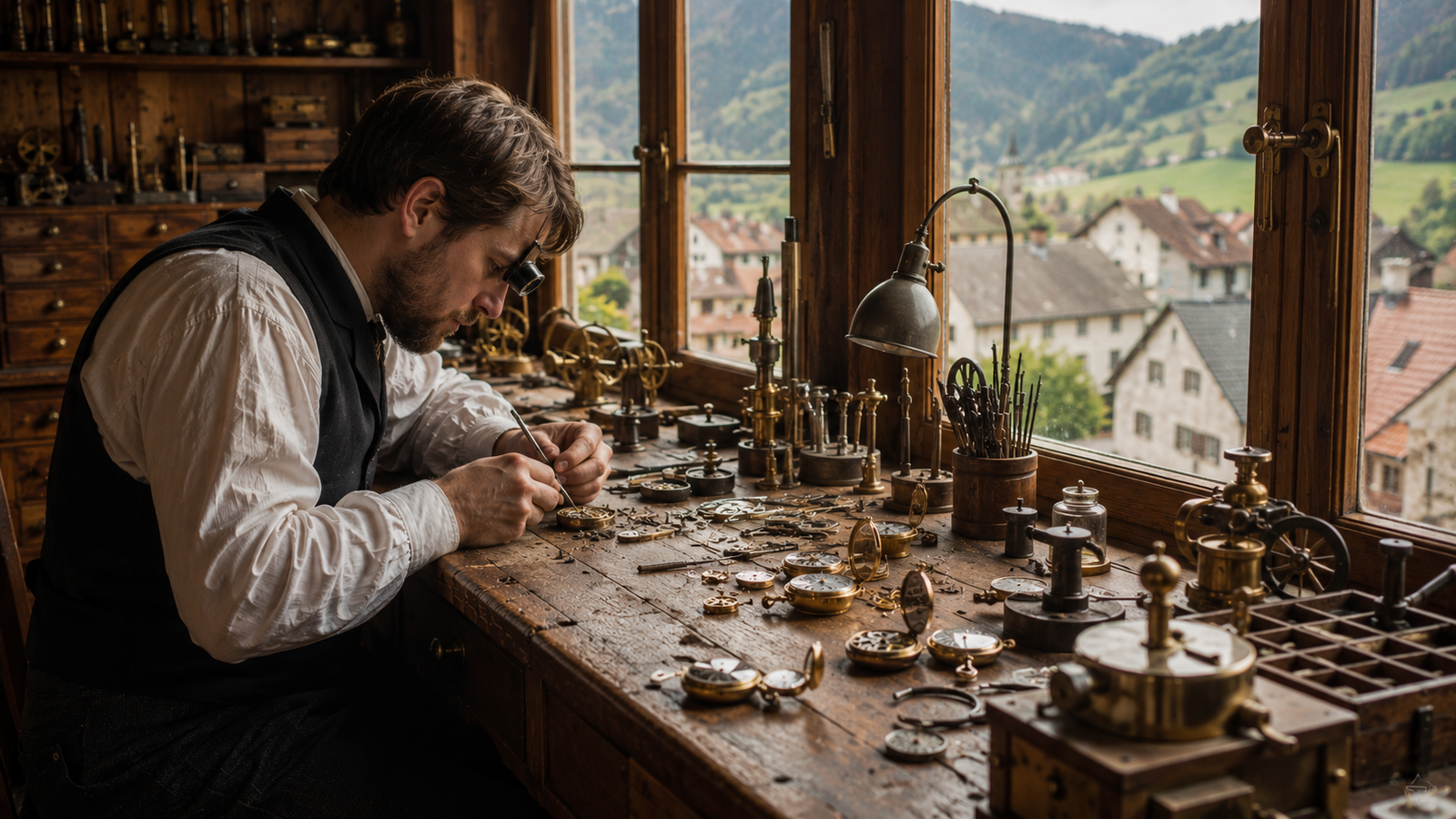
Many families began producing watch components from their homes. Tiny gears, springs, hands, and cases were manufactured in small workshops scattered throughout mountain villages.
This decentralized system became known as the établissage method.
Rather than producing complete watches in a single factory, specialists created individual parts that were later assembled by master watchmakers.
The approach encouraged extraordinary specialization and helped establish a culture of precision that remains central to Swiss watchmaking today.
Precision Becomes a National Reputation
By the eighteenth century, Swiss watches were gaining recognition throughout Europe.
Merchants exported timepieces to royal courts, wealthy merchants, and growing international markets. Swiss watchmakers continuously refined their techniques, focusing on accuracy, reliability, and craftsmanship.
Unlike mass-produced goods, many watches were assembled by hand and reflected the skill of individual artisans.
The industry became particularly strong in towns such as La Chaux-de-Fonds and Le Locle.
These communities grew around watch production and eventually became some of the most important horological centers in the world.
Their influence was so significant that urban planning linked to watchmaking development later earned recognition from UNESCO.
The Age of Innovation
The nineteenth century brought dramatic changes.
Industrialization transformed manufacturing across Europe, and Swiss watchmakers adapted quickly. New machinery improved production efficiency while still preserving many traditional skills.
Competition intensified as American manufacturers introduced factory-based production methods capable of producing watches in large quantities.
Swiss companies responded by embracing innovation rather than resisting it.
Engineers developed increasingly sophisticated movements, improved accuracy, and introduced technical advances that strengthened Switzerland’s position within the global market.
This period established the foundation for many of the iconic Swiss watch brands known today.
Innovation became just as important as tradition.
Timekeeping for a Changing World
The early twentieth century marked another turning point.
Pocket watches gradually gave way to wristwatches, particularly during and after the First World War. Soldiers found wristwatches more practical than pocket watches in military settings, accelerating their popularity.
Swiss manufacturers quickly adapted.
They produced durable, reliable wristwatches suited to both everyday use and demanding environments. Improvements in waterproofing, shock resistance, and automatic movements expanded the appeal of Swiss timepieces.
The industry became closely connected with aviation, exploration, scientific research, and sports.
Swiss watches were no longer simply accessories; they became essential tools for navigation, performance, and precision timing.
The Crisis That Changed Everything
Despite decades of success, Swiss watchmaking faced one of its greatest challenges during the 1970s.
The emergence of quartz technology transformed the industry.
Quartz watches, powered by batteries rather than traditional mechanical movements, were more affordable and often more accurate than many mechanical alternatives. Japanese manufacturers achieved enormous success with these innovations.
The resulting “Quartz Crisis” devastated parts of the Swiss watch industry.
Numerous companies closed, jobs disappeared, and many observers believed Swiss mechanical watchmaking might never recover.
The crisis forced the industry to rethink its future.
Instead of competing solely on price, Swiss manufacturers increasingly emphasized craftsmanship, heritage, design, and mechanical excellence.
This strategic shift would ultimately reshape the market.
The Return of Mechanical Mastery
By the late twentieth century, Swiss watchmaking experienced a remarkable revival.
Consumers began viewing mechanical watches not merely as instruments but as works of engineering art.
Hand-finished movements, intricate complications, and centuries-old traditions gained renewed appreciation among collectors worldwide.
Luxury Swiss watches became symbols of craftsmanship and prestige.
At the same time, many manufacturers successfully combined traditional techniques with modern technology, creating products that appealed to both enthusiasts and new generations of buyers.
This balance between heritage and innovation remains one of the industry’s defining strengths.
The Places Where Time Still Matters
Visitors interested in the history of Swiss watches can explore numerous destinations connected to the industry.


5
The watchmaking towns of La Chaux-de-Fonds and Le Locle offer museums, historic workshops, and architectural landmarks that reveal how deeply watchmaking shaped local communities.
Visitors can observe the remarkable precision involved in assembling mechanical movements and gain a greater appreciation for the skills behind every finished timepiece.
These destinations provide a unique perspective on Swiss industrial and cultural heritage.
More Than a Luxury Product
The global success of Swiss watches is often measured through prestige and economic impact, but their significance extends further.
Watchmaking helped transform isolated mountain regions into centers of innovation and international trade. It contributed to Switzerland’s reputation for precision engineering and manufacturing excellence.
The industry also influenced education, technology, design, and entrepreneurship throughout the country.
Many values associated with Switzerland today—accuracy, reliability, craftsmanship, and attention to detail—are reflected in the story of its watchmakers.
A Legacy That Continues to Move Forward
The history of Swiss watches is ultimately a story of adaptation.
From Geneva’s sixteenth-century artisans to modern luxury manufacturers, Swiss watchmakers have repeatedly responded to changing technologies, markets, and consumer expectations.
Their success has never depended solely on tradition. It has relied equally on innovation, resilience, and an unwavering commitment to quality.
Today, Swiss watches remain among the most respected products in the world. Whether displayed in museum collections, worn during expeditions, or passed from one generation to the next, they continue to represent centuries of expertise.
Every movement, gear, and finely polished component tells part of a larger story—a story that transformed a small Alpine nation into the global capital of watchmaking.