The Story of Chillon Castle
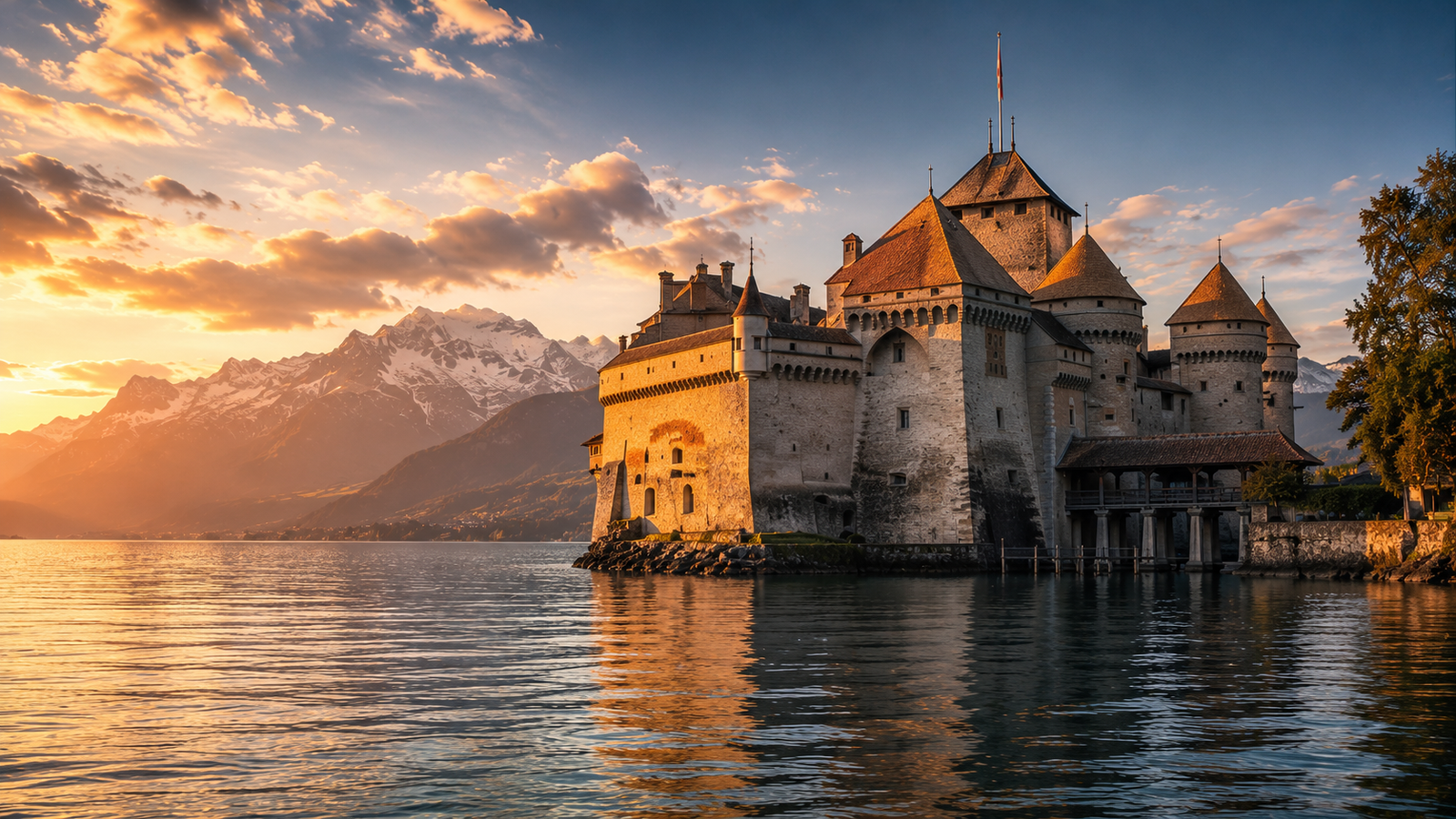
Few places in Switzerland capture the imagination quite like Chillon Castle. Rising from a rocky island along the eastern shores of Lake Geneva, the castle appears almost suspended between water and mountains. Its stone walls reflect in the lake’s shimmering surface while the Alps tower dramatically in the distance.
For centuries, travelers, artists, writers, and rulers have been drawn to this remarkable fortress. Today, Chillon Castle is one of Switzerland’s most visited historic landmarks, welcoming visitors from around the world. Yet its popularity is not merely the result of its stunning location. Behind its picturesque appearance lies a story of political power, medieval life, strategic importance, and cultural influence stretching back nearly a thousand years.
The castle is both a symbol of Swiss heritage and a window into the history of the Lake Geneva region.
A Strategic Position on an Ancient Route
The location of Chillon Castle was never chosen by chance.
Long before modern highways and railways connected Europe, the narrow shoreline between the mountains and Lake Geneva formed one of the most important transportation corridors in the region. Anyone traveling between northern Europe and Italy often passed through this area.
The rocky island on which the castle stands offered a natural defensive position. From here, local rulers could monitor trade routes, collect tolls, and control movement along the lake.
Archaeological evidence suggests that the site may have been occupied long before the medieval castle was constructed. However, the earliest written references to Chillon date to the twelfth century.
Its strategic location quickly transformed it into one of the most valuable strongholds in western Switzerland.
The Rise of the House of Savoy
The castle’s most influential period began under the powerful House of Savoy.
During the thirteenth century, the Counts and later Dukes of Savoy expanded and strengthened the fortress, transforming it into both a military stronghold and a prestigious residence.
Under Savoy rule, Chillon evolved into a complex structure containing dozens of buildings, courtyards, towers, storage areas, chapels, and ceremonial halls. Rather than a single building, it became a small fortified community capable of supporting both soldiers and noble residents.
The rulers of Savoy recognized the importance of controlling this key route along Lake Geneva. The castle allowed them to project authority throughout the region while protecting vital commercial connections through the Alps.
Many of the architectural features visitors see today originated during this era of expansion and prosperity.
Walking Through a Medieval World
One of the most remarkable aspects of Chillon Castle is how much of its medieval character remains intact.
Visitors crossing the wooden bridge enter a world shaped by centuries of history. Massive stone walls enclose a network of halls, chambers, towers, and defensive passages that reveal how medieval castles functioned as both homes and fortresses.
The grand ceremonial rooms demonstrate the wealth and influence of Savoy rulers. Large fireplaces, decorative ceilings, and elegant windows offer glimpses into aristocratic life during the Middle Ages.
Elsewhere, kitchens, storage rooms, guard posts, and workshops reveal the practical realities of daily life inside the fortress.
The castle’s architecture reflects continuous adaptation over hundreds of years, with each generation adding new features to meet changing political and military needs.
Shadows Beneath the Castle
While the upper halls showcase power and prestige, the castle’s underground chambers tell a different story.
The vaulted cellars beneath Chillon are among its most famous spaces. Supported by massive stone columns, these cavernous rooms once served multiple purposes, including storage and imprisonment.
The most well-known prisoner associated with the castle was François Bonivard, a Genevan patriot and religious reform supporter who was imprisoned there during the sixteenth century.
Bonivard’s captivity later inspired one of the most famous literary works connected to Switzerland.
Today, visitors can still see the location traditionally associated with his imprisonment, adding a powerful human dimension to the castle’s history.
The Poet Who Made Chillon Famous
Although Chillon Castle had already stood for centuries, its international fame expanded dramatically during the nineteenth century.
In 1816, British poet Lord Byron visited the castle while traveling through Switzerland.
Inspired by the story of François Bonivard, Byron wrote The Prisoner of Chillon, a poem that introduced the fortress to audiences throughout Europe and beyond.
The work became enormously influential during the Romantic era. Travelers eager to experience the landscapes celebrated by writers and artists began visiting the castle in growing numbers.
Byron even carved his signature into a pillar within the dungeon, where it remains visible today.
His visit transformed Chillon from a regional historical monument into one of Europe’s most celebrated cultural landmarks.
A Treasure Saved for Future Generations
Like many historic structures, Chillon Castle faced periods of decline.
After the Bernese conquest of the region in 1536, the fortress gradually lost much of its military significance. Changing political realities reduced the need for such defensive strongholds.
By the nineteenth century, concerns emerged about preserving the castle’s historical value.
Extensive restoration efforts began to protect and study the structure. Historians, architects, and archaeologists worked to uncover its history and preserve its medieval character.
These preservation projects helped ensure that future generations could experience one of Switzerland’s most important historic sites.
Today, Chillon is widely regarded as one of the best-preserved medieval castles in Europe.
The Beauty of Lake Geneva
Part of Chillon Castle’s enduring appeal lies in its extraordinary setting.


6
The fortress stands directly on the shores of Lake Geneva, one of Europe’s largest and most beautiful lakes. The surrounding scenery combines water, vineyards, mountains, and historic towns into a landscape that has inspired visitors for generations.
Nearby, the town of Montreux offers a vibrant cultural atmosphere, while the terraced vineyards of the Lavaux provide another layer of historical and scenic interest.
The combination of natural beauty and cultural heritage makes the castle one of the highlights of any journey through western Switzerland.
What Visitors Experience Today
Modern visitors can explore dozens of rooms throughout the castle, including noble residences, courtyards, defensive towers, chapels, and underground vaults.
Interactive exhibits and historical displays help bring the medieval world to life, while panoramic views across Lake Geneva provide countless photographic opportunities.
The castle hosts exhibitions, educational programs, and cultural events throughout the year, allowing visitors to engage with Swiss history in a dynamic way.
Each season offers a different perspective. Summer brings vibrant lakeside scenery, while winter often adds a dramatic atmosphere as snow appears on surrounding Alpine peaks.
The castle’s accessibility from Montreux makes it one of the most popular cultural attractions in Switzerland.
A Fortress That Became a National Icon
Chillon Castle has survived wars, political upheavals, changing rulers, and centuries of transformation. Through it all, it has remained a silent witness to the history of the Lake Geneva region.
Today, the fortress represents far more than medieval military architecture. It symbolizes Switzerland’s commitment to preserving its cultural heritage and sharing it with the world.
Visitors arrive to admire the scenery, but many leave with a deeper appreciation for the stories hidden within the castle’s walls. From noble courts and strategic power struggles to imprisoned reformers and Romantic poets, Chillon Castle embodies nearly a thousand years of European history.
Standing above the waters of Lake Geneva, it remains one of Switzerland’s most captivating landmarks—a place where history, architecture, literature, and natural beauty come together in extraordinary fashion.