
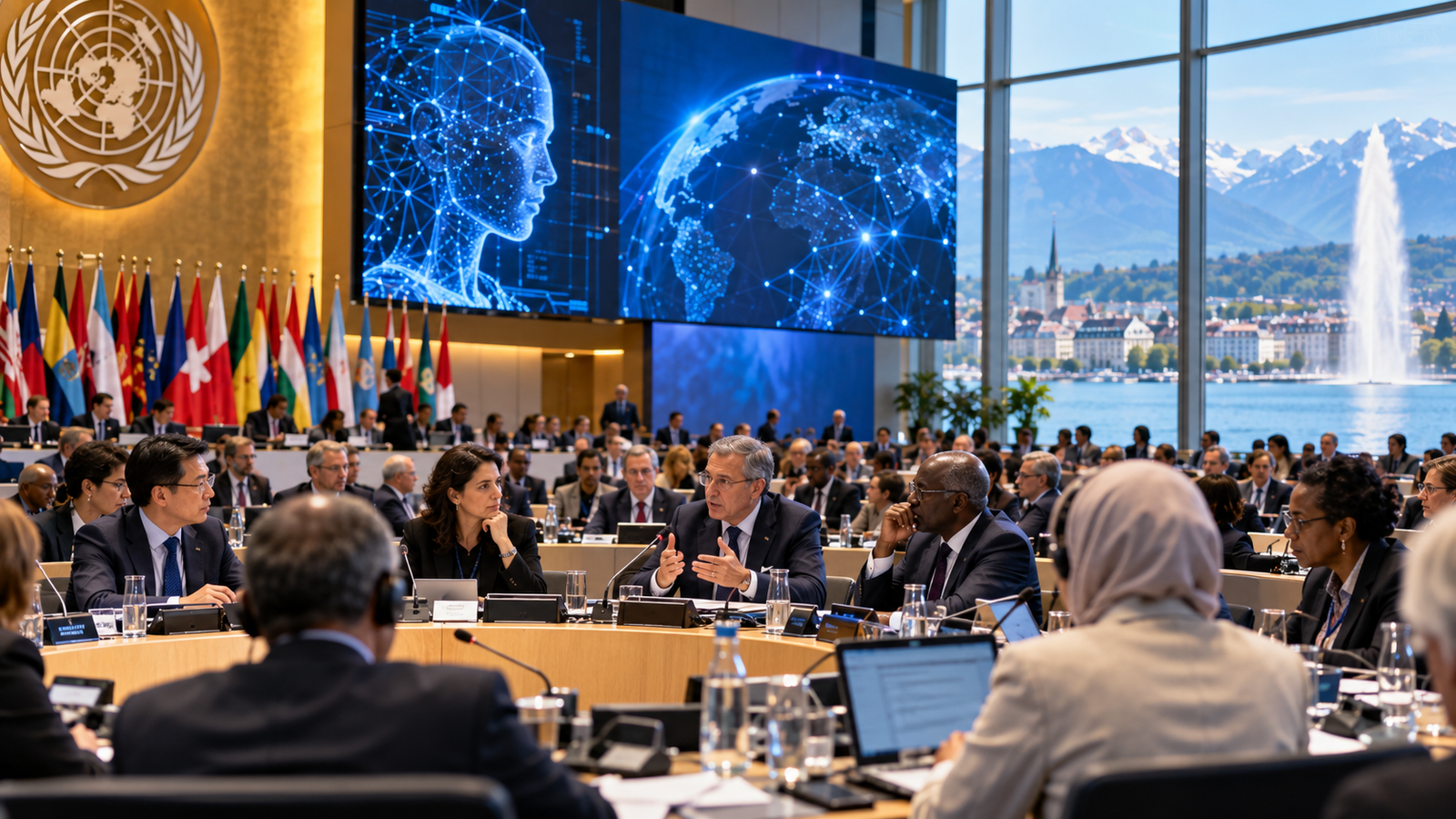
UN Rights Council Pushes for Stronger AI Protections Amid Global Governance Debate
The United Nations Human Rights Council has intensified calls for stronger oversight of artificial intelligence, warning that rapidly advancing technologies must be governed by safeguards that protect fundamental rights while allowing innovation to continue.
Meeting in Geneva, the council adopted a resolution emphasizing the need for governments, businesses, and international organizations to address the growing human-rights implications of AI systems. The move reflects increasing concern among policymakers worldwide that technological development is outpacing the legal and ethical frameworks needed to manage its impact.
The Geneva-based body highlighted a range of issues associated with artificial intelligence, including privacy risks, discrimination, surveillance, misinformation, and the growing use of automated decision-making systems in both public and private sectors. Human-rights experts have repeatedly argued that while AI offers substantial economic and social benefits, its deployment can also amplify existing inequalities if adequate safeguards are not in place.
The latest discussion comes as governments around the world grapple with how best to regulate technologies that are becoming increasingly influential in everyday life. AI tools are now used in fields ranging from healthcare and education to finance, employment screening, law enforcement, and national security. As adoption accelerates, international institutions are facing pressure to establish common principles that can guide responsible development.
The Human Rights Council’s action adds to a broader global debate that has gained momentum over the past two years. International organizations, researchers, and technology leaders have increasingly warned that existing regulations may not be sufficient to address emerging risks associated with advanced AI systems. Recent discussions at the United Nations have focused on the need for transparency, accountability, human oversight, and mechanisms that allow individuals to challenge automated decisions affecting their lives.
Human-rights advocates argue that AI systems can produce harmful outcomes when trained on biased data or deployed without adequate safeguards. Concerns have been raised about facial-recognition technologies, predictive policing systems, automated hiring tools, and algorithmic decision-making processes that may disproportionately affect certain groups. Critics say the absence of transparency often makes it difficult to identify errors or determine accountability when systems produce discriminatory outcomes.
Another major issue is surveillance. Advances in AI have dramatically expanded the ability of governments and organizations to collect, process, and analyze personal data. Privacy advocates warn that powerful monitoring systems could undermine civil liberties if deployed without strict legal protections and independent oversight. These concerns have become increasingly prominent as AI-powered tools become more sophisticated and widely available.
The Geneva discussions also occur against a backdrop of growing international concern about the use of artificial intelligence in military and security applications. Human-rights officials have repeatedly called for meaningful human control over systems capable of making decisions with life-or-death consequences. Recent debates surrounding autonomous weapons and AI-assisted targeting systems have reinforced demands for clear international standards.
Volker Türk, the UN High Commissioner for Human Rights, has been among the most prominent voices calling for stronger safeguards. In recent remarks, he warned that artificial intelligence could pose profound risks if left unchecked and urged governments to establish clear limits and robust accountability measures. He also emphasized the importance of ensuring that AI development remains consistent with international human-rights principles.
At the same time, policymakers face the challenge of balancing regulation with innovation. Businesses and technology developers frequently caution that excessive restrictions could slow research and limit economic opportunities. Many governments are therefore seeking approaches that promote innovation while minimizing risks.
Efforts to create international frameworks are already underway. The Council of Europe’s Framework Convention on Artificial Intelligence and Human Rights, Democracy and the Rule of Law represents one of the most significant attempts to establish common governance principles. The agreement emphasizes transparency, accountability, non-discrimination, and respect for human rights throughout the AI lifecycle. More than 50 countries have endorsed the convention, reflecting growing recognition that AI governance requires international cooperation.
Recent discussions at the United Nations have also revealed increasing support for stronger global coordination. Technology executives, researchers, and government officials have urged countries to cooperate on standards, testing procedures, and risk-management frameworks. Some experts have compared future AI governance structures to international systems used for nuclear safety, aviation oversight, and public-health regulation.
Despite broad agreement that safeguards are necessary, significant differences remain regarding how those safeguards should be implemented. Some countries favor legally binding international rules, while others support voluntary frameworks and industry-led initiatives. These disagreements have complicated efforts to establish a unified global approach.
Nevertheless, momentum for action continues to build. AI systems are becoming more capable, more autonomous, and more deeply integrated into society, increasing the urgency of governance discussions. The Human Rights Council’s latest intervention reflects a growing consensus that protecting human rights must remain a central consideration as artificial intelligence evolves.
For Geneva, long recognized as a hub for diplomacy and international cooperation, the debate reinforces the city’s role as a focal point for discussions about emerging technologies and global governance. As governments, companies, and civil-society groups continue negotiating the future of AI regulation, the challenge will be finding common ground between technological progress and the protection of fundamental rights.
The council’s call for safeguards signals that international institutions are unlikely to remain on the sidelines as AI development accelerates. Instead, policymakers appear increasingly determined to ensure that the technology’s benefits are realized without compromising the rights and freedoms that underpin democratic societies.