
Bern Expands Measures as Invasive Tiger Mosquito Continues to Spread
Authorities in the Swiss capital region are intensifying efforts to combat the spread of the Asian tiger mosquito, an invasive species that has established itself in several parts of Switzerland and is increasingly drawing attention from public health and environmental officials.
The City of Bern has announced additional measures aimed at limiting the expansion of the mosquito population after recent detections highlighted the continued presence of the species in the area. The latest actions are part of a broader strategy designed to monitor, contain, and where possible reduce breeding activity before populations become more firmly established.
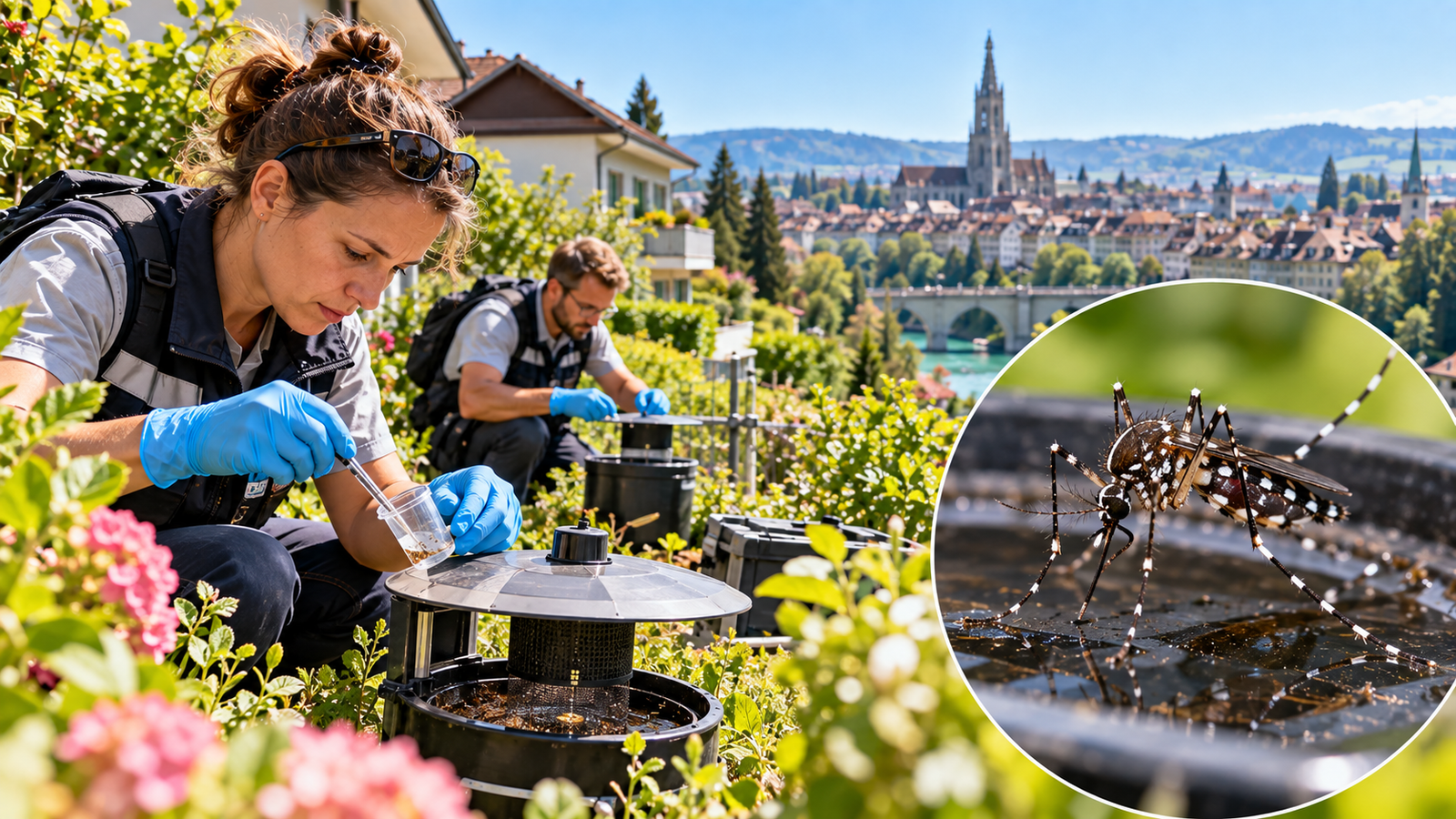
The Asian tiger mosquito (Aedes albopictus) is native to Southeast Asia but has expanded across large parts of Europe over recent decades through international trade and transportation networks. The insect is known for its distinctive black-and-white striped appearance and its ability to adapt to urban environments. It has become one of the world’s most closely monitored invasive mosquito species because it can act as a vector for several viral diseases under suitable conditions.
In Switzerland, the species was first detected in the southern canton of Ticino more than two decades ago. Since then, it has gradually spread northward, with established populations recorded in multiple regions of the country. Bern joined a growing list of Swiss locations where the mosquito has been identified, prompting authorities to expand surveillance and control efforts.
Local officials say preventing the creation of breeding sites remains one of the most effective tools available. Unlike many native mosquito species that rely on larger bodies of water, tiger mosquitoes can reproduce in very small accumulations of standing water. Flowerpots, rain barrels, buckets, drainage containers, and other water-holding objects can provide suitable breeding conditions.
As a result, public awareness forms a central part of Bern’s response. Residents are being encouraged to regularly inspect private properties, empty standing water containers, and eliminate locations where mosquito larvae could develop. Environmental specialists note that community participation is often essential because a significant proportion of breeding sites are found on residential properties rather than public land.
In addition to public outreach, authorities are expanding monitoring activities. Surveillance programs typically involve specialized traps that allow experts to detect eggs, larvae, and adult mosquitoes. These monitoring networks help officials identify emerging populations and evaluate whether control measures are working effectively. The information collected also assists scientists in understanding how rapidly the species is spreading and where intervention efforts should be concentrated.
Mosquito control specialists emphasize that early intervention is critical. Once large populations become established, eradication becomes significantly more difficult and expensive. Consequently, many European cities focus on reducing mosquito numbers before widespread colonization occurs.
The challenge facing Bern reflects a broader trend occurring across Europe. The Asian tiger mosquito has expanded into numerous countries, aided by rising mobility and increasingly favorable environmental conditions. Urban areas are particularly vulnerable because the species thrives in densely populated environments where artificial water containers are common.
Swiss authorities have responded by developing coordinated monitoring and management programs involving local governments, environmental agencies, and public health organizations. National strategies have emphasized surveillance, public information campaigns, and targeted control measures intended to slow expansion and reduce nuisance levels.
Experts caution that the presence of tiger mosquitoes does not automatically translate into disease outbreaks. Switzerland does not currently face the same level of mosquito-borne disease transmission seen in some tropical regions. However, health agencies continue to monitor the species because of its known ability to transmit pathogens such as dengue, chikungunya, and Zika viruses when specific epidemiological conditions are present.
The mosquito’s spread also presents practical challenges for municipalities. Residents often report increased biting activity because tiger mosquitoes are aggressive daytime feeders, unlike many native mosquito species that are most active during evening hours. This characteristic can affect outdoor recreation, public spaces, and quality of life during warmer months.
Climate and environmental factors are playing an increasingly important role in discussions surrounding mosquito management. Researchers across Europe continue studying how changing weather patterns may influence the geographic range of invasive mosquito species. While individual population changes cannot be attributed to any single factor, scientists generally agree that environmental conditions influence where these insects can survive and reproduce successfully.
Bern’s latest actions illustrate how local governments are adapting to emerging environmental and public health challenges that were relatively uncommon in Switzerland only a few decades ago. The focus remains on prevention, monitoring, and community cooperation rather than large-scale eradication campaigns.
Officials believe sustained vigilance will be necessary as the species continues to expand into new areas. Public participation, combined with scientific monitoring and targeted interventions, is expected to remain the cornerstone of mosquito-control efforts in the coming years.
For Bern, the expanded measures represent another step in a long-term effort to limit the impact of an invasive insect that has steadily advanced across Switzerland. While the mosquito’s presence cannot be eliminated overnight, authorities hope that coordinated action can slow its spread and reduce risks for residents throughout the region.