Geneva Residents Gain New Role in Shaping CERN’s Proposed Future Collider Project
CERN is expanding efforts to involve local communities in discussions surrounding its proposed Future Circular Collider (FCC), a project that could reshape the scientific landscape of Europe while significantly affecting communities on both sides of the Swiss-French border.
The initiative comes as the European particle physics organization seeks broader public engagement ahead of key decisions that will determine whether the ambitious research facility moves beyond the feasibility stage. The FCC is envisioned as the successor to the Large Hadron Collider (LHC), the machine that played a central role in the discovery of the Higgs boson in 2012. If ultimately approved, the new collider would become the largest scientific instrument ever built, extending beneath parts of Switzerland and France.
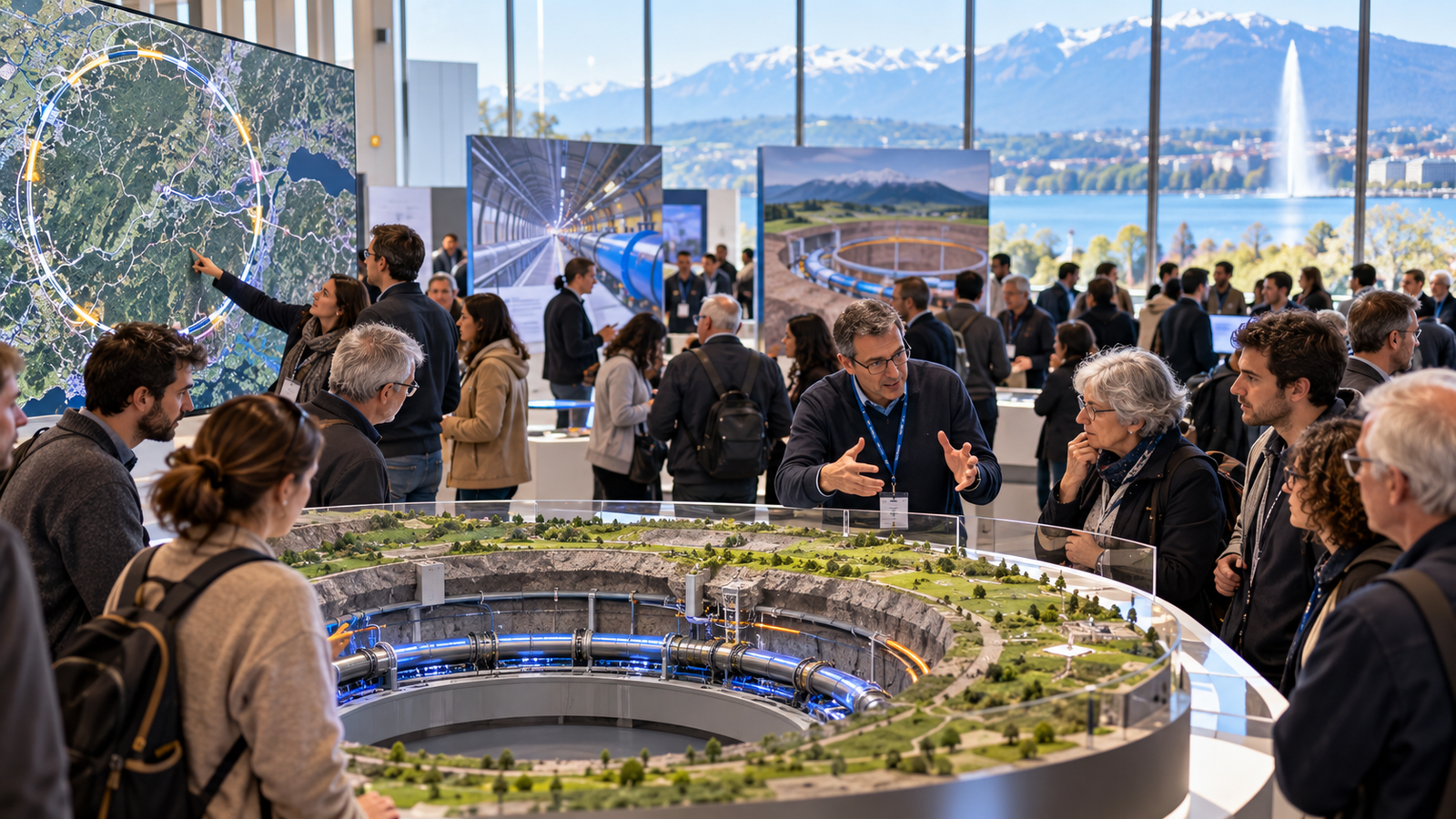
At the center of CERN’s latest outreach effort is a growing recognition that major scientific infrastructure projects increasingly require public participation alongside technical and political evaluation. Residents living in areas potentially affected by future construction, transportation changes, environmental impacts, or land-use considerations are being invited to contribute questions, concerns, and perspectives as discussions continue.
The FCC remains one of the most ambitious projects under consideration in modern science. Current plans envision a circular underground tunnel measuring approximately 91 kilometers in circumference, significantly larger than the existing 27-kilometer LHC ring. The proposed facility would be built beneath the Geneva region and neighboring French territories, hosting a new generation of particle colliders designed to operate for decades after the High-Luminosity LHC program concludes.
According to CERN’s FCC study, the project is intended to help researchers investigate some of the most fundamental questions in physics. Scientists hope future experiments could provide unprecedented precision in studying particles such as the Higgs boson while also searching for evidence of new physics beyond the current Standard Model. Researchers are particularly interested in unanswered questions involving dark matter, the imbalance between matter and antimatter, and the origins of particle mass.
While the scientific objectives have generated strong support within the research community, the scale of the project has also attracted scrutiny. Environmental organizations, local residents, elected officials, and policy groups have raised questions about energy use, land management, construction impacts, and long-term sustainability. These concerns have become an important part of the public discussion surrounding the project.
To address these issues, CERN and associated project teams have increased communication efforts aimed at local communities. Public information sessions, community discussions, educational materials, and citizen participation programs are being organized to ensure residents can engage directly with project representatives. CERN has stated that dialogue with local populations forms a key part of the feasibility process and that community feedback is being collected alongside technical, environmental, geological, and financial assessments.
The emphasis on public engagement reflects the complexity of the FCC proposal. Unlike previous generations of scientific infrastructure, modern mega-projects often face expectations for greater transparency and community involvement throughout the planning process. Supporters argue that early engagement helps build trust and allows concerns to be addressed before major decisions are finalized. Critics, meanwhile, contend that public consultation must have meaningful influence rather than serving as a procedural requirement.
The FCC feasibility study, which runs through 2027, examines a wide range of issues beyond scientific performance. Researchers and planners are evaluating construction methods, environmental impacts, costs, infrastructure requirements, governance models, and regional development implications. The study also assesses how the proposed collider could integrate with CERN’s existing facilities and international research programs.
CERN officials have repeatedly emphasized that no final approval has yet been granted. Any decision to proceed would require support from CERN’s member states and international partners following completion of the feasibility work and subsequent reviews. Current timelines discussed by CERN suggest that, if approved, construction would begin in the coming decades, with the first phase of operations potentially starting around the mid-2040s.
The project’s supporters argue that large-scale scientific infrastructure has historically produced benefits extending far beyond basic research. CERN’s past innovations have contributed to advances in computing, medical technologies, engineering, and international scientific collaboration. Advocates believe the FCC could generate similar long-term benefits while helping Europe maintain a leading role in particle physics research throughout the 21st century.
Opponents, however, continue to question whether such a large investment is justified at a time when governments face competing priorities related to climate, energy, healthcare, and public services. The debate reflects broader questions about how societies balance investment in fundamental science with other economic and environmental concerns.
For now, CERN’s latest participation initiative represents an effort to ensure that local communities are not merely observers in the conversation. As technical evaluations continue and political decisions draw closer, the voices of residents living above the proposed collider route are likely to play an increasingly visible role in shaping one of the most ambitious scientific projects ever proposed in Europe.